Germany has escaped recession but remains mired in industrial slump, leaving the country acutely vulnerable to China’s intractable woes and any further slowdown in global trade.
While Germany’s manufacturing sector has begun to stabilise after two years of contraction, this may not be enough to stop the gloom spreading to services and consumers over coming months.
The economy eked out 0.1pc growth in the third quarter but this was offset by revisions showing a deeper fall in the preceding quarter. In aggregate the German economy contracted over the six months to September.
Chris Beauchamp from IG said the market is paying more attention to the profit shock from Daimler as a gauge of global economic health in any case.
The blue-chip mother of Mercedes - the symbol of stability and Deutschland Inc - announced a €1.3bn retrenchment and a worldwide cull of 1,100 managers, warning that it will take two years to sort out the transition to electric vehicles and shake off the damage of the diesel scandal.
Daimler’s share price has dropped 40pc since early 2015. In a watershed moment, the company was overtaken this week by Tesla, its upstart US rival. Tesla’s $63bn market cap is now slightly larger.
There are tentative signs of recovery in Germany. The "second derivative” watched closely by traders and hedge funds has turned higher. The German Sentix and ZEW confidence indicators have rebounded. The Ifo Institute sees a “light at the end of the tunnel” for manufacturing.
Yet the slightest upset at this delicate stage would smother the green shoots. Much depends on China and Donald Trump’s trade reflexes. More than any other major country, Germany lives off exports. It is highly geared to the ups and downs of the global trade cycle.
The omens are mixed. The Ifo Institute said its global economic climate index for the fourth quarter is still deteriorating, falling from minus 10.1 to minus 18.8 points. The overnight news from China was unrelentingly weak.
Ting Lu from Nomura said retail sales, fixed asset investment, export value, and land sales all deteriorated in October. Growth of industrial output fell to 4.7pc, while production of steel and cement contracted.
He said this will force the People’s Bank to inject liquidity through its lending facility and cut borrowing costs, although incipient inflation makes monetary stimulus more treacherous. Stagflation is creeping in.
The Sino-US trade conflict has compounded the damage from China’s internal woes as it grapples with debt saturation and swathes of excess capacity. This cycle is different from past episodes, mild downturns followed by quick V-shaped rebounds. It has the hallmarks of post-bubble "Japanisation’"
Liu Aihua from China’s statistics bureau issued a candid warning that the country is not yet out of the woods. “Downward pressure on the economy has increased continuously. The risks and challenges we are facing cannot be underestimated,” she said.
China’s troubles pose a structural threat to the German economic model. The German Council of Economic Experts says a permanent 10pc decline in exports to China cuts German GDP by 4.8pc within a four-year period. This level of dependency is staggering.
China is shifting to a strategy of import substitution and partial autarky for reasons of strategic security. It is no longer an insatiable market for German capital goods. It is a rival. The council said China has moved up the technology ladder and is now competing toe-to-toe in the same niches.
Andrew Kenningham from Capital Economics said it is too early to conclude that Germany is back on track after just a flicker of growth. “We think the economy will probably contract slightly next year – so a recession may have been postponed rather than avoided altogether,” he said.
If nothing else, carry with you into the exam the "three Ds" - at the end of the article; a great way to analyse global economics:
A global slump is coming and we don't know why.
Ed Conway The Times 19.10.19
I remember precisely where I was when it dawned on me that the 2008 financial crisis was the big one. It was a wood-panelled room in the British embassy in Washington, 11 years ago almost to the day. A senior official took a few financial journalists aside and told us that the global financial system was on the brink of collapse.
Now in hindsight, a phrase like that might sound rather appropriate but remember this was before RBS or Lloyds had been nationalised and the consensus was still that the global economy would shrug it all off pretty quickly. The International Monetary Fund, whose annual meetings we were attending, was forecasting global growth of 3 per cent — weak by its standards but nowhere near the0.1 per cent contraction that eventually transpired. Don’t panic, they said in public. In private, that was precisely what they were doing.
Today the IMF is once again meeting in Washington and everyone is nervous about comparisons with 2008. They point out that banks have more capital to support their balance sheets and that the financial system is more resilient. Yet the noises emerging from the global engine room are rather worrying. This week the fund slashed its world economic growth forecasts for the fifth successive time. It calls this a “synchronised slowdown” rather than a recession but the global growth forecast for this year is, guess what, 3 per cent — identical to that in 2008.
Some, the IMF included, would like to blame the downgrade on “policy uncertainty”, which is one of those economics euphemisms better translated as “we don’t really know”. They namecheck Donald Trump’s trade wars with China, changing regulatory standards for carmakers and Brexit as the factors holding back growth. Yet none of these explains the scale and breadth of the slowdown.
Indeed, rather than “policy uncertainty” it might be more appropriate to talk about “policy failure”. For not only are policymakers flummoxed about what’s going wrong; even if they did know it is not clear they could actually do anything about it. Central bankers have pumped trillions of dollars into the global financial system yet inflation remains below target in most of the developed world. The rules and models that economists have relied on for decades seem to be failing. With interest rates still stuck near zero we no longer have the ammunition we once did to confront any recession. To top it all off, China and the rest of the emerging and developing world are slowing even more markedly than the West.
The engines that powered the world for the past decade are faltering. The odd thing is that this has garnered so little publicity, though given that there is so much else going on to distract us perhaps that’s no surprise. When the IMF published its forecasts this week one popular interpretation in the British press was that it was a fillip for the UK, which will grow faster this year and next than France or Germany. But only someone utterly obsessed with Brexit could interpret this as good news. It is not. Everyone is slowing but some more than others.
These days I spend much of my time travelling the country talking to businesses about Brexit. Make no mistake, some of them are perturbed by all the risks you’re perfectly familiar with. But in recent months the main thing worrying importers and shipping merchants is not Brexit but the fact that their warehouses are no longer filling up with goods from overseas. The ships coming into port are not so heavily laden, air cargo holds are increasingly empty. Global trade is grinding to a halt.
Again, the conventional wisdom is that this is down to the US-China trade war, but while that has affected the nature of some trade routes, forcing China to start importing its soybean from elsewhere, it does not explain why trade is falling globally.
So what is going on? Well, one possibility is that China’s almighty debt bubble is finally deflating, or even imploding, but don’t expect Beijing to let on about it for some time. Another is that the dollar’s strength in recent years has strangled many of the traders who rely on dollar-based finance to support the movement of goods along their supply chains, as a fascinating working paper from the Bank for International Settlements suggested this week.
The scariest explanation is that in trying to solve the last financial crisis we fuelled a deeper malaise in global economics. Our central banks printed money and governments cut taxes but rather than using this money to invest, households and businesses frittered it away on consumption and share buyback schemes respectively. These days debt levels are so high and interest rates so low that any attempt to stimulate activity is simply pushing on a string.
Jan Vlieghe, one of the Bank of England’s most intelligent policymakers, has a thesis: if you want to get your head round the oddness of the economic world you need to contemplate the three Ds: high debt levels, which make everyone especially sensitive to higher interest rates; the demographics of an ageing population with people saving more and working less; and distribution, in short the fact that much income and wealth goes to the richest, who tend on average to spend less. Put these together and you have a world where interest rates may have to stay low not just temporarily but for the foreseeable future.
The good news is that none of this amounts to a new financial crisis of the kind we saw in 2008. The bad news is that economics as we knew it seems to be broken. There’s no guessing how or when we can put it back together again.
The law of unintended consequences could lead us into a global recession
Actions have consequences, wanted or not. If there has been one lesson to take from the International Monetary Fund’s annual meetings in Washington this week, that has been it. A line can be traced from Donald Trump’s trade war with China to the collapse of Neil Woodford’s investment trusts. Another from Beijing’s decade of intellectual property theft to the $19 trillion timebomb of sub-prime corporate debt ticking away under the global economy. Everything is connected. It simply needs the lines of consequence to be drawn. Let’s start at the end. If the IMF is right, another financial crisis is closer than we think. All it takes is a further escalation in the US-China trade war and a couple of rounds of American tariffs on Europeangoods. The first of those was imposed yesterday on $7.5 billion of EU imports, from aircraft to Scotch whisky, in retaliation for Airbus subsidies. Round two would be an assault on the German car industry, which would tip the country into recession. Berlin has countermeasures prepared and we know what happens after that. The United States began with tariffs on $10.3 billion of Chinese goods in 2017. They now cover $550 billion and Chinese duty on $185 billion of US goods geos the other way. Between them the US and China have knocked 0.8 per cent off global GDP. That’s $650 billion. The world economy is now in a “synchronised slowdown”, Kristalina Georgieva, the IMF managing director, said. Growth is weaker than it has been since the 2009 crisis. A recession in Europe’s largest economy combined with a sharper contraction in global trade would drag everywhere down with it. At that point, much of the corporate debt in advanced economies becomes unserviceable: $19 trillion in all, the IMF reckons. Unregulated shadow banks — insurers, pension funds and hedge funds — own more of it than they should. As borrowers default, the shadow banks would be forced into fire sales, causing a market seizure not unlike that of a decade ago. Should the worst happen, “an internationally co-ordinated fiscal response may be required”, Gita Gopinath, the IMF’s chief economist, warned. The last co-ordinated response was in 2009, when Gordon Brown “saved the world”, as he put it. We find ourselves here, teetering on the brink, because of President Trump, because of his trade wars. Three years ago growth was picking up and for once the IMF was upbeat. “Spring is in the air and spring is in the economy,” Christine Lagarde, its managing director, said in April 2017. With a tailwind of stronger growth, central banks had an opportunity to raise rates, unwind quantitative easing and end more than half a decade of market distortions to bring the world back to normality. It all started so well. By the end of 2018 the US Federal Reserve had raised rates nine times and was expected to increase them a further three times this year. Instead, it has cut them twice and, having unwound some QE, is poised to buy US government debt again to fend off a slowdown. Talk in Washington this week was that the cycle had peaked, that the economy was on a terminally downward slope and that the chance to normalise rates had slipped away. Both the eurozone and China have eased monetary policy this year, as has the US. Markets reckon that eurozone interest rates, at -0.5 per cent, will be negative until at least 2023. A record $15 trillion stock of negative-yielding corporate and government debt guarantees investors’ losses. We are back in “lower for longer” territory, where investors have to hunt for yield in dangerous waters: be it in frontier markets such as Mozambique; splicing and dicing structured debt, like the bankers who gave us the financial crisis; or doing a Woodford by buying riskier private equity and venture capital assets that pay a better rate but cannot be liquidated. The conditions are perfect for another sub-prime bubble. Can all this be laid at Mr Trump’s door? Not if you trace the line still further back, to Beijing’s abuse of the global trading rules with subsidies, dumping and technology theft. When China joined the World Trade Organisation in 2001, it was a $1 trillion upstart economy. It is now a $13.5 trillion superpower to rival the US and no one outside Beijing believes that it should be allowed to game the system any longer. Mr Trump has been abrasive to China, but we should not fool ourselves into thinking that a Democrat president would roll back the tariffs and restore economic relations. Even within the G20, of which China is a member, Beijing’s trade practices and cybersurveillance have left it isolated. “If Trump had used the G20 instead of tariffs to take on China, it would have been nineteen-to-one against Beijing,” one official said this week. So this is where we are, eighteen years on from China’s accession to the WTO and one financial crisis later, amid the biggest monetary policy experiment ever undertaken, with investors being robbed blind by assets that pay them a worthless income, a power struggle masquerading as trade wars, a global system that is falling apart and growth stalling. The lines of consequence have converged. China’s ascendance, which led us inexorably to the tariffs that are warping global supply chains and sapping global growth, was distinct from the financial crisis, which gave us zero interest rates and populist politics. But they are intertwining, with dangerous results. Because growth is weak, central banks cannot raise rates. Low rates and QE will drive up asset prices. Bubbles are inflating in financial markets and one day they will burst. Policymakers can see it happening and know they will never be forgiven if another crisis strikes on their watch. This time they want to get ahead to turn what would otherwise be a clean-up operation into inoculation. To do so, the IMF says, they will need to intervene with more regulations, such as higher capital charges on corporate debt and new shadow banking controls. Rather than pull their tentacles out of the system by raising rates and letting markets function freely, the authorities will have to probe deeper and as they do they will create new distortions. Who knows what the consequences might be then.
Ambrose Evans Pritchard in the Daily Telegraph every Wednesday - a great read for big picture analysis.
The global manufacturing downturn is spreading to the once-resilient service sector in a string of countries, threatening to tip the world economy into a broad recession unless there is a swift response from the authorities.
IHS Markit said the US service industry saw the sharpest drop in headcount since late 2009 last month as firms battened down the hatches and cut excess capacity. Companies are being forced to lower prices to hold onto market share.
“The US slowdown signals are multiplying,” said James Knightley from ING. “We were well aware of the problems in manufacturing given the trade war, but it is clear that there are problems brewing in other sectors. The latest developments will keep the pressure on the Federal Reserve to ease monetary policy further.”
The ISM non-manufacturing index told the same story, dropping to a three-year low with new orders suffering the most damage. Capital Economics said that the combined service and manufacturing indexes in the US are now at levels “consistent with a recession” in the past.
Germany’s service sector finally buckled as well in September after seeming to shrug off the manufacturing slump and the crisis in the car industry for most of this year. The inflows of new work are falling in absolute terms. "The slowdown was even worse than first feared. A technical recession now looks to be all but confirmed,” said IHS Markit.
While the eurozone as a whole is still above water, service growth is barely enough to offset the industrial contraction. The currency bloc is now perched on the boom-bust line and vulnerable to the slightest economic shock. “There’s little doubt that winter has arrived for Europe, but the big question now is whether it is mild or harsh,” said Nomura.
The chart has 1 X axis displaying Time. Range: 2016-10-20 08:38:24 to 2019-10-10 15:21:36.
The chart has 1 Y axis displaying Values. Range: 50 to 62.5.
The Federal Reserve still has room to cut interest rates and relaunch quantitative easing but it may have waited too long to preempt metastasis as the economic cycle sputters out, given the long lags before monetary stimulus filters through. The Powell Fed has come under heavy criticism for claiming that the US economy faces no more than a ‘mid-cycle’ slowdown and requires no more than precautionary rate cuts. The deeply-inverted yield curve in the bond markets suggests that the underlying threat is more serious. Recessions begin on average nine months after the curve inverts. This episode started in May. The Fed continued to sell bonds and shrink its balance sheet (QT) long after stresses began to emerge in the funding markets, and especially in the $2.2 trillion ‘repo’ segment that plays such a vital role in lubricating finance. This has led to a global dollar shortage and transmitted a shock through the offshore funding markets. It has tightened conditions in Europe and Asia, and compounded the global damage from the US-China trade war. The New York Fed is now injecting liquidity but the level of excess reserves in the banking system is still too low. The European Central Bank is close to exhaustion under current policies and legal limits. A study by Bank of America warned that the spectre of “quantitative failure” now looms over global markets as negative rates and ever more convoluted forms of monetary stimulus start to do more harm than good.
Barnaby Martin, the bank’s credit strategist, said the ECB’s actions are becoming counter-productive. “Households and corporates are saving more not less, debt is being repaid not utilised, and banks are tightening rather than easing lending standards,” he said. Household saving rates in the eurozone have been rising since late 2017 as people put aside more money to make up for lost interest. They have risen 1.1 percentage points in Germany to 11pc. Companies have also been saving more, paying down debt and hoarding cash as a safety buffer. This may now be distorting eurozone money signals. Shweta Singh from TS Lombard said the seemingly robust growth of the M1 money supply - 8.4pc year-on-year - is not as healthy as it looks. “Firms are not raising their cash holdings in anticipation of a ramp-up in capex. Instead, they are turning increasingly cautious about access to credit. The ECB’s bank lending survey shows a tightening in loan standards for the first time since 2014,” she said.
Fiscal policy will have to take much of the strain from now on but there are barriers on both sides of the Atlantic. The US fiscal stimulus is fading and will turn to net contraction of 0.5pc of GDP (annualised) this quarter. The Democrats in Congress are in no mood to extend President Donald Trump a lifeline by agreeing to fresh round of budget largesse - except on their own political terms. Europe has ample scope to boost spending but is hamstrung by the Stability Pact and Fiscal Compact. Any stimulus is likely to be piecemeal and too late to head off a deepening downturn. Giovanni Zanni from Natwest Markets forecasts net fiscal expansion for eurozone as a whole of 0.4pc in 2020, led by the Netherlands (0.8pc), Germany (0.4pc), Italy (0.3pc) and France (0.1pc). Other forms of ‘quasi-fiscal’ support will ultimately kick in from green funds. It helps but it is not enough to counter the sledge-hammer blow of a full global downturn, should that occur. Much therefore depends on Donald Trump’s state of mind as the impeachment noose tightens. If he opts for a quick trade deal with China and dials down his threats against Europe the relief may be enough to unleash a wave of pent-up spending by companies and to restore animal spirits worldwide. If not, the mounting contagion from manufacturing to services may prove unstoppable.
This is chock-full of relevant arguments, in an easily-digestible package. I'm definitely going to read the book. You can extract at least four or five key things to carry into the exam, whether it be immigration or trade surpluses. Read and connect:
The real threat to our global economic and political order
Everything seemed so simple after the Berlin wall fell
Economics and history didn’t end with the fall of communism after all. TS Lombard’s Charles Dumas tells Merryn Somerset Webb where they’re going next.
Twenty five years ago, it was perfectly standard to think that the multi-millennium struggle to work out how best to run society had come to an end – witness The End of History by Francis Fukuyama, published in 1992 . The collapse of communism left the US as the world’s sole super power and, as Charles Dumas says in his book Populism and Economics, appeared to make it clear that “a blend of capitalism and democracy” was the ideal political and social system. Globalisation – a fast rise in the free flow of goods, capital and people around the world – followed, as did a stunning hi-tech revolution, and for a time all seemed well.
Then it suddenly went less well. Only a few decades later came the worst financial and economic crisis since the 1930s. Today it is perfectly clear that the struggle is no more over than it was in 1989. So what went wrong? And what next? Dumas’s answer is worth listening to. It comes down, he says, to a mix of four key elements: globalisation, technology, demography and financial imbalances, with the latter being the key to understanding the crisis itself.
The burgeoning global labour market
The better understood part of the story starts in the early 1990s as communism fell and China turned back to the world after the trauma of Tiananmen Square. This effectively “tripled or quadrupled” the global work force as three billion extra people entered the global economy, but they were almost all “prepared to work for wages far below the norm for western companies.” That in turn gave us lower overall wages, a much lower level of capital assets per worker, and a fast rise in profits as labour costs slid.
In a totally free global economy this would all have worked itself out reasonably quickly. But we don’t have a totally free global economy, particularly when it comes to labour. In the 1990s workers couldn’t simply move anywhere in the world to bump up their income and the UK, Ireland and Sweden aside, even the EU has only really had free movement of labour since 2011.
The result then was not a shift in workers to high-wage economies but a shift in “amoral and culturally neutral” capital to low-wage economies in order for a rising proportion of global production to be done – cheaply – by the new entrants to the global economy. This round of globalisation has manifested itself mostly in a huge rise in export growth from developing economies – “most spectacularly China” – and a corresponding fall in wage growth in developed economies (one of the main drivers of what we now call populism).
Emerging markets have exported a lot more than they have imported and the rest of us, apart from aggressively mercantilist Germany and Japan, have done the opposite. This dynamic has in turn given us what Ben Bernanke identified back in 2004 as the “savings glut.” Money has piled up in these exporting economies, leading to an excess of savings over investment, something that causes nasty imbalances in the global economy (those excess savings often end up invested in US Treasuries for example, something that pushes yields down and asset prices up).
The consequences of all this are complicated to unravel and not entirely uncontroversial. But one of the key points for now is that for every surplus there is a deficit and, with President Donald Trump having noticed where they come from – the US trade deficit hit all time highs with China and the EU over the summer. His reaction to those deficits is beginning to threaten the world of free trade we have all become used to. Trump does not like America’s trade deficit. China he says, is “robbing us blind..and stealing our jobs.”
From China to Europe
So what’s to be done? One interesting point here, says Dumas, is that the over the last few years the “Chinese surplus has almost disappeared.” If you are looking for the savings glut “it is no longer in China”. Instead it is almost all in Germany or “German-centred Europe”, in which Dumas includes Scandinavia, Benelux, Switzerland and Austria. Add them all up and they have a surplus of not far short of $700 bn. That’s huge: “more than 8% of GDP in Germany itself.”
Why does that matter? Because the result is massive capital inflows into the debtor countries such as the UK, something that has driven up our currency and made us even less competitive, says Dumas. It’s all “very nice for London and not so nice for the industrial zones of the north, the midlands and Wales”, as might have been reflected in the Brexit vote.
So the fall in the pound since our Brexit vote should be seen as good news? It was at least the point at which “quite a lot of people said, oh, wait a second, I’m not putting that money (into the UK) anymore” and the one at which our current account deficit started to fall. The OECD, an association of developed countries, expects it to be 3% of GDP this year against 6% two years ago.
So hooray for Brexit then? Dumas is a tad more cautious than that: “I think it has produced to some degree, coincidentally, a needed rebalancing…Remainers may think that those who voted for Brexit are shooting themselves in the foot. But the reality of the matter is that jobs will tend to shift towards industrial zones, which means that those people will actually not do worse. And in addition, if there is eventually – certainly there’s no sign of it – some restriction on immigration, that presumably takes away some of the downward pressure on wages at the low end of the scale.”
That’s an unconventional opinion, albeit one I share. The UK has seen two huge waves of immigration from eastern Europe – firstly when we opened our borders to all newcomers to the EU in 2004 (few other EU countries did this) and secondly in the wake of the European financial crisis when we became the employer of the last resort for the Mediterranean countries. Common sense might tell you that an influx of low-skilled labour on this scale would hold wages down. But the establishment has nonetheless continued to insist that it has not.
The immigration debate
That, says Dumas, is because they rely on a Bank of England study on the matter by Steve Nickell and Jumana Saleheen. Their work found evidence of only a very small impact on wages – and really only on already low wages. But the problem here says Dumas, is that the study does not allow for the lack of investment that a ready supply of cheap labour encourages. We haven’t trained nurses for example. We have imported them.
And we haven’t invested in robotics in the same say other economies have (if we had we wouldn’t be worrying so much about who will pick the fruit post Brexit – “there are perfectly good robots that can pick fruit”). Instead of investing in capital of any kind (human or not) we have just thrown more cheap labour at any problem – something actively encouraged by our tax credit system (which tops up low wages with cash welfare payments). The upshot is that productivity and wages stay low.
Leave out this rather vital part of the equation and any study is “inherently incapable of capturing a long-run tendency to depress wages at the lower end.” England is now more densely populated than the Netherlands, says Dumas. If low-wage immigration doesn’t help the economy “how much more do we really want?” None of this is to say that there aren’t perfectly good arguments for Remain as well as Leave, says Dumas (he outlines these in the book). But overall it does seem that “the consequences of Brexit are largely misunderstood and, you know, that it may well be that in [the] short term, there’s not very much effect at all” on growth.
Solving the savings glut
We go back to the savings glut. If China is no longer the real problem but Germany is, what needs to happen? There are two possible solutions, says Dumas. Italy, which hasn’t the devaluation options open to the UK, could leave the eurozone. It insists that it won’t and the French wouldn’t be very keen on the move because “the pressure would then move on to France”.
This would clearly push the euro up and hence German competitiveness down. However, this isn’t likely “in the near term.” The other solution is that the “Germans step up to the plate and say, yes, well, we’ve had all this catalyst benefit from the euro and we’re going to pay for it now” – think fiscal union. There is very little appetite for this either (particularly in Germany).
No solution then? None, says Dumas. Or at least none until Trump gets it, swings his big guns around to Germany and says “we’re going to penalise you guys until you do something about it”. One way or another the euro is going “way higher”. A region that is in “perfectly healthy condition” has no need to have negative real interest rates and shouldn’t have them. All these cans have been kicked down the road for years. But the interesting thing about Trump is that “he isn’t very tolerant of this kind of thing”.
He’s a “genuine maverick character”. He could be the catalyst for real change by forcing it. So could Italy, by recognising the disaster the euro has been for them and leaving, and so could Germany (by paying up). But, concludes Dumas in his book, as long as Europe works to preserve the status quo rather than to propose useful change, the “sad consequence” could be that the current promising world advance could well be cut off by a breakdown in globalisation.
Who is Charles Dumas?
Charles Dumas is chief economist at TS Lombard, which provides asset managers, banks and companies with macroeconomic, political and policy analysis. Dumas’s previous books are The Bill from the China Shop (2006), which anticipated the financial crisis, Globalisation Fractures (2010) and The American Phoenix (2011).
I have barely scratched the surface of his thoughts in this piece and strongly recommend reading his most recent book Populism and Economics to get a real sense of why today’s imbalances threaten our political and economic order.
From a 2014 blog, but the highlighted bit on the UK economy (and the bits about other big economies) could fit straight into an essay on "Assess the impact of...." covering trade, slowdowns etc. This is important because the monetary tightening that the US Fed is leading is already producing negative impacts elsewhere, particularly in emerging markets (and South Africa is still struggling, as a student pointed out):
Which major economy has performed the worst since 2007?
Who gets the prize? It’s Italy, the ninth largest economy in the world. Italy’s real GDP in Q3 2013 was some 9% below where it was at the end of 2007. And the next worst is the UK, now 1.3% down (Q4 2013). But which country’s workers have suffered the most in lost incomes and jobs since 2007? The prize goes to the UK, the 6th largest, with a combined loss of over 7%.
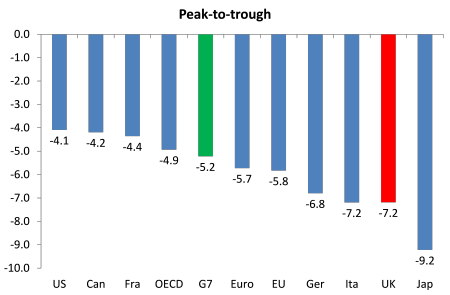
What the comparative data show is that real GDP in the UK underwent the joint-second largest contraction of the G7 economies during the 2008-09 economic downturn. Following the global financial shock, GDP in the UK fell by 7.2% between Q1 2008 and Q2 2009; this was the joint-second largest peak-to-trough fall among G7 economies. This is bigger than the fall in GDP in the G7 economies on average and bigger than in the European Union.
I think this confirms my forecast back in 2005 that if world capitalism went into a slump that the UK would suffer more than most because it was, more than any other, a rentier economy, i.e. its prosperity depended on its importance as a global financial centre where it could extract rent, interest and dividends out of the surplus value created by other economies. In the global financial crash, such economies were likely to take a bigger hit that those with a more productive base.
The drop in real GDP was even greater in Japan, which is not a rentier economy like the UK. But this was because Japan, of all the G7 top capitalist economies, is dependent on world trade, which took an almighty plunge in 2009. That other major trading economy, Germany, also dropped sharply, but by not as much as the UK. And the US, with a relatively small trade component in its GDP and not quite so dependent on its financial services sector, fell less, even though the world financial crash began there.
In the recovery period, the UK’s growth in the period following the recession has been slower than in other major economies. Average growth in the UK has also been slightly lower than that of the OECD total. Only Italy has been worse. Indeed, Italy has just stagnated at the level it reached in the trough of the GR. It is clearly the weakest of the top ten capitalist economies in the world.
Ambrose Evans Pritchard in the Telegraph gives a quick run through of important data, and the potential risks facing the global economy. Plenty of take-away in here - data, current conditions, forward-looking indicators, comparisons etc.
The whole world is slowing and Europe is just as vulnerable as Britain
World trade contracted in February as China cooled. It may be an early warning sign that monetary tightening by central banks is starting to bite CREDIT: AP
The world economy has suddenly slowed. This was foretold months in advance by the sharpest deterioration in the global money supply since the onset of the Great Recession.
Global conditions are a big part of why the open British economy shuddered to a near halt in the first quarter. The Beast from the Eastaccounts for much of the rest.
The crash in growth to 0.1pc was certainly awful but it tells us little about the specific impact of Brexit, and even less about the underlying pathologies of the British economy.
The eurozone is also in some trouble. Industrial output has contracted for three months in a row. Citigroup’s economic surprise index for the region has plummeted from peak euphoria in December to levels last seen at the depths of the EMU banking crisis in 2011.
Monetarists say Europe is feeling the delayed effects of central bank tightening. The flow of fresh stimulus from quantitative easing is tapering away. The pace of bond purchases has dropped from €80bn to €30bn (£70bn to £26bn) a month, andis expected to stop altogether by the end of the year.
This has reduced the growth rate of the eurozone’s broad M3 money supply to 2pc (three-month annualised). It is close to stall speed. Tim Congdon from the Institute of International Monetary Research says Europe faces a “monetary cliff” when QE ends. It risks sliding back into the quagmire of 2011-2014.
Aparallel saga is underway in the US where "quantitative tightening" is underway and theFederal Reserve is draining dollar liquidityat an accelerating rate. By the September the Fed will be shrinking its balance sheet by $50bn (£36bn) a month. It is also raising rates at a brisk pace, lifting the worldwide cost of corporate capital.
Three-month Libor – used to price $9 trillion of US and global contracts – has risen by 60 basis points since early February to a nine-year high of 2.36pc. This is causing international tremors. Hong Kong has had to intervene at five times in the exchange markets and is squeezing its leveraged financial system. Local Hibor rates are soaring. This will soon show who has been swimming naked in the frothy waters of the Pacific Rim.
In China, proxy indicators suggest that the true rate of economic growth dropped to 4.5pc at the start of the year as pollution controls combined with the delayed effects of tighter credit. It is why the People’s Bank (PBOC) cut the reserve requirement ratio for lenders by 100 basis points two weeks ago and signaled more to come.
The Dutch CPB index of world trade contracted by 0.4pc in February, the most recent month available. Data on US road freight volume is more recent and it is hardly glorious. The American Trucking Association says itsgauge of tonnagefell 0.8pc in February and a further 1.1pc in March.
Contrary to general belief, commodity prices have been falling this year. The broad IHS index of raw materials – including items such as rubber or fibres that are free from the distorting effects of financial speculation – peaked in early January and has been sliding fitfully ever since.
Oil is rising but not because of any acceleration in world demand. Brent crude prices havespiked to a three-year highnear $75 a barrel because production cuts by Opec and Russia have at last cleared the glut. This leaves the global economy more vulnerable to supply shocks, and there are plenty of geostrategic storms coming into view.
The implosion of the Maduro regime in Venezuela is causing a collapse in oil output. If Donald Trump re-imposes sanctions on Iran in May – now highly likely – it might reduce global supply by 700,000 barrels a day within a year.
The effect of rising energy costs on a slowing global economy is toxic. Consumers in the US, Europe, China, and India enjoyed a $1.6 trillion annual windfall when prices slumped in 2015 and 2016. This year they have been hit with an $800bn headwind.
Should we worry about a possible British recession? Yes, we should. The growth rate of real M1 money (three-month) has collapsed. The Bank of England’s Governor, Mark Carney, is right to back away from a rate rise in May.
We do not yet have the full first quarter readings from the eurozone. French GDP growth slid from 0.7pc to 0.3pc. The Bundesbank says only that the German economy has slowed “noticeably”. The Macroeconomic Policy Institute (IMK) in Düsseldorf says its recession risk indicator has jumped to 32.4pc, higher than in March 2008.
My guess is that Europe will muddle through the next few months in better shape than Britain, winning the immediate beauty contest. Those who want to turn this into a larger indictment of Brexit will have a field day. But note a caveat: the UK is still imposing austerity. Europe is adding fiscal stimulus.
The IMF estimates that Britain is tightening budget policy this year by 0.3pc of GDP, based on the "cyclically adjusted primary balance". The eurozone is loosening by 0.3pc. “It could go some way to explain the UK/euro area growth differences,” said David Owen from Jefferies.
Such subtleties will be lost in the political shouting match over Brexit, just as they were last year when the eurozone’s growth rate was flattered by the closure of its post-depression "output gap".
This year may be treacherous. “It has been an extremely long cycle and everybody is asking when the next crisis is coming,” said Garth Williams, head of credit conditions for Standard & Poor’s.
“We are at an extremely difficult stage in the transition. Central banks have been absorbing a lot of debt supply and nobody knows what will happen when they are not there anymore,” he said.
If not, Britain will start to face its Brexit ordeal in earnest. And Europe will start to pay the existential price of its own great failure: neglecting to fortify monetary union with the fiscal machinery needed to survive the next downturn. Pick your drama.


The whole world is slowing and Europe is just as vulnerable as Britain