Quote of the day

“I find economics increasingly satisfactory, and I think I am rather good at it.”– John Maynard Keynes
Showing posts with label oil price. Show all posts

Saturday, 7 June 2025

A look at Saudi Arabia as it tries to shift from oil to a diversified economy


Crown prince Mohammed bin Salman has opened up the kingdom

The new face of Saudi Arabia

Under the youthful crown prince known as MBS, the country’s de facto ruler, the kingdom has pursued ambitious reforms to transform itself into a thriving 21st-century economy. Simon Wilson reports

Has the country really changed?

Yes, in important ways Saudi Arabia has changed radically in the ten years since King Salman ascended the throne aged 79, and his son Mohammed bin Salman (MBS) became the country’s de facto ruler (as crown prince from 2017 onwards). Ten years ago, women were still shut out of the labour market and public life, prohibited from driving or even leaving the house without a male guardian. Today, they are free to work and travel where they like. Many have ditched the burqa for a simple headscarf. The religious police and “vice squad”, once a ubiquitous presence, have disappeared. Schools have slashed the amount of time devoted to religious instruction. What was once a closed and repressive society has opened up in myriad ways, and become far more akin to other Gulf and Middle Eastern states.

So it’s become a democracy?

Hardly. Saudi Arabia remains an autocracy, where a super-privileged elite hold power and the crown prince does not brook dissent. But the country no longer sponsors and exports jihadist terrorism and is a “force for order” and a “stabilising influence in the Middle East”, says The Economist. It counsels restraint on the conflict in Yemen. It is open to better relations with both Iran and Israel, and has helped Syria’s new government by paying some of its debts. If not exactly an enlightened despot, MBS – still aged just 39, and poised to become king for decades – is at least a sane and increasingly pragmatic one. 

What about the economy?

MBS’s stated mission, under his Vision 2030 rubric, is to transform Saudi Arabia from a petro-state into a diversified 21st-century economy with a flourishing private sector – readying it for the day when the oil runs dry. The hard truth is that while a start has been made, there is much left to do. Oil’s share of the economy remains high, too, although it has fallen from 36% of GDP in 2016 to 26% last year, according to official figures. However, other estimates put the share rather higher than this. And once all economic activity related to oil and gas extraction is factored in, almost half the Saudi economy (48%) is hydrocarbon-dependent, according to the World Economic Forum (WEF). And oil still accounts for between 60% and 75% of government revenues, meaning the House of Saud’s fragile social contract is still underwritten by the nation’s oilfields.

So the oil price is a worry?

According to projections by the International Monetary Fund, Saudi Arabia needs the global oil price to be more than $90 a barrel in order to balance its budget. Prices are currently a little above $60, and are not expected to rise much this year. Goldman Sachs has lowered its year-end 2025 oil price forecast to $60 a barrel for Brent crude, and $56 next year. If prices were to stay around $62 this year, Saudi Arabia’s 2024 budget deficit of $30.8bn would more than double to around $70bn-$75bn, according to the bank’s Middle East economist Farouk Soussa. “That means more borrowing, probably means more cutbacks on expenditure, it probably means more selling of assets, or all of the above, and this is going to have an impact both on domestic financial conditions and potentially even international ones.”

What about debt?

The lower oil price is a worry, but it’s not about to precipitate a debt crisis. At the end of last year, Saudi’s debt-to-GDP ratio was just under 30% – modest compared with the likes of the US (124%) or France (111%). Riyadh still has significant headroom for borrowing. Yet $75bn in debt issuance would be hard for the market to absorb, and the Saudis will need to look at other solutions. In terms of cutting expenditure, many regional economists believe that some of the flashier projects, such as the vast, futuristic “linear city” Neom, will be further scaled back. Other such projects, estimated to cost nearly $900bn by 2030, include 50 luxury hotels strung along the Red Sea, a ski resort in the desert, and the world’s biggest building in Riyadh. There’s also the possibility of selling more domestic assets, including stakes in the state-owned companies Saudi Aramco and Sabic.

What sectors are thriving?

Perhaps more important than such projects are the “government’s efforts to foster new industries, from tourism to carmaking”, says The Economist. Meanwhile, civil servants are rewriting rules on everything from divorce to foreign investment, with more than 600 packages of reforms in the works. A liberalisation of mortgage lending means that construction is booming. Retail and hospitality are growing fast, as is tourism, which has jumped from around 60 million overnight stays in 2016 to more than 100 million in 2023 (the bulk of this being domestic tourism). Yet the Saudi economy remains a textbook case of “crowding out”, where the state’s dominance of key sectors has stifled private investment and enterprise. About half the male labour force work as civil servants and political connections remain vital to doing business.

What does the future hold?

One ambition is to establish strength in artificial intelligence (AI) and data centres. Saudi’s new state-owned AI company Humain has signed deals worth $23bn with US tech groups including Nvidia, AMD, Amazon Web Services and Qualcomm, according to its chief executive. And it has launched a $10bn venture-capital fund as it leads the kingdom’s effort to become a global AI hub. It’s currently in talks with US groups including OpenAI, Elon Musk’s xAI and Andreessen Horowitz about its plans. But allied to these lofty ambitions are more prosaic goals – improving the country’s education system; attracting the expertise needed to boost emerging sectors, including carmaking, semiconductors and renewable energy. Social liberalisation may have bought the regime some time in terms of pushing through economic reforms. But those reforms are just getting started.

Wednesday, 14 November 2018

Big movements in the oil market

This blogger covers a lot of important issues relating to the UK economy, and bearing in mind the importance of oil (and related markets) this is quite timely; the blog can be found here - https://notayesmanseconomics.wordpress.com/:

The fall in the price of crude oil is a welcome development for UK inflation

One of the problems of official statistics is that we have to wait to get them. Of course numbers have to be collected, collated and checked and in the case of inflation data it does not take that long. After all we receive October’s data today. But yesterday saw some ch-ch-changes which will impact heavily on future producer price trends as you can see below.
Oil traders’ worries over record supplies arriving in Asia just as the outlook for its key growth economies weakens have pulled down global crude benchmarks by a quarter since early October. Ship-tracking data shows a record of more than 22 million barrels per day (bpd) of crude oil hitting Asia’s main markets in November, up around 15 percent since January 2017, and an increase of nearly 5 percent since the start of this year.
Not only is supply higher but there are issues over likely demand.
China, Asia’s biggest economy, may see its first fall in car sales on record in 2018 as consumption is stifled amid a trade war between Washington and Beijing.
In Japan, the economy contracted in the third quarter, hit by natural disasters but also by a decline in exports amid the rising protectionism that is starting to take its toll on global trade.
And in India, a plunging rupee has resulted in surging import costs, including for oil, stifling purchases in one of Asia’s biggest emerging markets. India’s car sales are also set to register a fall this year.
You may note along the way that this is a bad year for the car industry as we add India to the list of countries with lower demand. But as we now look forwards supply seems to be higher partly because the restrictions on Iran are nor as severe as expected and demand lower. Does that add up to the around 7% fall in crude oil benchmarks yesterday? Well it does if we allow for the fact that it seems the market has been manipulated again.
Hedge funds and other speculative money have swiftly changed from the long to the short side.
When the bank trading desks mostly withdrew from punting this market it would seem all they did was replace others. Of course OPEC is the official rigger of this market but its effort last weekend did not cut any mustard. So we advance with Brent Crude Oil around US $66 per barrel and before we move on let us take a moment for some humour.
As recently as September and October, leading oil traders and analysts were forecasting oil prices of $90 or even $100 a barrel by year-end.
Leading or lagging?
The UK Pound £
This can be and indeed often is a powerful influence except right now as the film Snatch put it, “All bets are off!” This is because it will be bounced around in the short-term ( and who knows about the long-term) by what we might call Brexit Bingo Bongo. Personally I think the deal was done weeks and maybe months ago and that in Yes Prime Minister style the Armistice celebrations gave a perfect opportunity to settle how it would be presented to us plebs. For those who have not seen Yes Prime Minister its point was such meetings are perfect because everybody thinks you are doing something else. The issue was whether it could be got through Parliament which for now is unknown hence the likely volatility.
Producer Prices
These are the official guide to what is coming down the inflation pipeline.
The headline rate of output inflation for goods leaving the factory gate was 3.3% on the year to October 2018, up from 3.1% in September 2018. The growth rate of prices for materials and fuels used in the manufacturing process slowed to 10.0% on the year to October 2018, from 10.5% in September 2018.
Except if we now bring in what we discussed above you can see the issue at play.
Petroleum and crude oil provided the largest contribution to both the annual and monthly rates of inflation for output and input inflation respectively.
They bounce the input number around and also impact on the output series.
The monthly rate of output inflation was 0.3%, with the largest upward contribution from petroleum products (0.14 percentage points). The monthly growth for petroleum products rose by 0.5 percentage points to 2.0% in October 2018.
Actually the impact is higher than that because if we look at another influence which is chemical and pharmaceutical products they too are influenced by energy costs and the price of oil. So next month will see quite a swing the other way if oil price remain where they are. We have had a 2018 where oil prices have been well above their 2017 equivalent whereas now they are not far from level ( ~3% higher).
Inflation now
We saw a series of the same old song.
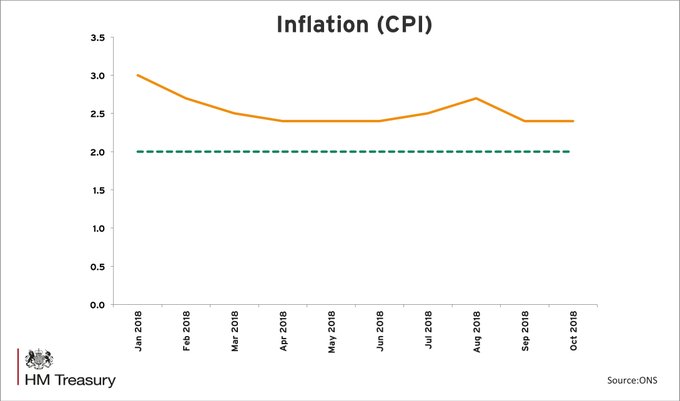
The all items CPI annual rate is 2.4%, unchanged from last month……..The all items RPI annual rate is 3.3%, unchanged from last month.
This was helped by something especially welcome to all but central bankers who of course do not partake in any non-core activities.
Food prices remain little changed since the start of 2018 and fell by 0.1% between September and October 2018 compared with a rise of 0.5% between the same
two months a year ago.
Happy days in particular if you are a fan of yoghurt and cheese. The other factor was something which an inflation geek like me will be zeroing in on.
Clothing and footwear, where prices fell between September and October 2018 but rose between
the same two months a year ago.
There is an issue of timing as we are in the Taylor Swift zone of “trouble,trouble,trouble” on that front but this area is a big issue in the inflation measurement debate. Let me look at this from a new perspective presented by Sarah O’Connor of the FT.
Online fast-fashion brands have enjoyed success catering to what Boohoo calls the “aspirational thrift” of young millennials. They sell clothes that are often made close to home so that they can be produced more quickly in response to customer trends. “Our recent evidence hearing raised alarm bells about the fast-growing online-only retail sector,” said Mary Creagh, the committee’s chair. “Low-quality £5 dresses aimed at young people are said to be made by workers on illegally low wages and are discarded almost instantly, causing mountains of non-recycled waste to pile up.”
This is a direct view on the area of fast and often disposable fashion which is one of the problem areas of UK inflation measurement. There are issues here of poverty wages and recycling. But the inability of our official statisticians to keep up with this area is a large component of the gap between CPI and RPI, otherwise known as the “formula effect”.
Comment
The fall in the price of crude oil is a very welcome development for the trajectory of UK inflation. Should it be sustained then we may yet see UK inflation fall back to its target of 2% per annum. For example the price of fuel at the pump is some 10 pence per litre higher than a year ago for petrol and 14 pence per litre higher than a year ago for diesel, so the drop is not in the price yet. That may rule out an influence for November’s figures but we could see an impact in December. Other prices will be influenced too although probably not domestic energy costs which for other reasons only seem to go up. But as we looked at yesterday the development would be good for real wages where we scrabble for every decimal point.
Meanwhile I have left the “most comprehensive” measure of inflation to last which is what it deserves. This is because the CPIH measure ignores a well understood and real price – what you pay for a house – which is rising at an annual rate of 3.5% and replaces it with Imputed Rents which are never paid to get this.
The OOH component annual rate is 1.1%, up from 1.0% last month.
But I do not need to go on because the body that has pushed for this which is Her Majesty’s Treasury which plans to save a fortune by using it may be having second thoughts if it’s media output is any guide.

Sunday, 9 October 2016

New technology, innovation and energy resources

Well, application of an old technology in a new way - always a good way to achieve productivity gains:

Move over fracking, there's a new technology in town.


What do Hot Pockets and oil shale have in common? As it turns out, more than you might imagine. True, you can’t bake oil shale the way you can Hot Pockets. And you can’t steam Hot Pockets (unless you like ’em soggy) the way you can oil shale when you want to siphon off its black gold. But there is one preparation method that works for both these two improbable sources of abundant energy, and it’s probably in your kitchen at this very moment: microwaves.

As strange as it sounds, producers are experimenting with ways to zap previously unextractable oil resources with microwaves, which has the potential to kick-start an even bigger energy revolution than fracking — and appease environmentalists while they’re at it. This is potentially “a whole shift in the paradigm,” says Peter Kearl, co-founder and CTO of Qmast, a Colorado-based company pioneering the use of the microwave tech. Some marquee names are betting on the play: Oil giants BP and ConocoPhillips are pouring resources into developing similar extraction techniques, which can be far less water- and energy-intensive than fracking.

If producers can find a way to microwave oil shales in the Green River Formation, which sprawls across Colorado, Utah and Wyoming, the nation’s recoverable reserves could soar and energy independence could become more than an election slogan. Even with existing methods — strip-mining the shale and then cooking it, or injecting steam to cook the rock underground (hydraulic fracturing is useless here) — the formation contains enough oil to last the U.S. 165 years at current rates of consumption. Microwave extraction could goose those numbers even higher. After all, there are more than 4 trillion (with a “t”) barrels of oil in the Green River Formation. And yet this microwave extraction technology comes at a time when the world is awash in oil, and prices are so low that domestic producers are having a hard time pumping at a profit.

We don’t need water for our process, and we don’t have wastewater to dispose of afterward.
PETER KEARL, CO-FOUNDER OF MICROWAVE TECHNOLOGY COMPANY QMAST

Time for a quick geology lesson. Don’t worry, if “painless” and “geology lesson” ever belonged in the same sentence, it’s this one. The most important takeaway: Don’t confuse shale oil with the not-at-all-confusingly-named oil shale. Shale oil is essentially liquid oil locked up in rock that’s found in deep formations and requires hydraulic fracturing, or fracking, for it to flow freely to the wellbore for extraction. Oil shale, on the other hand, isn’t really oil yet. Instead, it is found in more shallow formations that contain solid organic materials called kerogen. “You can get oil out of it,” says Dr. Seth Shonkoff, executive director of the energy science and policy institute PSE Healthy Energy, but it “usually involves subjecting the oil shale to high heat.” High heat from, say, microwaves. OK, class dismissed.

In Kearl’s playbook, you’d leave the kerogen in the ground and bring its oil to the surface. Producers would microwave oil shale formations with a beam as powerful as 500 household microwave ovens, cooking the kerogen and releasing the oil. It also would turn the water found naturally in the deposits to steam, which would help push the oil to the wellbore. “Once you remove the oil and water,” Kearl continues, “the rock basically becomes transparent” to the microwave beam, which can then penetrate outward farther and farther, up to about 80 feet from the wellbore. It doesn’t sound like much, but a single microwave-stimulated well, which would be drilled in formations on average nearly 1,000 feet thick, could pump about 800,000 barrels. Qmast plans to have its first systems deployed in the field in 2017 and start producing by the end of that year.

Potential extraction for three types of U.S. oil reserves (from top to bottom): zapping, tapping and fracking. These figures from the USGS show “technically recoverable” deposits. Scale: 1:4.2 trillion.


Kearl claims there are multiple environmental advantages to this technique. Fracking can slurp up to 10 million gallons of water per operation — not good, especially in the arid West. “We don’t need water for our process,” Kearl says, “and we don’t have wastewater to dispose of afterward.” In fact, microwave extraction might produce water — one barrel of water for every three barrels of oil. In situ recovery using microwaves also avoids the massive environmental impact of mining and then processing the kerogen. What’s more, natural gas that often is flared off in conventional oil-well production could be used to power the generator that creates the microwaves.

Kearl and company may overcome technical challenges and stand ready to bring microwaved wells on line, but there’s nothing they can do about their highest hurdle: the price of oil. Kearl estimates his pumping costs will be about $9 per barrel, which is only about $2 more than conventional wells. However, a recent report claims the price of oil needs to be $65 per barrel in order for new oil-patch investments to break even. The current price is about $47. So, unless the price of oil soars, all that microwavable oil shale may remain untapped.

Strip mining in Canada’s oil sands, an environmentally devastating process, is similar to the practice currently used to exploit oil shales in the Green River Formation.


Waiting for crude to cost a Benjamin a barrel may buy the time some experts think the technology needs to mature. “[It] isn’t there yet,” says James W. Rector, professor of geoengineering at the UC Berkeley Department of Civil and Environmental Engineering. “Maybe in another 15 to 20 years it’ll be there.” He emphasizes that the massive capital expenditures required and the culture of the oil and gas industry translate into a long gestation period for any new technology.


In the meantime, Kearl and others think that the best use of the technique might be to clean conventional oil wells, which can clog with paraffin and other gunk, and to steam-clean fracked formations where water is blocking the flow of oil to the wellbore. “In the end,” says Shonkoff, “these microwave technologies may just enhance the ability of oil operators to squeeze a little bit more oil out of the ground.

SOURCEROBERT INGELHART/GETT