Quote of the day

“I find economics increasingly satisfactory, and I think I am rather good at it.”– John Maynard Keynes
Showing posts with label trade deficit. Show all posts

Wednesday, 26 March 2025

What if the US does weaken the USD?


Will Undermining the Dollar Bring an American Industrial Renaissance?

Reviving manufacturing by beating down the dollar would necessitate a complete reorganization of the US economy .

For decades, America’s manufacturing sector has seemingly eroded, with jobs and production shifting overseas in search of lower costs and fewer regulatory constraints. While many companies have relocated abroad, the reality is more nuanced than it appears. Certain industries have declined, but US manufacturing output has fluctuated rather than collapsed outright. By some measures, total output has remained stable or even grown. For instance, US manufacturing output in 2021 reached $2.5 trillion, an 11.55 percent increase from 2020. A more accurate depiction of manufacturing trends suggests that while employment in the sector has fallen, productivity gains and technological advancements have prevented an absolute decline in output.

Nevertheless, domestic manufacturing has been in relative decline for decades, making it a convenient political talking point. Recently, the concept of a “Mar-a-Lago Accord” has emerged — a theoretical framework aimed at restructuring the international financial system to benefit US interests.

Key proponents, including Treasury Secretary Scott Bessent and economic adviser Stephen Miran, suggest that such an accord could reduce US debt and revitalize domestic manufacturing by weakening the dollar, lowering borrowing costs, and attracting investment — all while maintaining dollar dominance. This plan would involve persuading foreign trade partners to cooperate, swapping US bonds for long-term, non-tradable debt, and potentially using US assets as collateral. However, securing such international cooperation could lead to unintended consequences, including rising domestic borrowing costs and higher consumer prices. But the lynchpin of all of that is purposeful, politically-motivated, dollar depreciation.

The US Dollar Index vs. the Trade-Weighted Dollar

To fully assess the dollar’s strength since the end of the Cold War, the most relevant metric is the trade-weighted US dollar (TWUSD), which considers exchange rates with a broader range of trading partners, including China and Mexico — two of the largest recipients of outsourced American manufacturing. In contrast, the more commonly cited US Dollar Index (DXY) primarily tracks the dollar against a limited basket of six currencies (euro, yen, British pound, Canadian dollar, Swedish krona, and Swiss franc) and fails to capture broader trade dynamics.

Trade-Weighted US Dollar (black) vs. the US Dollar Index (blue), 1990–present
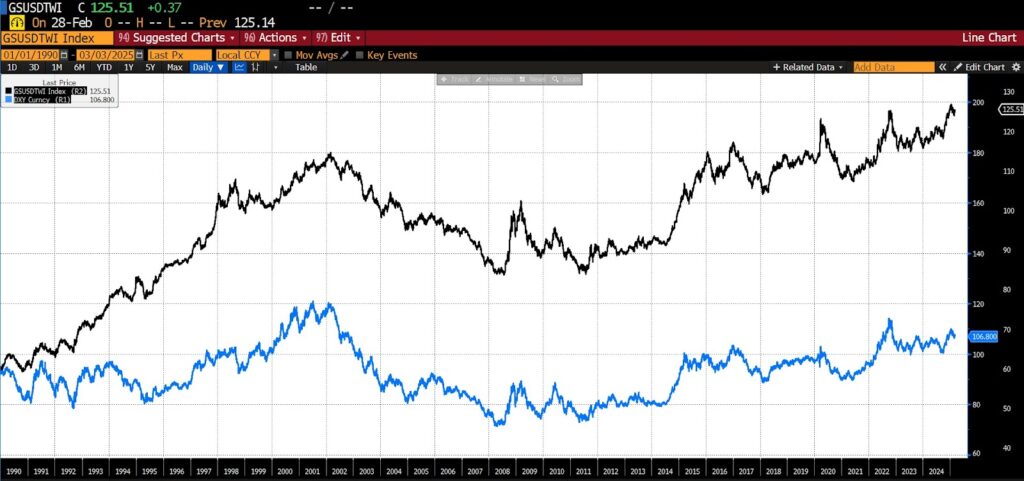
(Source: Bloomberg Finance, LP)

Since the fall of the Soviet Union, the trade-weighted dollar index has risen over 110 percent, making US exports more expensive globally while making imports cheaper. As the financial sector has gained dominance, domestic industries competing with foreign firms have faced increasing pressure.

Proponents of a weaker dollar argue that devaluation would make US exports more attractive while raising import costs, thereby incentivizing domestic production and consumption. However, currency devaluation alone does not enhance the quality or competitiveness of goods; it simply manipulates prices. As a National Bureau of Economic Research study notes, currency undervaluation can influence comparative advantage, but its impact varies widely depending on broader economic conditions.

Devaluing the Dollar: Shortsighted and Ineffectual

Even if America were to beat the dollar down as a first step toward embracing an all-out industrial policy aimed at reviving manufacturing, the transition would take decades  likely generations. And over the course of those years the economic landscape is likely to shift unpredictably multiple times: new technologies, global shifts in shifts, and financial crises, each of which inexorably alters the global landscape. At the same time, the successful accomplishment of the reshoring of manufacturing to the US would require an improbable number of other things – access to cheap and reliable energy and efficient raw mineral sources, for example – to remain the same or improve.

If the US dollar is to be the focus of policy, a more broadly beneficial approach would be to prioritize long-term stability over persistent inflationary pressures, ensuring a sound monetary foundation for both investment and economic growth. The Federal Reserve’s inflationary bias has played a pivotal role in facilitating the shift away from toward financialization. If the Fed were restricted to a single mandate of maintaining a stable dollar with a zero percent inflation/deflation target, it could reduce the outsized emphasis on financial markets. Curbing excessive liquidity-driven asset inflation and making financial markets less dependent on Fed intervention would tacitly encourage capital to flow into productive, long-term investments rather than speculative financial assets.

Politicians should attempt to be honest about the realities of reshoring. As difficult as it may be to accept, Americans may need to adapt to and navigate the realities of today’s economic landscape rather than attempting to recreate the unique, long-gone conditions of the 1960s. While browbeating the dollar might provide a temporary boost to exports, it is no silver bullet. Instead of looking for quick fixes and promising overnight rejuvenation of a bygone era, a more productive focus seeks market-based solutions that enhance innovation, investment, and global trade.

The Structural Challenges of a Weaker Dollar Strategy

For decades, America’s primary exports have been the dollar itself–actual dollars, US Treasury bonds, and dollar-denominated financial assets–rather than physical goods. China, Japan, Germany. Mexico, Canada, and other major trading partners have accepted dollars in exchange for their exports, fueling America’s consumption-driven economy. Those dollars have been invested in US Treasuries, enabling the massive pile of debt that now threatens America’s economic heath and national security. Undoing that long-established arrangement would require much more than just a weak dollar — it would necessitate a complete reorganization of the US economy away from financialization.

Even if the process of shifting resources away from financial products into brick and mortar goes smoothly, industrial power won’t return within one or two presidential terms; certainly not overnight. America has spent decades deindustrializing, and much of the required physical infrastructure, supply chain establishment, and cultivation of a skilled labor force essential for large-scale production will have to start anew. Reviving these components requires far more than currency manipulation.


Friday, 10 May 2024

Industrial strategy - pretty much a ready-made essay:

 And have a look at the Chinese factory at the end (via Twitter/X):


Britain doesn’t make enough. We need to reindustrialise to compete

The doubters will say it’s impossible, but look at the range of industries in other developed countries

A man walks past the Alstom train manufacturing facility and factory

After the turbulence of a global pandemic, war in Europe, trouble in the Middle East – and an aborted experiment in Trussonomics – Rishi Sunak has stabilised the economy. Yet the question of longer-term reform lingers. What must Britain do to increase our productivity, prosperity and security in the decades ahead? 

In A Conservative Economy, our new report endorsed by Michael Gove, Gavin Rice and I set out our answer. As part of our Future of Conservatism project based at the think tank Onward, we propose not only radically different policies, but a radically different way of thinking about economic policy itself. 

Consensus economists and politicians see policy in terms of wafer-thin efficiency. Global supply chains are cheaper, therefore better, than local production. Comparative advantage – the idea each country should do what it is good at, and buy the things other countries are good at – is unquestioned. Even though unfettered capitalism has the tendency and power to destroy the non-capitalist public goods it depends upon, markets are deemed unstoppable, immovable forces that must always come first and will indeed always prevail. 

We disagree. While of course free markets are the most efficient way to allocate capital and generate growth, private investment is almost always more effective than state delivery, and widely shared growth is preferable to redistribution as a means of spreading prosperity, we need to think differently about the purpose of policy. 

The nation state provides the best social forum for the promotion of community, good work, solidarity and altruism. It is not a neutral entity to be bought and sold, or made the object of international rent-seeking. Equally we must challenge the idea of maximal economic efficiency – or at least the kind of short-term efficiency sought by consensus policymaking – at any cost. Instead, the objective of policy must be the flourishing of workers, families and communities. 

On these terms – indeed even on its own – our existing economic model is bust. Like in many other Western countries, our growth is sluggish, and wages stagnant. Our birth rate is declining, and immigration is rocketing. Investment is low and productivity is poor. We have trade and budget deficits and a large stock of debt. Our exposure to the bond markets means there are no easy shortcuts, so tax cuts without big spending cuts, or debt-fuelled spending sprees, are off the table. 

At the heart of our problems is a simple truth. We cannot go on consuming and importing more than we produce and export. As the US economist Tyler Cowen noted this weekend, Britain does not make, do or sell enough of that the world needs, nor even enough of what we consume. 

Consensus policymakers insist that the trade deficit does not matter. They say we can make up for it by attracting inward investment instead, since the flow into Britain of foreign capital creates jobs and sustains the currency. But our desperate need for foreigners to buy assets in sterling leads to all sorts of perverse outcomes. 

The capital we attract is not always productivity-improving investment but extraction and rent-seeking: just look at the treatment of the water companies by their foreign owners. And not only with these most egregious examples, we end up with less control over our economy, and owners who are less interested in taking responsibility for recruiting and training local workers, helping to build up local supply chains, or respecting the environment. 

The trade deficit leads to our budget deficit, because to pay for our consumption – unmatched by what we produce – we import the world’s savings. And as we do that, we compound the problem with our unbalanced regional economy. 

While London is a net exporter, much of the foreign capital we seek to compensate for our overall trade deficit gets sucked into the south-east – increasing regional inequality and overheating asset prices where they are already unaffordable for many families. 

Our solution is the reindustrialisation of Britain. Amid the defeatism and intellectual impoverishment of British politics, it is inevitable that many – not least many of those inside the Treasury and Bank of England – will say it cannot be done. But the argument that high-end services are the limit of our comparative advantage, or that we are in the low-growth late stages of development are clearly absurd. From the United States to Switzerland, many Western countries are richer than us, per capita. Almost all have a more diverse range of industries than Britain. 

Now is as good a time as any to pursue reindustrialisation. Global transport costs are high, geopolitical insecurity is a risk, and new technology means we can move production closer to customers. 

Brexit – maligned by consensus policymakers as economically damaging – is already leading to the reformulation of supply chains. 

But we will need to do far more. As our report makes clear, we need internationally competitive industrial energy costs, which means decarbonisation must come after security and affordability in the so-called energy trilemma. 

We need new planning laws with radical zoning policies in the cities and place-based liberalisation to get new infrastructure built. We need more investment, with the profile of public spending shifted, more private saving, and more of our savings directed towards equities not government debt. 

We need tax and regulatory reform to remove disincentives to invest and build. We need to end the addiction to low-skill, low-paid immigration, returning annual net migration to the tens of thousands. 

We need radical changes to the provision of post-eighteen education and training. 

And we need an industrial strategy that maximises our existing strengths, builds up supply chains, encourages high-growth sectors, protects strategically vital industries like steel, and supports industries of importance to specific regions. 

Of course we need other things besides – not least more support for parents and families, and a demographic correction caused by higher birth rates – but for Tories in pursuit of a big idea and a plan to revive the country, we believe this is it.


https://x.com/LoftusSteve/status/1788689047956635658


Tuesday, 25 January 2022

"So, Mr Greenfield, you think inflation will die?

 Apologies to Ernst Blofeld (look him up), the above twists one of my favourite lines from any James Bond film (look that up too). This is a great opinion piece on where we are right now - a coming together of many very malign factors in a perfect storm, or mere structural obstacles that can easily be overcome? You decide:


A falling pound will be the next inflation shock

The strong pound this winter has kept the worst of post-pandemic inflation at bay

Be grateful for the strong pound. If it were not for the soaring global exchange rate of sterling, the inflation shock this winter would be even more extreme.

The 7.5pc rise in the retail price index is the highest since the peak of the Lawson credit boom over thirty years ago. The difference today is that the UK is not trying to shadow the Deutsche Mark within the pre-euro Exchange Rate Mechanism. 

This country can let the currency rise to help break the back of inflation, and the Bank of England can conduct an autonomous monetary squeeze, assuming it has the nerve to do so. 

Both forms of macro-economic tightening cause serious collateral damage, but we are picking our poison at this belated juncture. The inflation genie is out of the bottle, the direct and predictable consequence of money creation Ã  outrance over the last two years, by which I mean the most steeply-negative real interest rates in British peace-time history and the continuation of emergency quantitative easing after the output gap had closed and the economy was starting to overheat. 

We are now in a surreal situation. Would you have believed it if told after Brexit that sterling would today be higher than it was a decade ago against the Japanese yen, the ultimate safe-haven currency issued by a country in perma-deflation? 

The Bank of England’s trade-weighted index for sterling - the one that matters - has risen 8pc since mid-2020 and is above the level just before the pandemic began. It is roughly where it was all through the post-Lehman and early austerity years.

This currency strength is unsustainable. Sterling is arguably as over-valued today as it was in those halcyon days before the global financial crisis, when homeowners in Croydon and Beckenham were dollar millionaires, and the British middle classes could afford a hotel bill in Switzerland.

The UK has been running persistently higher inflation than its major peers for year after year, and ultimately relative price moves are what set exchange rates in a world of free capital flows. 

UK inflation is rising to worrying levels

Line chart with 2 lines.
The chart has 1 X axis displaying Time. Range: 1988-09-02 18:43:12 to 2022-03-31 05:16:48.
The chart has 1 Y axis displaying % change over 12 months. Range: -5 to 15.
SOURCE: ONS
End of interactive chart.

War drums at Threadneedle Street essentially explain the pound’s latest spike. The Bank of England is the first of the major western central banks to raise interest rates, though the US Federal Reserve may shock us next week and join what is fast becoming a stampede. 

The pavlovian trade for FX speculators and global-macro hedge funds is to pile into the currency of the first central bank to move, surfing the wave until it starts to roll over. At a certain point they switch sides and go in for the kill. It is the fear of this coming dénouement that keeps me awake at night.

“The party’s over. The peak of the cycle has passed as UK growth slows, in both absolute and relative terms,” says Kamal Sharma, Bank of America’s currency strategist. 

Traders have turned net short. Positioning in the currency options market suggests that investors are preparing for a time-honoured sterling treat: after ‘staircase up’ during the boom phase, it is invariably ‘escalator down’ when the music stops.

Paul Meggyesi from JP Morgan said Britain’s stagflation cocktail of rising prices, weaker growth, and a coming fiscal squeeze, is not one that currency traders will tolerate for long.

Bank of America said there was a surge of pent-up inward investment into the UK after the EU-UK trade deal agreed at the end of 2020, inadequate though it was. These inflows led to a balance sheet surplus of 20pc of GDP in the first quarter of last year. 

It turbo-charged sterling and masked the UK’s chronic current account deficit: some 4.2pc of GDP even before the winter gas shock. This is red-warning territory for a country with a low savings rate. 

Foreign money kept propping up the pound through the year but for a different reason: global wealth funds were buying Gilts and British debt, faute de mieux in a low-yield world. 

The UK has been borrowing from fickle global markets to finance what is still one of the highest primary budget deficits in the world, or put crudely to let us live beyond our means. One thing I have learned over the years is that elephantine twin trade and budget deficits usually catch up with a country in the end.

The biggest component of the UK’s stubborn trade gap is now energy. This is why I favour pulling out the stops on every kind of domestic alternative, wherever there is a credible case that it can match or undercut imported gas, oil, and electricity on price. That includes drilling in the North Sea and off Western Scotland, and at this point includes even domestic fracking in the super-rich Bowland Basin, subject to regulation on methane leakage. 

It includes a faster roll-out of cheap offshore wind, buttressed by long-term storage in the form of green hydrogen from electrolysis. Let us revive the 8.6 gigawatt Severn Barrage tidal project, abandoned by George Osborne in 2010 on the grounds that the country was then “on the brink of bankruptcy”, as if we were Greece (a sub-sovereign borrower). His solution to this fictional problem was to slash public investment with a high economic multiplier.

The UK is now entering a period of falling real living standards. All key measures of inflation are running higher than pay growth, which averaged 4.2pc over the last three months. The energy shock will hit with a lag after Easter. 

“Our central assumption is that regulated energy bills will rise by around 40pc in April. But, without some sort of government intervention, it's entirely plausible that bills will rise by 50pc plus,” said Chris Hare from HSBC.

Inflation drivers

Bar chart with 13 bars.
Contributions to annual CPIH % rate, Nov-Dec 2021
The chart has 1 X axis displaying categories.
The chart has 1 Y axis displaying Percentage points change. Range: -0.1 to 0.15.
SOURCE: ONS
End of interactive chart.

The markets are pricing in four rate rises this year. Such tightening would feed through gradually to floating mortgages and small business credit. The accumulated effect would not be trivial in such an over-leveraged economy.  

The optimistic view is that inflation will subside almost as fast as it rose, and therefore that such rapid tightening will not in fact happen. If so, we might somewhat cynically congratulate the Bank of England for wiping out the Treasury debt burden left from the pandemic through a one-off bust of monetisation, expropriating bondholders just as the Bank and Federal Reserve both did via financial repression in the 1940s and early 1950s to pay for the Second World War. 

Peter Warburton, a credit theorist at Economic Perspectives, fears it will not be so simple. He has been warning all through Covid that western central banks have been losing control of inflation - as have monetarists such as Tim Congdon.

Dr Warburton thinks we are in the foothills of a ‘price reset revolution’ that will turn economies upside down, and especially the British economy. “It is becoming increasingly likely that we have embarked on a multi-year reset of the price level, to the tune of 30 to 50 per cent,” he said.

This is the scale of debasement that will be required to inflate away the public debt and the credit-financed promises for pensions, entitlements, and other inert transfers, scattered liberally like confetti. He said our system of private-sector credit allocation has by now been so warped by dirigiste meddling and the mispricing of risk that loans are skewed towards housing inflation (the most socially-destructive kind), and skewed away from productive business. The negative supply-shock has become a structural feature of the credit regime. 

Whichever view you take, the strong pound this winter has kept the worst of post-pandemic inflation at bay. It is sobering to contemplate what will happen once the global currency markets turn on us and the inevitable reversal runs its course. As a precaution, I am parking my cash savings in Japanese.