Quote of the day

“I find economics increasingly satisfactory, and I think I am rather good at it.”– John Maynard Keynes

Wednesday, 6 December 2023

Argentina is a great example of the impacts of inflation - and money supply is at the heart

 Marcelo Capobianco is a butcher in Buenos Aires, where he works in a white-tiled room surrounded by dangling hooks, slabs of beef, and a sign that reads “Long live freedom!”

He livestreams prices on Facebook daily, but like many merchants in Argentina, he uses chalkboards in his store so he can update prices throughout the day as pesos lose their value.

The New York Timeswhich recently interviewed Capobianco, reported on the inflation that “has convulsed Argentina” and led to the rise of Javier Milei, who last week became Argentina’s first libertarian president (and arguably the first libertarian president in the world in modern history).

Prior to Milei’s stunning victory, inflation in Argentina hit 143 percent. Triple-digit inflation has helped push 40 percent of Argentines into poverty and has led to a surge in demand for US dollars. 

An estimated $200 billion in US currency has gravitated toward Argentina’s $487 billion economy, the Times estimates, nearly 10 percent of all US dollars in circulation (more than any other country in the world except for the USA).

The appeal of US dollars in Argentina should come as little surprise. The purchasing power of the peso is depreciating so fast that people continually swap them out for dollars, which are hoarded. 

“You’re constantly gathering up money quickly in order to buy dollars,” a 30-year-old supermarket worker told the newspaper, “because the next day, it’s devalued again.”

To give you an idea of how hard Argentina’s peso has fallen, today a single US dollar purchases 1,000 pesos. In 2019, a dollar bought 48 pesos. In 2011, a dollar could be exchanged for 3.45 pesos.

Ignoring the Elephant

The Times story is solid and worth reading, but its primary focus — beyond the collapse of Argentina’s currency — is the dollarization of Argentina’s economy. 

During his presidential campaign and since his electoral victory, Milei proposed abandoning the peso altogether and embracing the US dollar as Argentina’s official currency. The Times argues this would be difficult and would not immediately solve Argentina’s economic woes.

Both of these claims are true, but scrapping Argentina’s central bank would largely solve one of Argentina’s biggest headaches.

“If you dollarize, you get rid of inflation,” says Daniel Raisbeck, a policy analyst on Latin America at the Cato Institute, “and you get rid of the currency devaluation problem, which is a huge problem in Argentina.”

Killing triple-digit inflation won’t fix all of Argentina’s economic problems, which are decades in the making and stem from its embrace of Peronism (a blend of fascism and national socialism). But it can prevent Argentine politicians from painting over its economic problems by simply printing pesos, which is precisely what Argentina has done for the last 25 years (more on that shortly). 

This brings me to my primary complaint with the New York Times story. 

The reporters do a splendid job showing the serious harm inflation has wrought on Argentina’s 46 million people, but they spend very little time examining how inflation arrived in Argentina. 

The Times asserts that Argentina’s economic woes stem from a variety of factors, ranging from overspending and large deficits to protectionist trade policies and currency controls, before citing an “overreliance on printing more pesos to pay the government’s bills” as a contributing factor. 

Now, dollarization is actually a remedy to many of these problems, because most of them — particularly overspending — are enabled by money printing. But the real problem is that the Times, in a story on inflation, spends ten words explaining its direct cause.

Argentina’s Inflation Explained in One Chart

Though the Times opted to downplay the monetary elephant in the room, it’s a topic worth exploring. Argentina is hardly the only country struggling with inflation, after all, and there’s a great deal of confusion about what inflation is and what causes it.

Both in the United States and Canada, two countries that have struggled with surging consumer prices since 2020, politicians have argued that inflation is the result of greedy corporations who are price-gouging consumers. 

“It’s corporate greed, pure and simple,” Sen. Elizabeth Warren recently said. “I’ve got a plan to tackle their price gouging and break up big monopolies that hit families with higher costs.”

In Canada, lawmakers have gone so far as to threaten grocery chains with new taxes if they don’t reduce food prices, and they have also threatened to drag CEOs before Parliament. 

To the Times‘ credit, the paper doesn’t entertain the fatuous notion that Argentina’s inflation is the result of greedy entrepreneurs. And for good reason. 

Anyone seeking to understand Argentina’s inflation need only look at its money supply in recent decades (see below).
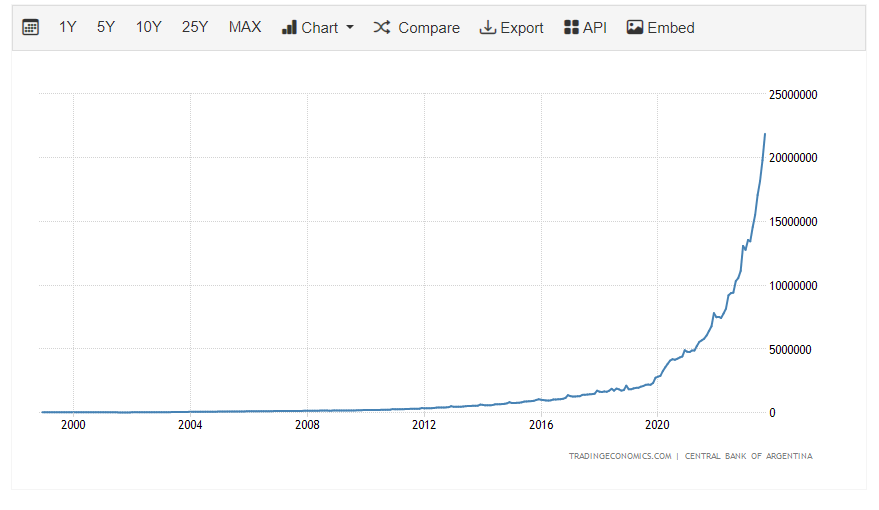
In 1990, Argentina had 711 billion pesos (ISO 4217 code: ARS) in circulation. By 2020, Argentina had roughly 2.5 trillion pesos in circulation. In other words, the Argentine government nearly quadrupled the amount of money in circulation over a 30-year period.

That’s a massive increase in the money supply, even over three decades, which explains why Argentina has battled inflation for years. Yet it’s small potatoes compared to Argentina’s recent money printing.

As of September 2023, Argentina’s total money supply stood at 22 trillion pesos, which means the government expanded the money supply nearly tenfold in less than four years.

Economics 101

This is why the people of Argentina are suffering massive inflation. 

It’s Economics 101. Practically any econ textbook you pick up will tell you that if you expand the money supply faster than an economy can produce goods and services, you will have inflation.

Too many people ignore the reality that inflation is first and foremost a monetary issue. 

The Nobel-Prize-winning economist Milton Friedman famously said that inflation “is always and everywhere a monetary phenomenon,” but it’s not like Friedman is alone. This is a truth widely understood in economic circles.

“I think almost everything other than the Federal Reserve is a sideshow when it comes to the dynamics of inflation,” Jason Furman, one of President Barack Obama’s top economists, responded last year when asked about Warren’s “greedflation” theory. 

This simple explanation for inflation is one many are disinclined to accept, however, and not just political partisans who speak of “greedflation.” We often hear suggested such things as hot labor markets and disrupted supply chains as causes of inflation, or declining gasoline prices as evidence of cooling inflation. 

There’s a simple reason there’s so much confusion on the issue: The definition of inflation has changed over time.

Today many people, including economists, confuse increases in price with inflation. Think about how inflation is reported: The government measures consumer prices, and this tells us how much “inflation” there is in an economy. 

There are several problems with this approach, however, including the fact that prices are constantly changing for reasons that have nothing to do with inflation, including supply and demand. (The price of gas, which are heavily influenced by crude oil supplies, is one of a million good examples.)

Inflation was not originally defined as an increase in consumer prices. For generations across various countries, inflation was defined as an expansion of the supply of money in an economy. 

“Inflation, as this term was always used everywhere and especially in this country, means increasing the quantity of money and bank notes in circulation and the quantity of bank deposits subject to check,” the economist Ludwig von Mises pointed out in Economic Freedom and Interventionism. “But people today use the term ‘inflation’ to refer to the phenomenon that is an inevitable consequence of inflation, that is the tendency of all prices and wage rates to rise.”

Mises saw the devolution of the term as a kind of tragedy, since there was no longer “any word available to signify the phenomenon that has been, up to now, called inflation.”

The Austrian economist was right, but there’s an obvious reason many today prefer the new definition of inflation. 

Under the former definition, it was easy to spot the culprits of rising prices: It was always and only those who expanded the money supply. Whereas under today’s definition, as Senator Warren shows, a general increase in consumer prices can be blamed on just about anyone or anything. 

Americans should not be fooled. Whichever definition one prefers to use — an expansion of the money supply which leads to price increases, or a broad and sustained increase in consumer prices — inflation is caused by the governments and central banks who control the money supply.

Which brings us to the United States. A glimpse at the steady expansion of the US money supply shows why prices in the US are also rising at a historic clip, and why its current fiscal path — which includes adding nearly $20 trillion to the $34 trillion national debt over the next ten years — is a cause for grave concern. 

“If a government resorts to inflation, that is, creates money in order to cover its budget deficits or expands credit in order to stimulate business, then no power on earth, no gimmick, device, trick or even indexation can prevent its economic consequences,” the Austrian economist Hans Sennholz once observed.

This is not to say the fate of the United States must be that of Argentina. But if politicians continue on their current course of money expansion and massive deficits, Americans will likely one day find themselves in a situation much like Marcelo Capobianco — using chalkboards in their stores to update prices throughout the day as they do business.


Tuesday, 5 December 2023

And this from the left-of-centre newspaper, The Guardian:


I’ve got news for those who say Brexit is a disaster: it isn’t. That’s why rejoining is just a pipe dream

Larry Elliott

Many still hanker for how things were: but looking across the Channel, it’s completely illogical to do that

Brexit is a dead issue at Westminster. There are any number of issues where it is hard to separate Labour and the Conservatives, and the reluctance to reopen the 2016 referendum debate is one of them. As with tax and spending, Keir Starmer is broadly offering continuity Rishi Sunak.

That doesn’t mean the debate about leaving is over. Plenty of people still nurture the hope that the decision will be reversed and are working to that end. But any successful campaign would need to do two things: convince voters that the UK economy had become a basket case since the Brexit vote and that life for those still in the club was so much better.

Neither criterion has been met. Britain’s economic performance in the seven years since 2016 has been mediocre but not the full-on horror show that was prophesied by the remain camp during the weeks leading up to the referendum. The doomsday scenario – crashing house prices (falls of up to 18% could result, warned then chancellor George Osborne) and mass unemployment – never happened.

What’s more, after the inevitable disruption caused by leaving, there have been signs of the economy adjusting. Nissan’s decision to invest more than £1bn in its Sunderland plant with the intention of building three new electric car models is an example of that. Microsoft’s £2.5bn investment in the growing UK AI sector is another.

That’s not to say that the process is complete. Brexit provided opportunities to do things differently but those opportunities have so far not been exploited. It is a lot easier for a giant Japanese car company to make the Brexit transition than it is for a small food and drink exporting company faced with loads more red tape. But while it is convenient for those who have never quite got over being on the losing side in the referendum to brand Brexit a disaster, the reality is that it hasn’t been. Covid-19 scarred the economy deeply and the long-term costs of ill health and children missing out on school will grow over time. Even so, Brexit Britain has recovered more strongly than either France or Germany from the pandemic. Relative performance matters. The rejoin camp tends not to focus on what is happening on the other side of the Channel, and it is not hard to see why.

Rishi Sunak and Jeremy Hunt during a visit to the Nissan car plant in Sunderland, which will build three new electric models.
Rishi Sunak and Jeremy Hunt during a visit to the Nissan car plant in Sunderland, which will build three new electric models. Photograph: Ian Forsyth/PA

Back in the 1960s and 1970s, one of the key arguments for joining what was then called the Common Market was that members of the bloc were doing so much better than we were. While Britain was living on past glories, other western European countries powered ahead. The contrast was starkest with Germany, but unflattering comparisons were also made with France, the Netherlands and even Italy. Indisputably, the six countries that formed the original Common Market grew faster and had fewer structural problems.

That argument cannot be made today. Over a prolonged period, not just since the arrival of Covid-19, the EU’s economic performance has been woeful.

Fifteen years ago, the US and EU economies were of a similar size; today America’s is a third bigger. Fluctuations in exchange rates account for some of the difference, but the US is at the cutting edge of the fourth industrial revolution and the EU is not. All seven of the world’s leading tech companies – Apple, Microsoft, Alphabet, Amazon, Nvidia, Meta and Tesla – are American: there is no European tech giant to match the behemoths of Silicon Valley. In 2000, the EU had a 25% share in the semiconductor market: today it is 8%. The US and China are streets ahead of Europe in the development of artificial intelligence.

A number of factors are to blame for the EU’s economic woes. The one-size-fits-all nature of the single currency is one; the lack of a federal budget to match in size that of the US is another; the adherence to neoliberal economic ideas– such as tough controls on the size of budget deficits – a third. The problems go right to the heart of the EU. Its biggest economy – Germany – is expected to contract this year and has been left with a €60bn black hole in the public finances after the country’s constitutional court ruled against the coalition government’s spending plans.

Despite its relative decline, the EU remains prosperous. It is certainly rich enough to act as a magnet for those in poorer parts of the world seeking a better life. So at the same time as its economy has struggled, the number of migrants has increased. One result has been the rise of aggressively rightwing politics. In Germany, Alternative für Deutschland (AfD) is currently second in the opinion polls with voter support running at about 22%. In France, Marine Le Pen could be the next president. Giorgia Meloni leads the most rightwing Italian government since the second world war, while in the Netherlands the anti-immigration Freedom party led by Geert Wilders won the most seats in last month’s election. Something has gone seriously awry when politics in four of the founding members of the European project have turned so ugly.

Nor are the traditionally liberal Scandinavian countries immune to this trend. Denmark – which once had one of the world’s most liberal migration regimes – has shifted from a policy of welcome and integration to one of detention and return. Sweden and Finland have both seen the emergence of ultranationalist rightwing parties.

Britain is one of the relatively few European countries to buck this trend. That’s not because economic performance has been stellar here, because it clearly hasn’t. There has been no meaningful recovery from the global financial crisis of 2008. Living standards have been squeezed hard for the past two years by the cost of living crisis, and have only just started to recover.

Nor is it because the government has been more successful in restricting migration since the referendum. Far from it. Net migration hit a record level in 2022, with a decline in the numbers arriving from the EU comfortably offset by an increase from the rest of the world. Yet, if the polls are correct, the next election will be won by a party of the centre-left rather than a party of the extreme right.

This wasn’t supposed to happen. Perhaps because Brexit provided a safety valve – unavailable elsewhere – for those who felt their concerns were being ignored, the UK has not witnessed the rise of the nasty nationalism seen across the Channel. The worrying state of EU politics explains why rejoiners face a long battle. And why the main parties in the UK are right to let sleeping dogs lie.

  • Larry Elliott is the Guardian’s economics editor

Monday, 4 December 2023

Immigration numbers vs vacancies - job market analysis


author-image
DAVID SMITH | ECONOMIC OUTLOOK

We have record immigration. So why are we so short of workers?

The Sunday Times
Share
Save

Readers may know, if they wake early enough, that the Office for National Statistics (ONS) releases some statistics — on topics such as inflation, wages and the public finances — at 7am. This, I have to say, is not universally popular with those who have to instantly analyse and report them.

For some of the most consequential statistics, however, the ONS still sticks to the more leisurely 9.30am release time. This was true of its bombshell revisions to pandemic gross domestic product (GDP) figures a few weeks ago. It was also true of the latest immigration figures, also quite a bombshell.

These showed, you will remember, that net migration to the UK (immigration minus emigration) in the most recent 12 months for which figures are available — up to the end of June this year — was 672,000. The ONS tried to make the best of the situation by pointing out that this was slightly down on the figure for the whole of last year, which was 745,000.

That, however, merely drew attention to the size of that 2022 figure, easily the biggest on record. I am old enough to remember when a net migration figure of 333,000 — for 2015, released during the EU referendum campaign — helped swing the leave vote. That 2015 figure, by the way, has now been revised down to 303,000.

If you are thinking at this point, “Oh no, not another immigration piece”, my aim today is limited to answering a simple question: how come, when net migration is so high, we still have such a tight labour market and so many job vacancies?

To try to answer it, let me start with some statistics, covering last year’s record net migration of 745,000. It consisted of non-EU net immigration of 873,000, offset by a net outflow of 123,000 EU citizens and a 4,000 net emigration of Britons. If that does not get you to exactly 745,000, any difference is due to rounding.

It has become more difficult to assess what is happening to employment among migrant workers because of problems with the official Labour Force Survey, which everybody hopes will be resolved in the next few months.

A good substitute, for now, however, are the PAYE (pay as you earn) figures from HM Revenue & Customs. These show that there has been a rise in the number of non-EU workers in the UK, partly offset by a fall in EU workers. In 2022, the number of non-EU workers rose by 416,000, outstripping a 273,000 increase in employment among UK nationals as the economy recovered from the pandemic. There was a 13,000 drop in the number of EU workers, continuing a trend seen since December 2019, during which time the number of EU workers has dropped by some 160,000, while non-EU worker numbers have risen by about 630,000.

That 630,000, however, has to be set against non-EU migration over the same period of 1.47 million. It confirms that most non-EU net migration to the UK is not for work purposes. This chimes with the ONS’s own figures, covering the slightly later period to June this year.

Non-EU migrants who come to the UK for work purposes bring with them almost as many dependants — and numbers arriving for work are exceeded by those coming to the UK to study. Students also bring dependants, numbers of whom have been swelled by arrivals from Nigeria and India, the ONS says, though not as many as with workers. International students are the lifeblood of many of our universities, though recent evidence suggests that they are staying for longer, on average, than earlier cohorts.

Non-EU migrants also come to the UK for family reasons, or to seek asylum. Those arriving on British national (overseas) passports from Hong Kong, most of whom have not been integrated into the UK labour market, and fleeing the war in Ukraine, which swelled the figures before, between them accounted for only 8 per cent of non-EU immigration in the latest 12 months.

The situation we appear to have, then, is that record levels of migration are co-existing with a tight labour market and — while the total has been falling in recent months — nearly a million job vacancies.

There is a domestic explanation, which is the rise in economic inactivity since the start of the pandemic, with about 1.5 million people economically inactive because of long-term ill health. The increase in working-age inactivity since late 2019 is, however, now only about 300,000 — about 1 per cent of employment. If those people were brought back into the active workforce — as the government, with a series of measures announced around the autumn statement, is trying to do — it would make a difference, though might not be transformative.

There is another explanation, which is the change in the composition of migration to and from the UK. This is a point made by S&P, the ratings agency, in a generally downbeat assessment of the outlook for the UK economy next year.

As S&P put it in a report a few days ago: “Admittedly, net immigration has remained high even though fewer EU workers are now part of the UK labour market. Yet the skill set of the non-EU immigrants is different and their participation in the labour market is lower. Many are students or refugees. Consequently, immigration does not necessarily help fill the gaps in industries where the workforce is lacking.”

That is true. EU migrants came to the UK to work, and some still do, though they are now outweighed by those who are leaving. They were part of a UK labour market that was flexible and responsive, and associated with a long rise in employment, including for UK nationals.

That has now gone, and the danger is that the government makes things worse by tightening the conditions under which migrant workers can come to the UK — by raising the qualifying salary level for worker visas, or changing the rules under which foreign recruits on the shortage occupation list can be paid lower salaries than is the norm for the sector. Organisations already struggling to recruit may find it even harder, damaging the economy and its recovery prospects. It is not a happy prospect.

PS

December has arrived, and it is a bit chilly, so that can mean only two things. The first is that the countdown has begun for my Christmas quiz, which will appear here on Christmas Eve.

I’m giving you advance warning, because last year I introduced an innovation, which was that I would reward the best multiple entries from a school with a talk from me. Before you say it, second prize was not two talks. Anyway, the comfortable winner was Emmanuel College in Gateshead, and I spent a most enjoyable day there last spring.

It would be good, therefore, to see entries from schools, colleges and other organisations. Individual entries will also be encouraged, and for those prizewinners I can’t promise to come to your houses, but I do have books to give away.

The second thing the season brings, by popular request (genuinely), is the return of some jokes. The flood into my inbox during the pandemic has turned into a trickle, but I have a few.

Martin Keenan of Bristol hasn’t given up. He tells me he accidentally passed his wife a glue stick rather than a chapstick, and she’s still not talking to him. An economic one: in the supermarket the other day, he swapped 100 raisins for 50 sultanas, and still can’t believe the currant exchange rate. He is also a bit worried about Christmas: because of a typo, he has sent his wish list to Satan.

Speaking of the devil, the ever-reliable David Lewis takes us back to the rich vein of jokes about the legal profession. A young lawyer is working late one night when Satan appears before him. “How would you like to win every case for the rest of your life?” the devil says. “Your clients will love you, your colleagues envy you, and you’ll make embarrassing sums of money.

“All I want in exchange,” he adds, “is your wife’s soul, your children’s souls, the souls of your parents and grandparents, and the souls of all your friends and law partners.”

The young lawyer listens intently, before saying: “OK — what’s the catch?”
Now I’ve set the hare running, I need more material. So over to you.