Quote of the day

“I find economics increasingly satisfactory, and I think I am rather good at it.”– John Maynard Keynes
Showing posts with label money supply. Show all posts

Wednesday, 6 December 2023

Argentina is a great example of the impacts of inflation - and money supply is at the heart

 Marcelo Capobianco is a butcher in Buenos Aires, where he works in a white-tiled room surrounded by dangling hooks, slabs of beef, and a sign that reads “Long live freedom!”

He livestreams prices on Facebook daily, but like many merchants in Argentina, he uses chalkboards in his store so he can update prices throughout the day as pesos lose their value.

The New York Timeswhich recently interviewed Capobianco, reported on the inflation that “has convulsed Argentina” and led to the rise of Javier Milei, who last week became Argentina’s first libertarian president (and arguably the first libertarian president in the world in modern history).

Prior to Milei’s stunning victory, inflation in Argentina hit 143 percent. Triple-digit inflation has helped push 40 percent of Argentines into poverty and has led to a surge in demand for US dollars. 

An estimated $200 billion in US currency has gravitated toward Argentina’s $487 billion economy, the Times estimates, nearly 10 percent of all US dollars in circulation (more than any other country in the world except for the USA).

The appeal of US dollars in Argentina should come as little surprise. The purchasing power of the peso is depreciating so fast that people continually swap them out for dollars, which are hoarded. 

“You’re constantly gathering up money quickly in order to buy dollars,” a 30-year-old supermarket worker told the newspaper, “because the next day, it’s devalued again.”

To give you an idea of how hard Argentina’s peso has fallen, today a single US dollar purchases 1,000 pesos. In 2019, a dollar bought 48 pesos. In 2011, a dollar could be exchanged for 3.45 pesos.

Ignoring the Elephant

The Times story is solid and worth reading, but its primary focus — beyond the collapse of Argentina’s currency — is the dollarization of Argentina’s economy. 

During his presidential campaign and since his electoral victory, Milei proposed abandoning the peso altogether and embracing the US dollar as Argentina’s official currency. The Times argues this would be difficult and would not immediately solve Argentina’s economic woes.

Both of these claims are true, but scrapping Argentina’s central bank would largely solve one of Argentina’s biggest headaches.

“If you dollarize, you get rid of inflation,” says Daniel Raisbeck, a policy analyst on Latin America at the Cato Institute, “and you get rid of the currency devaluation problem, which is a huge problem in Argentina.”

Killing triple-digit inflation won’t fix all of Argentina’s economic problems, which are decades in the making and stem from its embrace of Peronism (a blend of fascism and national socialism). But it can prevent Argentine politicians from painting over its economic problems by simply printing pesos, which is precisely what Argentina has done for the last 25 years (more on that shortly). 

This brings me to my primary complaint with the New York Times story. 

The reporters do a splendid job showing the serious harm inflation has wrought on Argentina’s 46 million people, but they spend very little time examining how inflation arrived in Argentina. 

The Times asserts that Argentina’s economic woes stem from a variety of factors, ranging from overspending and large deficits to protectionist trade policies and currency controls, before citing an “overreliance on printing more pesos to pay the government’s bills” as a contributing factor. 

Now, dollarization is actually a remedy to many of these problems, because most of them — particularly overspending — are enabled by money printing. But the real problem is that the Times, in a story on inflation, spends ten words explaining its direct cause.

Argentina’s Inflation Explained in One Chart

Though the Times opted to downplay the monetary elephant in the room, it’s a topic worth exploring. Argentina is hardly the only country struggling with inflation, after all, and there’s a great deal of confusion about what inflation is and what causes it.

Both in the United States and Canada, two countries that have struggled with surging consumer prices since 2020, politicians have argued that inflation is the result of greedy corporations who are price-gouging consumers. 

“It’s corporate greed, pure and simple,” Sen. Elizabeth Warren recently said. “I’ve got a plan to tackle their price gouging and break up big monopolies that hit families with higher costs.”

In Canada, lawmakers have gone so far as to threaten grocery chains with new taxes if they don’t reduce food prices, and they have also threatened to drag CEOs before Parliament. 

To the Times‘ credit, the paper doesn’t entertain the fatuous notion that Argentina’s inflation is the result of greedy entrepreneurs. And for good reason. 

Anyone seeking to understand Argentina’s inflation need only look at its money supply in recent decades (see below).
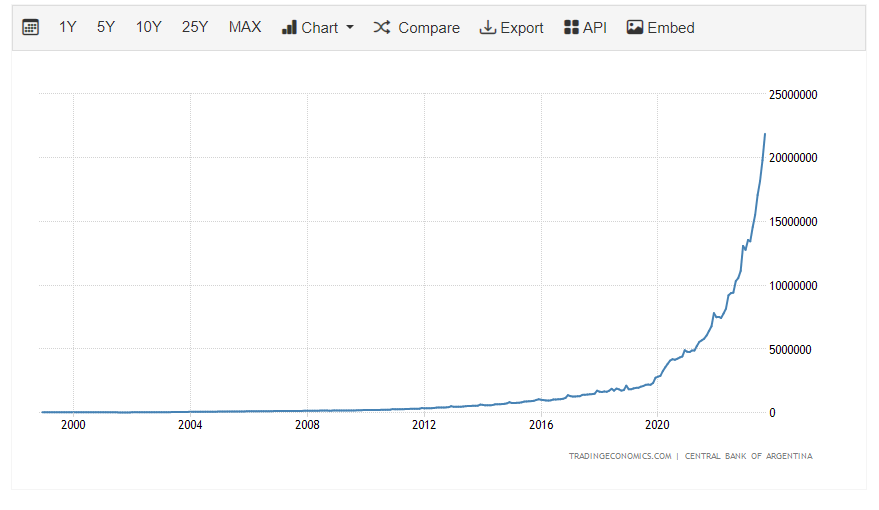
In 1990, Argentina had 711 billion pesos (ISO 4217 code: ARS) in circulation. By 2020, Argentina had roughly 2.5 trillion pesos in circulation. In other words, the Argentine government nearly quadrupled the amount of money in circulation over a 30-year period.

That’s a massive increase in the money supply, even over three decades, which explains why Argentina has battled inflation for years. Yet it’s small potatoes compared to Argentina’s recent money printing.

As of September 2023, Argentina’s total money supply stood at 22 trillion pesos, which means the government expanded the money supply nearly tenfold in less than four years.

Economics 101

This is why the people of Argentina are suffering massive inflation. 

It’s Economics 101. Practically any econ textbook you pick up will tell you that if you expand the money supply faster than an economy can produce goods and services, you will have inflation.

Too many people ignore the reality that inflation is first and foremost a monetary issue. 

The Nobel-Prize-winning economist Milton Friedman famously said that inflation “is always and everywhere a monetary phenomenon,” but it’s not like Friedman is alone. This is a truth widely understood in economic circles.

“I think almost everything other than the Federal Reserve is a sideshow when it comes to the dynamics of inflation,” Jason Furman, one of President Barack Obama’s top economists, responded last year when asked about Warren’s “greedflation” theory. 

This simple explanation for inflation is one many are disinclined to accept, however, and not just political partisans who speak of “greedflation.” We often hear suggested such things as hot labor markets and disrupted supply chains as causes of inflation, or declining gasoline prices as evidence of cooling inflation. 

There’s a simple reason there’s so much confusion on the issue: The definition of inflation has changed over time.

Today many people, including economists, confuse increases in price with inflation. Think about how inflation is reported: The government measures consumer prices, and this tells us how much “inflation” there is in an economy. 

There are several problems with this approach, however, including the fact that prices are constantly changing for reasons that have nothing to do with inflation, including supply and demand. (The price of gas, which are heavily influenced by crude oil supplies, is one of a million good examples.)

Inflation was not originally defined as an increase in consumer prices. For generations across various countries, inflation was defined as an expansion of the supply of money in an economy. 

“Inflation, as this term was always used everywhere and especially in this country, means increasing the quantity of money and bank notes in circulation and the quantity of bank deposits subject to check,” the economist Ludwig von Mises pointed out in Economic Freedom and Interventionism. “But people today use the term ‘inflation’ to refer to the phenomenon that is an inevitable consequence of inflation, that is the tendency of all prices and wage rates to rise.”

Mises saw the devolution of the term as a kind of tragedy, since there was no longer “any word available to signify the phenomenon that has been, up to now, called inflation.”

The Austrian economist was right, but there’s an obvious reason many today prefer the new definition of inflation. 

Under the former definition, it was easy to spot the culprits of rising prices: It was always and only those who expanded the money supply. Whereas under today’s definition, as Senator Warren shows, a general increase in consumer prices can be blamed on just about anyone or anything. 

Americans should not be fooled. Whichever definition one prefers to use — an expansion of the money supply which leads to price increases, or a broad and sustained increase in consumer prices — inflation is caused by the governments and central banks who control the money supply.

Which brings us to the United States. A glimpse at the steady expansion of the US money supply shows why prices in the US are also rising at a historic clip, and why its current fiscal path — which includes adding nearly $20 trillion to the $34 trillion national debt over the next ten years — is a cause for grave concern. 

“If a government resorts to inflation, that is, creates money in order to cover its budget deficits or expands credit in order to stimulate business, then no power on earth, no gimmick, device, trick or even indexation can prevent its economic consequences,” the Austrian economist Hans Sennholz once observed.

This is not to say the fate of the United States must be that of Argentina. But if politicians continue on their current course of money expansion and massive deficits, Americans will likely one day find themselves in a situation much like Marcelo Capobianco — using chalkboards in their stores to update prices throughout the day as they do business.



Friday, 22 September 2023

Nice short post looking at where we are with moneteray policy


21 September 2023

On interest rates, the Bank of England’s ‘Goldilocksers’ have won the day

By  

In a surprise move, the Bank of England has voted 5-4 to hold rates at 5.25%. Many financial market participants and monetary policy Kremlinologists had expected a rise to 5.5% but it was acknowledged as a knife-edge decision.

There is a three-way split in current UK monetary policy thinking. The first camp (not represented on the Monetary Policy Committee but with significant media presence) we might call the ‘monetarists’ – those who place significant weight upon monetary data in guiding their thinking about monetary policy. Having urged higher interest rates for much of the past decade and warned early about the inflationary consequences of the large amount of QE done late in the Covid period (especially in 2021), this camp has recently swung to the other end of the spectrum.

Some monetarists (including yours truly) were urging that interest rate rises be paused as long ago as the spring, when rates were still at 4%. It wasn’t necessarily that we were urging that 4% be the peak. We might eventually have wanted rates to rise to similar levels to now, just after a pause to check what the impacts would be of the already-rapid rises that had occurred by then. We can boil this thought down to two key factors.

First, monetary policy operates with a lag. For example, raised interest rates will continue to feed through to higher mortgage rates for a year or two even after interest rates peak, because people on fixed rate mortgages will only experience the rise when their fixed rate term expires.

Second, for some considerable time now it has been clear that monetary growth had slowed markedly, and now it is in outright contraction.

‘.

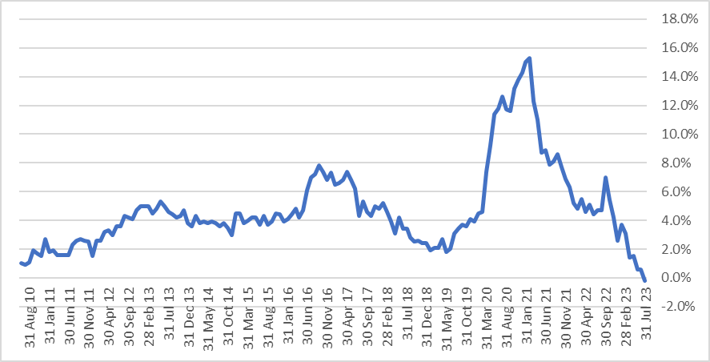
UK M4ex Broad Money Growth (Source: Bank of England)

The relationship between monetary growth and inflation is not precise or mechanical and does not arise with reliable lags, but broadly speaking if money growth is very rapid (eg the 15% levels we saw in 2021) one can expect rapid inflation perhaps 18 months or so later. And if monetary growth is negative (as it is now), and especially if it becomes markedly negative (as current trends suggest it might) then inflation can be expected to be very low or even negative around 18 months later, even without additional tightening.

So much for the monetarists. The next school we might term the ‘hawks’. These urge that raising rates too far is better than risking raising them not far enough, because of the risk inflation expectations rise and inflationary tendencies become embedded in firms’ decision-making and in wage-setting. The highest-profile area of such concern has been wages.

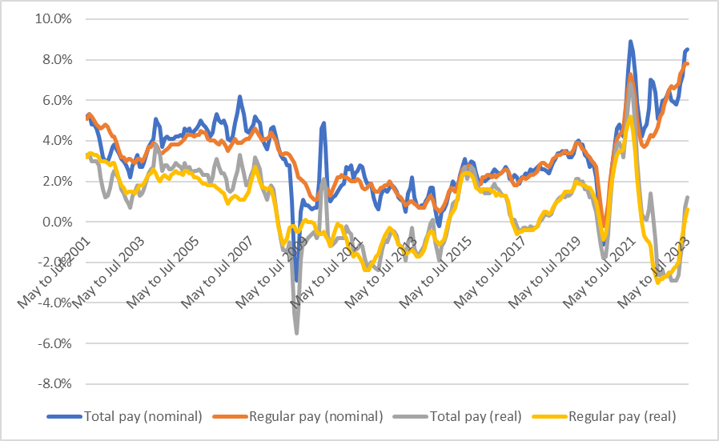
UK Annual Pay Growth

Recent regular pay growth has been at its most rapid this century. Those who believe in ‘wage-price spirals’ are concerned that rapid pay growth will force up firms’ costs so firms raise prices to remain profitable, so inflation becomes persistent and workers continue to demand rapid wage increases.

Those disputing this story reject the concept of a ‘wage-price spiral’ as bad theory and emphasize that in real terms wage growth is still low even by the standards of most of the past decade. Workers have merely been catching up some of the rapid real-terms reductions in wages they experienced, because of high inflation, until only a few months ago.

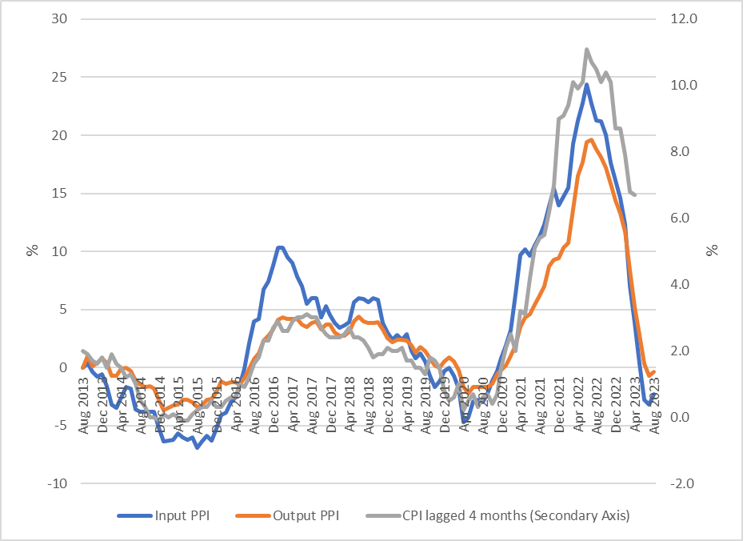
The third camp are the ‘Goldilocksers’. These reject both the ‘too much’ story of the monetarists and the ‘too little’ story of the hawks, and think the current set of rises is just right, with no more needed for now. They point to fairly resilient (albeit not spectacular) GDP growth data showing growth in the most recent three months as demonstrating that the fears of monetary overkill have thus far proved unfounded. And they say that the forward indicators suggest that inflation will fall quite rapidly now rather than become persistent. For example, producer prices inflation tends to run about four months ahead of consumer prices inflation, and has fallen sharply in the past few months.

Comparison of producer price inflation with CPI inflation four months later

The Goldilocksers carried the day. So we can expect 5.25% to have been the peak unless something unexpected causes inflation to rise again. Then we shall have to wait to see, over the next year or two, how accurate the concerns of the monetarists prove to have been, and whether those that choose to ignore monetary data will start cutting rates too late as inflation falls just as, by ignoring that data a couple of years ago, they started raising rates too late as inflation rose.

Wednesday, 8 February 2023

Money supply!!!!


Central banks are fighting the wrong war – the West’s money supply is already crashing


Jerome Powell
Jerome Powell of the Federal Reserve is raising interest rates relentlessly CREDIT: Jonathan Ernst/Reuters

Monetary tightening is like pulling a brick across a rough table with a piece of elastic. Central banks tug and tug: nothing happens. They tug again: the brick leaps off the surface into their faces.

Or as Nobel economist Paul Kugman puts it, the task is like trying to operate complex machinery in a dark room wearing thick mittens. Lag times, blunt tools, and bad data all make it nigh impossible to execute a beautiful soft-landing.

We know today that the US economy went into recession in November 2007, much earlier than originally supposed and almost a year before the collapse of Lehman Brothers. But the Federal Reserve did not know that at the time. 

The initial snapshot data was wildly inaccurate, as it often is at inflexion points in the business cycle. The Fed’s “dynamic-factor markov-switching model” was showing an 8pc risk of recession. (Today it is under 5pc). It never catches recessions and is beyond useless.

Fed officials later grumbled that they would not have taken such a hawkish line on inflation in 2008 – and therefore would not have set off the chain reaction that brought the global financial edifice crashing down on our heads – had the data told them what was really happening. 

One might retort that had central banks paid more attention, or any attention, to the drastic monetary slowdown underway in early-to-mid 2008, they would have known what was going to hit them.

So where are we today as the Fed, the European Central Bank, and the Bank of England raise interest rates at the fastest pace and in the most aggressive fashion in forty years, with quantitative tightening (QT) thrown in for good measure?

Monetarists are again crying apocalypse. They are accusing central banks of unforgivable back-to-back errors: first unleashing the Great Inflation of the early 2020s with an explosive monetary expansion, and then swinging to the other extreme of monetary contraction, on both occasions with a total disregard for the standard quantity theory of money. 

“The Fed has made two of its most dramatic monetary mistakes since its establishment in 1913,” said professor Steve Hanke from Johns Hopkins University. The growth rate of broad M2 money has turned negative – a very rare event – and the indicator has contracted at an alarming pace of 5.4pc over the last three months.

It is not just the monetarists who are fretting, though they are the most emphatic. To my knowledge, three former chief economists of different stripes from the International Monetary Fund have raised cautionary flags: Ken Rogoff,  Maury Obstfeld, and Raghuram Rajan.

The New Keynesian establishment is itself split. Professor Krugman warns that the Fed is relying on backward-looking measures of inflation – or worse, “imputed” measures (shelter, and core services) – that paint a false picture and raise the danger of over-tightening.

Adam Slater from Oxford Economics said central banks are moving into overkill territory. “Policy may already be too tight. The full impact of the monetary tightening has yet to be felt, given that transmission lags from policy changes can be two years or more,” he said.

Mr Slater said the combined tightening shock of rate rises together with the switch from QE to QT – the so-called Wu Xia “shadow rate” – amounts to 660 basis points in the US, 900 points in the eurozone, and a hair-raising 1300 points in the UK. It is somewhat less under the alternative LJK shadow rate.

He said the overhang of excess money created by central banks during the pandemic has largely evaporated, and the growth rate of new money is collapsing at the fastest rate ever recorded.

What should we make of last week’s blockbuster jobs report in the US, a net addition of 517,000 in the single month of January, which contradicts the recessionary signal from falling retail sales and industrial output? 

The jobs data is erratic, often heavily revised, and almost always misleads when the cycle turns. In this case a fifth of the gain was the end of a strike by academics in California.

“Employment didn’t peak until eight months after the start of the severe 1973-1975 recession,” said Lakshman Achuthan, founder of the Economic Cycle Research Institute in the US. “Don’t be fooled, a recession really is coming.” 

Is the Fed’s Jay Powell right to fear a repeat of the 1970s when inflation seemed to fall back only to take off again – with yet worse consequences – because the Fed relaxed policy too soon the first time? 

Yes, perhaps, but the money supply never crashed in this way when the Fed made its historic mistake in the mid-1970s. Critics say he is putting too much weight on the wrong risk.

It is an open question whether the Fed, the ECB, or the Bank of England will screw up most. For now the focus is on the US because it is furthest along in the cycle. 

All measures of the US yield curve are flagging a massive and sustained inversion, which would normally tell the Fed to stop tightening immediately.  The Fed’s preferred measure, the 10-year/3-month spread, dropped to minus 1.32 in January, the most negative ever recorded.

“Inflation and growth are slowing more dramatically than many believe,” said Larry Goodman, head of the Center for Financial Stability in New York, which tracks ‘divisia’ measures of money.

Broad divisia M4 is in outright contraction. He said the fall now dwarfs the largest declines seen during Paul Volcker’s scorched-earth policy against inflation in the late 1970s.

The eurozone is following with a lag. This threatens to set off a North-South split and again expose the underlying incoherence of monetary union. 

Simon Ward from Janus Henderson says his key measure – non-financial M1 – has fallen in outright terms for the last four months. The three-month rate of contraction has accelerated to 6.6pc, the steepest dive since the data series began in 1970. The equivalent headline M1 rate is contracting at a rate of 11.7pc.

These are startling numbers and threaten to overwhelm the windfall relief from tumbling energy costs. The sharpest contraction is now in Italy, replicating the pattern seen during the eurozone debt crisis. Eurozone bank lending has begun to contract too in what looks like the onset of a credit crunch.

This did not stop the ECB raising rates by 50 basis points last week and pre-committing to another 50, as well as pledging to launch QT in March. 

Mr Ward says the Bank risks a repeat of its epic blunders in 2008 and 2011. “They have ditched their monetary pillar and are ignoring clear signals that money is much too restrictive,” he said.

It is just as bad in the UK, if not worse. Mr Ward says the picture is eerily similar to events in mid-2008 when the consensus thought the economy would muddle through with a light downturn and no need for a big change in policy.

They were unaware that the growth rate of real narrow M1 money (six-month annualised) was by then plummeting at an annual rate of around 12pc. 

That is almost exactly what it is doing right now. Yet the Bank of England is still raising rates and withdrawing liquidity via QT.  I hope they know what they are doing at Threadneedle Street.

And no, the apparent strength of the UK jobs market does not mean that all is well. The employment count kept rising in the third quarter of 2008, after the recession had begun. It is a mechanical lagging indicator.

One can argue that the economic convulsions of Covid have been so weird that normal measures no longer have much meaning in any of the major developed economies. The whole nature of employment has changed. 

Firms are holding onto workers for dear life, which could prevent the normal recessionary metastasis from unfolding. But labour-hoarding cuts two ways: it could lead to sudden lay-offs on a big scale if the recession does happen, accelerating a destructive feedback loop. In the meantime, it eats into profit margins and should give pause for thought on stretched equity prices.

Personally, I am more Keynesian than monetarist, but the monetarists were right in warning of an unstable asset boom in the mid-Noughties, they were right in warning about the pre-Lehman contraction of money that followed, they were right about pandemic inflation, and I fear that they about right the monetary crunch developing in front of our eyes.

We are told that almost “nobody” saw the global financial crisis coming in September 2008. So at the risk of journalistic indecency, let me recall the news piece that we ran in The Telegraph in July 2008. It cites several leading monetarists.  

“The money supply data from the US, Britain, and now Europe, has begun to flash warning signals of a potential crunch. Monetarists are increasingly worried that the entire economic system of the North Atlantic could tip into debt deflation over the next two years if the authorities misjudge the risk,” it began. 

That was two months before the sky fell. The monetarists most assuredly saw it coming. So tread carefully.