
How QE landed taxpayers with yet another huge bill
Jun 06 2025 by Mike Denham, former chairman
The Bank of England’s ‘quantitative easing’ (QE) scheme is costing taxpayers billions. The Bank’s most recently published estimate puts the total cost at around £150bn, and the final bill is probably going to be even higher. All of it falls on the shoulders of taxpayers – a further £5,000 or more of debt landed on every single household in Britain.
How on earth has the Bank managed to do this to us? Did they not see it coming, and if not, why not? What if anything can be done about it now? Can the costs be reduced? And can we be sure they won’t do the same thing again in future?
QE is a monetary policy tool designed to ease credit conditions by directly increasing the quantity of money in the economy (hence the name, quantitative easing). It was launched as an untested emergency measure in the immediate aftermath of the 2008 financial crash, amid serious fears of a cascading financial and economic collapse. It was thought necessary because the standard policy of easing through cutting interest rates was running out of road, with the Bank Rate, sometimes called the ‘base rate’, already getting close to zero.
The programme was mainly implemented by the Bank going into the market and purchasing large amounts of gilts from their private sector owners (mainly institutional investors like pension funds and insurance companies). The idea was that the sellers would then be sitting on piles of cash which they would look to invest in other assets, like company debt, thus heading off a collapse of credit.
To pay for their purchases the Bank effectively printed money. It wasn’t money in the form of notes and coins, but credit entries in the current accounts that all commercial banks hold at the Bank, otherwise known as reserve balances. But it was still money, directly increasing the money supply.
It’s important to note that the Bank pays interest on reserve balances at Bank Rate. To offset the cost, it receives interest income from its QE gilt purchases. However, whereas the scheme’s gilts have a fixed interest rate, the Bank Rate is variable.
As long as the Bank Rate is below the fixed gilt rate, the scheme generates a positive cashflow, and is likely to be in profit – which was the case for its first 12 years of existence. But it’s a risky position, because if the Bank Rate rises above the fixed gilt rate, then cashflow turns negative and profit quickly turns to loss. And that’s exactly what’s now happened, as described below.
Now, although QE was untried and risky, in the panicky circumstances of the crash it’s easy to understand why the Bank – along with other central banks – grabbed at it. And by later standards they began quite modestly with a £100bn programme.
What’s much less easy to understand is why they later expanded the programme so massively. At its peak in early 2022, QE gilt holdings totalled £875bn, a whopping 35 per cent of all outstanding government debt. Throughout the years there had been no attempt, or even plan, to sell gilts back into the market. Yet the economy had recovered, growing in every single year since 2010, right up until the covid lockdown in 2020.
For sure the lockdown did then whack growth disastrously, but the government was already pumping in hundreds of billions in a gigantic fiscal support package. Doubling up with a staggering additional £450bn of QE was reckless overkill.
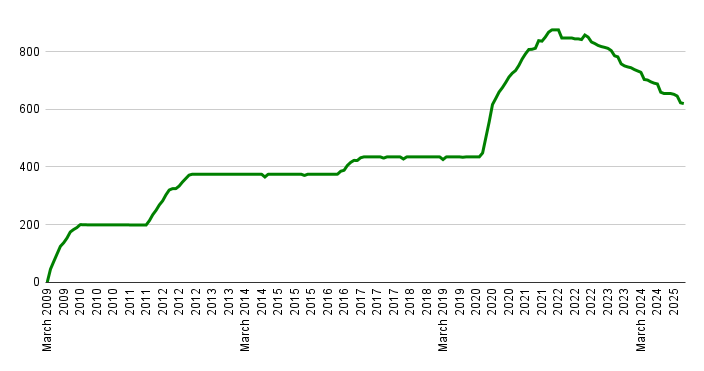
Chart: Bank of England asset purchase facility, March 2009 to April 2025 (£bn)
In the words of Lord King, who’d been Governor when QE was first launched, the Bank “got into a mindset of just doing QE whenever there was bad news. It was a way of telling the world, ‘Don’t worry, we’re here’.” They came to believe that “QE is about signalling things. This was a terrible mistake. They lost track of the fact that QE was simply printing money.
As any basic economics textbook will explain, printing money rarely ends well. And sure enough, following the Bank’s 2020 QE splurge, the money supply surged and UK inflation soared. By 2022 it reached almost 10 per cent – five times the Bank’s 2 per cent official target. And although the Bank blamed the Ukraine war and the spike in energy and commodity prices, in truth, inflation had already surged above target well before the war began. And even now it remains well above target.
The Bank was slow in tackling the inflation surge, maintaining it was no more than transitory. But eventually they increased the Bank Rate, peaking at 5.25 percent in 2023.
And it was that increase that exposed the big risk of QE to taxpayers. Because for the first time since the start of QE, the Bank Rate rose above the rate of interest the Bank was receiving on the gilts it had purchased.
In the low interest world of 2020 and 2021, annualised interest payments on the reserve balances had been below £1bn, but by 2023, with the Bank Rate at 5.25 per cent, they’d ballooned to over £40bn. And with income from the gilts running at only around £15bn, there was an annualised negative cashflow of getting on for £30bn.
The scheme’s positive cashflows up until 2022 had generated a cumulative profit of over £120bn, but huge negative cashflows since have quickly eroded that. And as already mentioned, the Bank’s most recent estimate is for a lifetime loss of £150bn.
Fortunately for the Bank, it is a quango ultimately underwritten by taxpayers. Although granted policy-making independence by Gordon Brown in 1997, the Bank remains fully owned by the state, which is the guarantor of its liabilities. Indeed, in the case of the QE programme, the Bank has a specific Treasury indemnity against all potential losses.
Taxpayers are not so fortunate. The Bank’s debts are taxpayers’ debts, just as much as gilts. We get no say over the Bank’s operations but we have to pay their bills.
So what can be done about the bill for QE? Is there some way to reduce it?
The obvious step is to reverse the programme, and in 2022 that’s precisely what the Bank decided to do, via a new programme imaginatively named quantitative tightening (QT).
QT is the mirror image of QE – the Bank sells its gilts back to the market and the sale proceeds reduce its reserve balance liabilities to the commercial banks (almost like unprinting money). So far QT has reduced gilt holdings by one-third to around £600bn, and at the current rate the entire portfolio will have gone by the early 2030s.
However, active sales have their own problems. For one thing, they crystallise the losses on the portfolio, which are substantial. Gilt prices have fallen a long way since the Bank did its buying, and although they don’t publish regular figures for their book loss, we know it stood at nearly £200bn (25 per cent of the portfolio) in December 2023. And prices have fallen even further since then.
On top of that, QT sales put downward pressure on prices in the gilt market. That means a corresponding increase in market yields, an increase in government borrowing costs, and a hike in Government’s future debt interest payments.
Nobody knows quite how much the QT sales have pushed up borrowing costs, but one respected research institution, the NBER, estimates they’ve increased gilt yields by 0.5 to 0.7 per cent, implying an increase in future government debt interest measured in tens of billions. What’s more, those costs are in addition to the £150bn direct lifetime QE cost estimate quoted earlier.
So given the massive cost of sales, why not halt them and just leave the portfolio to run off naturally as its gilts mature? After all, while other central banks have conducted QE programmes, the Bank of England is virtually alone in now making active sales. And while a halt would not avoid eventual realisation of losses, it would spread the pain over a much longer period.
However, a sales halt also has drawbacks. In particular, the longer the portfolio remains in place, the more the Bank has to pay out in interest on those commercial banks’ reserve balances.
And that’s prompted another suggestion, which is to scrap interest payments on reserve balances. After all, before 2006 there were no such payments, and frankly, nobody ever likes giving money to bankers.
For taxpayers it’s a highly tempting proposition. As things stand today, it would save around £25bn annually, at a stroke reducing government debt interest payments by almost a quarter.
But again, there are problems. As the Bank points out, the direct fiscal cost of its interest payments is not the only consideration. The Bank Rate is its principal tool of monetary policy, and by paying it to commercial banks on their reserve balances, they can ensure that it’s effective as a floor to bank lending rates across the economy.
If reserve balances paid zero interest, it’s unlikely banks would want to hold as much as now. They’d attempt to switch funds into other more lucrative short-term assets, pushing down market interest rates below the Bank Rate. Short-term lending to the private sector would expand, boosting the broader money supply and before long spilling over into higher inflation. The Bank Rate would be a much less effective tool for fighting rising prices.
On top of that, paying zero interest on a significant chunk of their assets would in essence be another tax on the banking system. It’s highly uncertain how banks would respond, but increasing the opportunity cost of holding safe readily available liquid assets might well push them towards less safe alternatives, thereby undermining financial stability.
It’s for these reasons that both the US Fed and the ECB pay interest on their corresponding reserve balances. Given the remaining high level of the Bank’s QE reserve balances, it would be going out on an even more dangerous limb to scrap interest payments.
The bottom line is that the Bank’s QE programme has lumbered taxpayers with an expensive headache and no pain-free cure. And it’s done so seemingly without considering the cost implications for taxpayers, and without much scrutiny from our elected representatives.
The Bank argues that its independence from political interference is a strength, allowing it to pursue monetary policy based on “objective analysis” rather than political expediency.
And it maintains that without QE the crash could have become a depression, causing even higher costs for taxpayers. However, even if that’s correct, it doesn’t excuse the later further waves of QE which more than doubled the size of the programme, massively increasing its costs, and ultimately fuelling the post-pandemic inflation surge. The Bank’s record in deploying QE is decidedly mixed.
So given the costs, should they be free to use QE again in future? It’s hard to disagree with the conclusions of the Treasury Select Committee. In their report early last year they said:
“It strikes us as highly anomalous that decisions have been and are being taken about QE and QT concerning huge sums of public money without any regard to the usual value-for-money requirements. This may have been more easily tolerable had QE remained at the relatively modest scale originally envisaged, or had a lifetime loss remained an unlikely scenario rather than the central projection…
...Given what we now know, any future QE should not proceed automatically under the existing arrangements. Instead, the arrangements should be revisited in the light of the implications for value-for-money, public spending and Bank independence.”
18 months on, have “the arrangements” now been changed to ensure value-for-money in any future QE operations? Is there perhaps now a framework for safeguarding taxpayer interests?
The answer is all too predictable.
No.



Central banks are fighting the wrong war – the West’s money supply is already crashing