Quote of the day

“I find economics increasingly satisfactory, and I think I am rather good at it.”– John Maynard Keynes
Showing posts with label QE. Show all posts

Monday, 9 June 2025

Dliemma for the Bank of England

How QE landed taxpayers with yet another huge bill


 Jun 06 2025 by Mike Denham, former chairman 

The Bank of England’s ‘quantitative easing’ (QE) scheme is costing taxpayers billions. The Bank’s most recently published estimate puts the total cost at around £150bn, and the final bill is probably going to be even higher. All of it falls on the shoulders of taxpayers – a further £5,000 or more of debt landed on every single household in Britain.

How on earth has the Bank managed to do this to us? Did they not see it coming, and if not, why not? What if anything can be done about it now? Can the costs be reduced? And can we be sure they won’t do the same thing again in future?

QE is a monetary policy tool designed to ease credit conditions by directly increasing the quantity of money in the economy (hence the name, quantitative easing). It was launched as an untested emergency measure in the immediate aftermath of the 2008 financial crash, amid serious fears of a cascading financial and economic collapse. It was thought necessary because the standard policy of easing through cutting interest rates was running out of road, with the Bank Rate, sometimes called the ‘base rate’, already getting close to zero.

The programme was mainly implemented by the Bank going into the market and purchasing large amounts of gilts from their private sector owners (mainly institutional investors like pension funds and insurance companies). The idea was that the sellers would then be sitting on piles of cash which they would look to invest in other assets, like company debt, thus heading off a collapse of credit. 

To pay for their purchases the Bank effectively printed money. It wasn’t money in the form of notes and coins, but credit entries in the current accounts that all commercial banks hold at the Bank, otherwise known as reserve balances. But it was still money, directly increasing the money supply.

It’s important to note that the Bank pays interest on reserve balances at Bank Rate. To offset the cost, it receives interest income from its QE gilt purchases. However, whereas the scheme’s gilts have a fixed interest rate, the Bank Rate is variable. 

As long as the Bank Rate is below the fixed gilt rate, the scheme generates a positive cashflow, and is likely to be in profit – which was the case for its first 12 years of existence. But it’s a risky position, because if the Bank Rate rises above the fixed gilt rate, then cashflow turns negative and profit quickly turns to loss. And that’s exactly what’s now happened, as described below.

Now, although QE was untried and risky, in the panicky circumstances of the crash it’s easy to understand why the Bank – along with other central banks – grabbed at it. And by later standards they began quite modestly with a £100bn programme. 

What’s much less easy to understand is why they later expanded the programme so massively. At its peak in early 2022, QE gilt holdings totalled £875bn, a whopping 35 per cent of all outstanding government debt. Throughout the years there had been no attempt, or even plan, to sell gilts back into the market. Yet the economy had recovered, growing in every single year since 2010, right up until the covid lockdown in 2020.  

For sure the lockdown did then whack growth disastrously, but the government was already pumping in hundreds of billions in a gigantic fiscal support package. Doubling up with a staggering additional £450bn of QE was reckless overkill. 
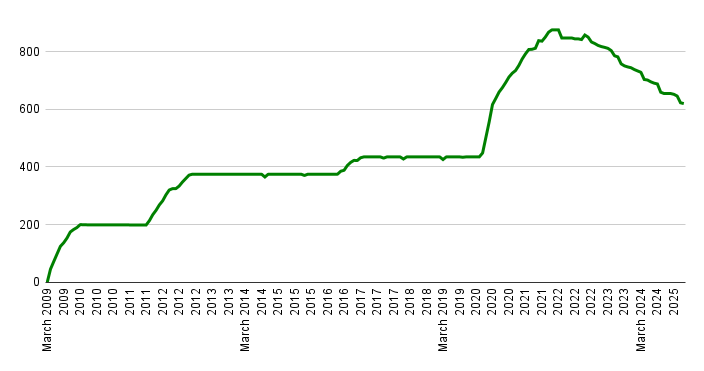

Chart: Bank of England asset purchase facility, March 2009 to April 2025 (£bn)

Chart: Bank of England asset purchase facility, March 2009 to April 2025 (£bn)

In the words of Lord King, who’d been Governor when QE was first launched, the Bank “got into a mindset of just doing QE whenever there was bad news. It was a way of telling the world, ‘Don’t worry, we’re here’.” They came to believe that “QE is about signalling things. This was a terrible mistake. They lost track of the fact that QE was simply printing money.

As any basic economics textbook will explain, printing money rarely ends well. And sure enough, following the Bank’s 2020 QE splurge, the money supply surged and UK inflation soared. By 2022 it reached almost 10 per cent – five times the Bank’s 2 per cent official target. And although the Bank blamed the Ukraine war and the spike in energy and commodity prices, in truth, inflation had already surged above target well before the war began. And even now it remains well above target. 

The Bank was slow in tackling the inflation surge, maintaining it was no more than transitory. But eventually they increased the Bank Rate, peaking at 5.25 percent in 2023. 

And it was that increase that exposed the big risk of QE to taxpayers. Because for the first time since the start of QE, the Bank Rate rose above the rate of interest the Bank was receiving on the gilts it had purchased. 

In the low interest world of 2020 and 2021, annualised interest payments on the reserve balances had been below £1bn, but by 2023, with the Bank Rate at 5.25 per cent, they’d ballooned to over £40bn. And with income from the gilts running at only around £15bn, there was an annualised negative cashflow of getting on for £30bn. 

The scheme’s positive cashflows up until 2022 had generated a cumulative profit of over £120bn, but huge negative cashflows since have quickly eroded that. And as already mentioned, the Bank’s most recent estimate is for a lifetime loss of £150bn. 

Fortunately for the Bank, it is a quango ultimately underwritten by taxpayers. Although granted policy-making independence by Gordon Brown in 1997, the Bank remains fully owned by the state, which is the guarantor of its liabilities. Indeed, in the case of the QE programme, the Bank has a specific Treasury indemnity against all potential losses. 

Taxpayers are not so fortunate. The Bank’s debts are taxpayers’ debts, just as much as gilts. We get no say over the Bank’s operations but we have to pay their bills.

So what can be done about the bill for QE? Is there some way to reduce it?

The obvious step is to reverse the programme, and in 2022 that’s precisely what the Bank decided to do, via a new programme imaginatively named quantitative tightening (QT). 

QT is the mirror image of QE – the Bank sells its gilts back to the market and the sale proceeds reduce its reserve balance liabilities to the commercial banks (almost like unprinting money). So far QT has reduced gilt holdings by one-third to around £600bn, and at the current rate the entire portfolio will have gone by the early 2030s.

However, active sales have their own problems. For one thing, they crystallise the losses on the portfolio, which are substantial. Gilt prices have fallen a long way since the Bank did its buying, and although they don’t publish regular figures for their book loss, we know it stood at nearly £200bn (25 per cent of the portfolio) in December 2023. And prices have fallen even further since then. 

On top of that, QT sales put downward pressure on prices in the gilt market. That means a corresponding increase in market yields, an increase in government borrowing costs, and a hike in Government’s future debt interest payments. 

Nobody knows quite how much the QT sales have pushed up borrowing costs, but one respected research institution, the NBER, estimates they’ve increased gilt yields by 0.5 to 0.7 per cent, implying an increase in future government debt interest measured in tens of billions. What’s more, those costs are in addition to the £150bn direct lifetime QE cost estimate quoted earlier.

So given the massive cost of sales, why not halt them and just leave the portfolio to run off naturally as its gilts mature? After all, while other central banks have conducted QE programmes, the Bank of England is virtually alone in now making active sales. And while a halt would not avoid eventual realisation of losses, it would spread the pain over a much longer period. 

However, a sales halt also has drawbacks. In particular, the longer the portfolio remains in place, the more the Bank has to pay out in interest on those commercial banks’ reserve balances.

And that’s prompted another suggestion, which is to scrap interest payments on reserve balances. After all, before 2006 there were no such payments, and frankly, nobody ever likes giving money to bankers. 

For taxpayers it’s a highly tempting proposition. As things stand today, it would save around £25bn annually, at a stroke reducing government debt interest payments by almost a quarter. 

But again, there are problems. As the Bank points out, the direct fiscal cost of its interest payments is not the only consideration. The Bank Rate is its principal tool of monetary policy, and by paying it to commercial banks on their reserve balances, they can ensure that it’s effective as a floor to bank lending rates across the economy. 

If reserve balances paid zero interest, it’s unlikely banks would want to hold as much as now. They’d attempt to switch funds into other more lucrative short-term assets, pushing down market interest rates below the Bank Rate. Short-term lending to the private sector would expand, boosting the broader money supply and before long spilling over into higher inflation. The Bank Rate would be a much less effective tool for fighting rising prices. 

On top of that, paying zero interest on a significant chunk of their assets would in essence be another tax on the banking system. It’s highly uncertain how banks would respond, but increasing the opportunity cost of holding safe readily available liquid assets might well push them towards less safe alternatives, thereby undermining financial stability. 

It’s for these reasons that both the US Fed and the ECB pay interest on their corresponding reserve balances. Given the remaining high level of the Bank’s QE reserve balances, it would be going out on an even more dangerous limb to scrap interest payments.

The bottom line is that the Bank’s QE programme has lumbered taxpayers with an expensive headache and no pain-free cure. And it’s done so seemingly without considering the cost implications for taxpayers, and without much scrutiny from our elected representatives. 

The Bank argues that its independence from political interference is a strength, allowing it to pursue monetary policy based on “objective analysis” rather than political expediency. 

And it maintains that without QE the crash could have become a depression, causing even higher costs for taxpayers. However, even if that’s correct, it doesn’t excuse the later further waves of QE which more than doubled the size of the programme, massively increasing its costs, and ultimately fuelling the post-pandemic inflation surge. The Bank’s record in deploying QE is decidedly mixed.

So given the costs, should they be free to use QE again in future? It’s hard to disagree with the conclusions of the Treasury Select Committee. In their report early last year they said:

“It strikes us as highly anomalous that decisions have been and are being taken about QE and QT concerning huge sums of public money without any regard to the usual value-for-money requirements. This may have been more easily tolerable had QE remained at the relatively modest scale originally envisaged, or had a lifetime loss remained an unlikely scenario rather than the central projection…

...Given what we now know, any future QE should not proceed automatically under the existing arrangements. Instead, the arrangements should be revisited in the light of the implications for value-for-money, public spending and Bank independence.”

18 months on, have “the arrangements” now been changed to ensure value-for-money in any future QE operations? Is there perhaps now a framework for safeguarding taxpayer interests?


The answer is all too predictable. 


No. 

Wednesday, 8 February 2023

Money supply!!!!


Central banks are fighting the wrong war – the West’s money supply is already crashing


Jerome Powell
Jerome Powell of the Federal Reserve is raising interest rates relentlessly CREDIT: Jonathan Ernst/Reuters

Monetary tightening is like pulling a brick across a rough table with a piece of elastic. Central banks tug and tug: nothing happens. They tug again: the brick leaps off the surface into their faces.

Or as Nobel economist Paul Kugman puts it, the task is like trying to operate complex machinery in a dark room wearing thick mittens. Lag times, blunt tools, and bad data all make it nigh impossible to execute a beautiful soft-landing.

We know today that the US economy went into recession in November 2007, much earlier than originally supposed and almost a year before the collapse of Lehman Brothers. But the Federal Reserve did not know that at the time. 

The initial snapshot data was wildly inaccurate, as it often is at inflexion points in the business cycle. The Fed’s “dynamic-factor markov-switching model” was showing an 8pc risk of recession. (Today it is under 5pc). It never catches recessions and is beyond useless.

Fed officials later grumbled that they would not have taken such a hawkish line on inflation in 2008 – and therefore would not have set off the chain reaction that brought the global financial edifice crashing down on our heads – had the data told them what was really happening. 

One might retort that had central banks paid more attention, or any attention, to the drastic monetary slowdown underway in early-to-mid 2008, they would have known what was going to hit them.

So where are we today as the Fed, the European Central Bank, and the Bank of England raise interest rates at the fastest pace and in the most aggressive fashion in forty years, with quantitative tightening (QT) thrown in for good measure?

Monetarists are again crying apocalypse. They are accusing central banks of unforgivable back-to-back errors: first unleashing the Great Inflation of the early 2020s with an explosive monetary expansion, and then swinging to the other extreme of monetary contraction, on both occasions with a total disregard for the standard quantity theory of money. 

“The Fed has made two of its most dramatic monetary mistakes since its establishment in 1913,” said professor Steve Hanke from Johns Hopkins University. The growth rate of broad M2 money has turned negative – a very rare event – and the indicator has contracted at an alarming pace of 5.4pc over the last three months.

It is not just the monetarists who are fretting, though they are the most emphatic. To my knowledge, three former chief economists of different stripes from the International Monetary Fund have raised cautionary flags: Ken Rogoff,  Maury Obstfeld, and Raghuram Rajan.

The New Keynesian establishment is itself split. Professor Krugman warns that the Fed is relying on backward-looking measures of inflation – or worse, “imputed” measures (shelter, and core services) – that paint a false picture and raise the danger of over-tightening.

Adam Slater from Oxford Economics said central banks are moving into overkill territory. “Policy may already be too tight. The full impact of the monetary tightening has yet to be felt, given that transmission lags from policy changes can be two years or more,” he said.

Mr Slater said the combined tightening shock of rate rises together with the switch from QE to QT – the so-called Wu Xia “shadow rate” – amounts to 660 basis points in the US, 900 points in the eurozone, and a hair-raising 1300 points in the UK. It is somewhat less under the alternative LJK shadow rate.

He said the overhang of excess money created by central banks during the pandemic has largely evaporated, and the growth rate of new money is collapsing at the fastest rate ever recorded.

What should we make of last week’s blockbuster jobs report in the US, a net addition of 517,000 in the single month of January, which contradicts the recessionary signal from falling retail sales and industrial output? 

The jobs data is erratic, often heavily revised, and almost always misleads when the cycle turns. In this case a fifth of the gain was the end of a strike by academics in California.

“Employment didn’t peak until eight months after the start of the severe 1973-1975 recession,” said Lakshman Achuthan, founder of the Economic Cycle Research Institute in the US. “Don’t be fooled, a recession really is coming.” 

Is the Fed’s Jay Powell right to fear a repeat of the 1970s when inflation seemed to fall back only to take off again – with yet worse consequences – because the Fed relaxed policy too soon the first time? 

Yes, perhaps, but the money supply never crashed in this way when the Fed made its historic mistake in the mid-1970s. Critics say he is putting too much weight on the wrong risk.

It is an open question whether the Fed, the ECB, or the Bank of England will screw up most. For now the focus is on the US because it is furthest along in the cycle. 

All measures of the US yield curve are flagging a massive and sustained inversion, which would normally tell the Fed to stop tightening immediately.  The Fed’s preferred measure, the 10-year/3-month spread, dropped to minus 1.32 in January, the most negative ever recorded.

“Inflation and growth are slowing more dramatically than many believe,” said Larry Goodman, head of the Center for Financial Stability in New York, which tracks ‘divisia’ measures of money.

Broad divisia M4 is in outright contraction. He said the fall now dwarfs the largest declines seen during Paul Volcker’s scorched-earth policy against inflation in the late 1970s.

The eurozone is following with a lag. This threatens to set off a North-South split and again expose the underlying incoherence of monetary union. 

Simon Ward from Janus Henderson says his key measure – non-financial M1 – has fallen in outright terms for the last four months. The three-month rate of contraction has accelerated to 6.6pc, the steepest dive since the data series began in 1970. The equivalent headline M1 rate is contracting at a rate of 11.7pc.

These are startling numbers and threaten to overwhelm the windfall relief from tumbling energy costs. The sharpest contraction is now in Italy, replicating the pattern seen during the eurozone debt crisis. Eurozone bank lending has begun to contract too in what looks like the onset of a credit crunch.

This did not stop the ECB raising rates by 50 basis points last week and pre-committing to another 50, as well as pledging to launch QT in March. 

Mr Ward says the Bank risks a repeat of its epic blunders in 2008 and 2011. “They have ditched their monetary pillar and are ignoring clear signals that money is much too restrictive,” he said.

It is just as bad in the UK, if not worse. Mr Ward says the picture is eerily similar to events in mid-2008 when the consensus thought the economy would muddle through with a light downturn and no need for a big change in policy.

They were unaware that the growth rate of real narrow M1 money (six-month annualised) was by then plummeting at an annual rate of around 12pc. 

That is almost exactly what it is doing right now. Yet the Bank of England is still raising rates and withdrawing liquidity via QT.  I hope they know what they are doing at Threadneedle Street.

And no, the apparent strength of the UK jobs market does not mean that all is well. The employment count kept rising in the third quarter of 2008, after the recession had begun. It is a mechanical lagging indicator.

One can argue that the economic convulsions of Covid have been so weird that normal measures no longer have much meaning in any of the major developed economies. The whole nature of employment has changed. 

Firms are holding onto workers for dear life, which could prevent the normal recessionary metastasis from unfolding. But labour-hoarding cuts two ways: it could lead to sudden lay-offs on a big scale if the recession does happen, accelerating a destructive feedback loop. In the meantime, it eats into profit margins and should give pause for thought on stretched equity prices.

Personally, I am more Keynesian than monetarist, but the monetarists were right in warning of an unstable asset boom in the mid-Noughties, they were right in warning about the pre-Lehman contraction of money that followed, they were right about pandemic inflation, and I fear that they about right the monetary crunch developing in front of our eyes.

We are told that almost “nobody” saw the global financial crisis coming in September 2008. So at the risk of journalistic indecency, let me recall the news piece that we ran in The Telegraph in July 2008. It cites several leading monetarists.  

“The money supply data from the US, Britain, and now Europe, has begun to flash warning signals of a potential crunch. Monetarists are increasingly worried that the entire economic system of the North Atlantic could tip into debt deflation over the next two years if the authorities misjudge the risk,” it began. 

That was two months before the sky fell. The monetarists most assuredly saw it coming. So tread carefully.

Monday, 16 May 2022

A quick coup de grace for UBI and MMT


The Left always wanted to pay people to do nothing and now we are seeing the results

Far from being harmless, the ‘progressive’ economic theories trialled during the pandemic have been tested to destruction

They have been awfully quiet recently, the purveyors of those “modern” and “progressive” economic theories that were so in vogue before the pandemic. Not long ago, after all, we were being forced to listen to proponents of ideas like “modern monetary theory” (MMT) and “universal basic income” (UBI) tell us why there was little practical constraint on printing or spending money and that the problem was that governments spend too little, not too much.

Then along came the pandemic and, quite suddenly, the moment arrived for us to experiment with these miraculous, economic cure-alls. Governments and central banks unleashed a wall of cash and for some of it, like furlough money, they had good reason. The chief advocate of MMT, a US professor called Stephanie Kelton, declared victory and told economists warning about the inflationary consequences to “take a hike”. Various forms of stimulus and furlough in the US and Europe were discussed as just the start of a massive expansion in the welfare state that would pay everyone to do nothing. Now, the reckoning has arrived.

Going by the latest data, which showed the economy shrinking in March, the UK is very likely already in recession. Inflation is forecast to hit double digits this year. In the City, bankers report that we have switched almost overnight from a sellers’ to a buyers’ market. The Government is dithering, caught between the horror of millions of households unable to make ends meet and the parlous state of public finances.

Meanwhile, post-furlough, the workforce has shrunk dramatically, workers are refusing demands to come back into the office and markets are demanding ever more in interest to lend to the Government. The public sector’s culture of producer-capture, whereby services are run for the benefit of their staff rather than users, has gone into overdrive. The pandemic maxim to “protect the NHS”, at the cost of our lives, has infected everything, so the Government is now castigated for the “mental health” effect of its immigration policy on Home Office staff and GPs’ surgeries display posters emphasising that doctors are overworked and under-appreciated. Guilt-tripping patients for needing medical treatment is par for the course.

Advocates of radical, high-spending government policies have long told sceptics that they were wrong to fear malign effects from an over-expansion of the state. Supposedly, the natural good in humans would overcome the dark pull of financial incentives. If the Government, following the principle of UBI, paid everyone a minimum amount to do nothing, they would not just sit at home and milk the state, but would be more productive and creative. To be sure, if you measured economic output in Facebook posts and amateur sourdough production, furlough was undoubtedly a pro-growth strategy.

Likewise with the enormous expansion in quantitative easing (QE) by central banks during the course of the pandemic. MMT, a series of tautologies masquerading as a new economic theory, appeared to suggest that any government with its own currency could print money to its heart’s content and never worry about ballooning deficits. No wonder the idea was embraced by the Labour Party under Jeremy Corbyn, whose manifesto included a proposal for a “People’s QE” to fund all sorts of spending goodies.

Not even in Mr Corbyn’s wildest dreams could he have imagined seeing a Conservative government effectively pursue the same policy – except that instead of spending the cash on infrastructure, as Labour was supposedly planning and which would in theory generate returns, it was handed out to households. Yet as The People’s QE has duly generated The People’s Inflation, promoters of MMT like Professor Kelton have begun to obfuscate and backtrack. She never said that inflation wasn’t a risk, she claims. All she meant was that governments could print and spend lots and lots more money without any ill effects. This is the rhetorical equivalent of a dog chasing its own tail.

Despite the near-fraudulent silliness of these radical schemes, however, the scales have yet to fall from people’s eyes. As recently as February, The New York Times ran a glowing profile celebrating Professor Kelton’s “victory lap”, with just one or two sheepish “caveats” mentioned towards the end. The Welsh Government is pressing ahead with a “trial” of universal basic income, by handing 500 young people an unconditional annual income of £19,200 a year for two years. More broadly, even with a recession looming and warnings of job losses across the economy, public sector and corporate workplaces are still obsessing over lifestyle choices rather than survival.

Few would argue that the Government should simply have done nothing in response to the pandemic. As the virus spread and the economy closed down, households needed emergency support to avoid catastrophic economic damage and it is likely they would have needed help even without the lockdowns imposed from above. But for a large segment of the British Left, pandemic relief schemes were not a one-off lifeline and a massive gamble. They were the fulfillment of long-held dreams about the way they want society to be governed.

It is only fair, then, to judge them on their outcomes. The resounding conclusion is that, far from being harmless and manageable, the vast expansion in state spending and monetary policy trialled by Covid policies have had profoundly damaging effects on the cost of living, the security of public finances and the resilience and working culture of our economy. Nor did it take years to generate this result. The effect has been almost immediate.

If this cabal of self-righteous spendthrifts had any sense of dignity left, they would take a well-earned break from dispensing advice on how to run the economy and stop trying to build a façade of intellectual credibility to disguise their pie-in-the-sky notions.

Instead, we have to listen to the Labour Party haranguing the Government simultaneously for failing to bring down the cost of living, not spending enough, and failing to address “climate justice” and “structural inequalities” all at the same time.

The Left, however, has failed to learn the lesson of its own delusions: if a pet theory looks too good to be true, then it’s almost certainly false. There is nothing progressive about crashing the economy.

Monday, 18 January 2021

Bank of England independence and credibility


Covid is a clear and present danger to the Bank of England’s independence

The Times
Share
Save

Just over three years ago, the Bank of England celebrated two decades of independence. There was much to toast and luminaries who attended the event at London’s Fishmongers’ Hall made sure to raise a flute or two. Independence had consigned rampant inflation to history. Since Labour had given the Bank control over interest rates, inflation had averaged 2 per cent — bang on target. In the preceding two decades, it had been 6 per cent.

So successful had the Bank been that it may be managing itself out of a job, Andy Haldane, its chief economist, had suggested in a recent speech. Because the young had no reference point for high inflation, there could be “a less strong constituency for independence”.

Yet for all the reasons to celebrate, there was anguish at the conference, not back-slapping bonhomie. At the end of 2017, the Bank’s independence was under threat like never before. Several politicians were calling for the head of Mark Carney, the governor, claiming that he had abused the Bank’s code of impartiality by warning of a Brexit recession. Quantitative easing was being blamed for widening wealth inequalities because the money printed had been used to buy financial assets, sending those prices soaring. At Fishmongers’ Hall, a number of speakers argued bleakly that “peak” independence had been reached.

Over the following 12 months, the warnings subsided as the Bank raised rates twice to 0.75 per cent. But last year’s actions brought the issue of independence back into glaring focus. For many, the Bank crossed the Rubicon during the pandemic. Almost every penny of debt issued by the government to cover the cost of lockdown was matched by a penny of QE. If it looks like Zimbabwe-style monetary financing and smells like monetary financing, perhaps the central bank is financing the government’s deficit, they said.

Technically, the Bank is prohibited from buying government bonds directly from the state, but those private sector investors who buy the bonds are quite free to sell similarly dated ones to the Bank outside of the fortnight for which restrictions are in place. Sir Paul Tucker, a former deputy governor at the Bank, certainly is suspicious. He wrote last month: “It has been difficult to tell whether the Bank has reverted to being the Treasury’s operational arm.” For the 18 biggest investors in the market, it is not even a debate. The majority made clear in a Financial Times survey that the Bank was deliberately matching QE to government issuance to absorb the debt and keep the Treasury’s borrowing costs low.

Should markets conclude that the Bank is monetary financing, it would be a far worse threat to independence than angry Brexiteer MPs. Investors collectively would be saying that they no longer believed that the Bank was acting independently to keep inflation in check and would demand higher rates for their money.

To reclaim its independence, the Bank would have to raise rates to prove that it was fighting inflation. Policymakers effectively would be trapped. Either way, the real economy — and the government — would feel the harsh winds of higher borrowing costs. And politicians, who ply what Sir Paul calls “an opportunistic trade”, no doubt would attack the Bank for failing the country in its hour of need.

Quantitative easing risks opening the Bank to claims it is an arm of the Treasury
JASON ALDEN/BLOOMBERG/GETTY IMAGES

This year will be a serious test for the Bank. Every way you look, its options are narrowing. Economists reckon that the third lockdown will add another £30 billion to government borrowing on top of the £394 billion in the year to March and £160 billion in 2021-22. The Bank has committed a total of £450 billion of QE since the pandemic, £150 billion of which is for 2021, more than doubling its portfolio despite the concerns about inequality. In February, it is likely to accelerate the rate of purchases, buying more gilts every month to keep borrowing costs low in the latest round of the crisis.

At some point, the Bank will have to step back, either by reducing the purchase rate or because the £150 billion is spent. If private investors cannot soak up the debt issuance alone, then government borrowing costs, on which real economy rates move, will rise and the Bank may feel obliged to intervene with more QE. There are also calls for the Bank to use QE in the recovery so that the government can afford to ramp up infrastructure spending. Either would leave it open to accusations of monetary financing, with those associated risks.

SPONSORED

Another option to help to spur the recovery being investigated by the Bank is cutting rates from the present 0.1 per cent into negative territory, or giving banks subsidised funding so that they can reduce their lending rates, as the European Central Bank has done. But the Bank has less flexibility than the ECB.

With about £5 billion of capital and nearly £1 trillion of assets, it is one of the most leveraged institutions in the world. Central banks make money in a number of ways: through “seigniorage”, the return from selling banknotes at face value to cash operators; interest paid on the gilts held through QE; and the “cash deposit ratio”, a requirement that commercial lenders place non-interest bearing deposits at the central bank, which it can then invest in bonds.

Unlike the ECB, the Bank sweeps all the seigniorage and QE receipts back to the Treasury, leaving it with only limited cash deposit income. Were it to start subsidising commercial bank funding, it would quickly burn through its capital. At that point, the Bank would have to go cap-in-hand to the Treasury for a top-up from the taxpayer. Doing so would turn its actions from monetary into fiscal policy, only without electoral accountability.

What this all means is that the Bank’s balance sheet is another source of risk to its independence. Blurring monetary and fiscal policy would raise questions about its status and would give politicians who want to rein in its power a chance to rewrite the rulebook.

Assuming that the vaccine programme works, there should be a sharp economic rebound this year and, with it, the threat of higher inflation. Jettisoning the implication of monetary financing and reasserting its independence to prevent a loss of confidence in inflation targeting will be the Bank’s biggest task this year. If that means doing nothing while teeing up rate rises for the end of the year or 2022, so be it.

Philip Aldrick is Economics Editor of The Times