Quote of the day

“I find economics increasingly satisfactory, and I think I am rather good at it.”– John Maynard Keynes
Showing posts with label wages. Show all posts

Friday, 22 September 2023

Nice short post looking at where we are with moneteray policy


21 September 2023

On interest rates, the Bank of England’s ‘Goldilocksers’ have won the day

By  

In a surprise move, the Bank of England has voted 5-4 to hold rates at 5.25%. Many financial market participants and monetary policy Kremlinologists had expected a rise to 5.5% but it was acknowledged as a knife-edge decision.

There is a three-way split in current UK monetary policy thinking. The first camp (not represented on the Monetary Policy Committee but with significant media presence) we might call the ‘monetarists’ – those who place significant weight upon monetary data in guiding their thinking about monetary policy. Having urged higher interest rates for much of the past decade and warned early about the inflationary consequences of the large amount of QE done late in the Covid period (especially in 2021), this camp has recently swung to the other end of the spectrum.

Some monetarists (including yours truly) were urging that interest rate rises be paused as long ago as the spring, when rates were still at 4%. It wasn’t necessarily that we were urging that 4% be the peak. We might eventually have wanted rates to rise to similar levels to now, just after a pause to check what the impacts would be of the already-rapid rises that had occurred by then. We can boil this thought down to two key factors.

First, monetary policy operates with a lag. For example, raised interest rates will continue to feed through to higher mortgage rates for a year or two even after interest rates peak, because people on fixed rate mortgages will only experience the rise when their fixed rate term expires.

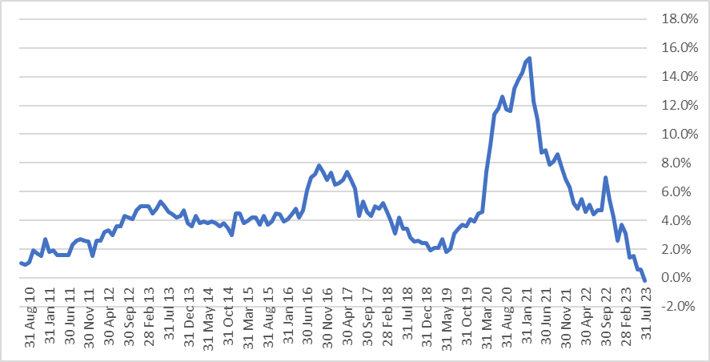
Second, for some considerable time now it has been clear that monetary growth had slowed markedly, and now it is in outright contraction.
‘.

UK M4ex Broad Money Growth (Source: Bank of England)

The relationship between monetary growth and inflation is not precise or mechanical and does not arise with reliable lags, but broadly speaking if money growth is very rapid (eg the 15% levels we saw in 2021) one can expect rapid inflation perhaps 18 months or so later. And if monetary growth is negative (as it is now), and especially if it becomes markedly negative (as current trends suggest it might) then inflation can be expected to be very low or even negative around 18 months later, even without additional tightening.

So much for the monetarists. The next school we might term the ‘hawks’. These urge that raising rates too far is better than risking raising them not far enough, because of the risk inflation expectations rise and inflationary tendencies become embedded in firms’ decision-making and in wage-setting. The highest-profile area of such concern has been wages.
‘

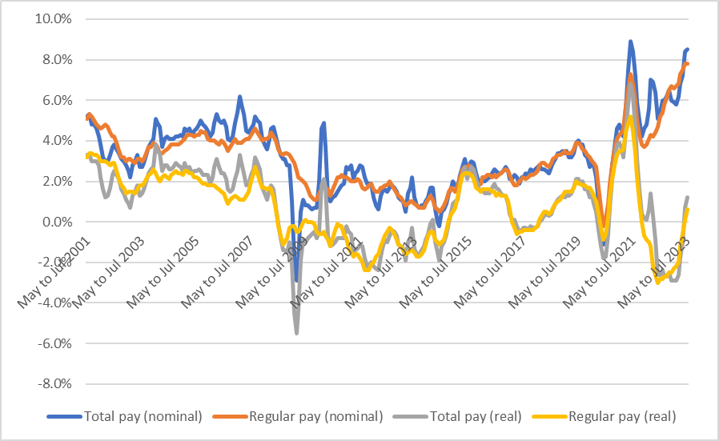
UK Annual Pay Growth

Recent regular pay growth has been at its most rapid this century. Those who believe in ‘wage-price spirals’ are concerned that rapid pay growth will force up firms’ costs so firms raise prices to remain profitable, so inflation becomes persistent and workers continue to demand rapid wage increases.

Those disputing this story reject the concept of a ‘wage-price spiral’ as bad theory and emphasize that in real terms wage growth is still low even by the standards of most of the past decade. Workers have merely been catching up some of the rapid real-terms reductions in wages they experienced, because of high inflation, until only a few months ago.

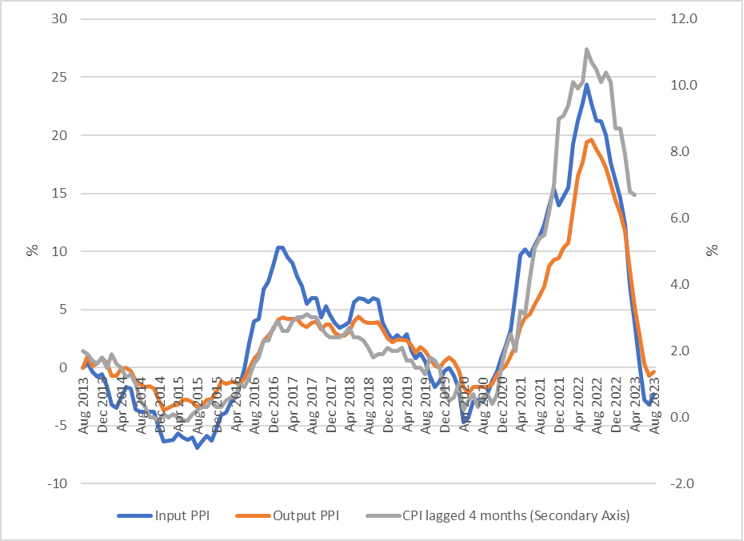
The third camp are the ‘Goldilocksers’. These reject both the ‘too much’ story of the monetarists and the ‘too little’ story of the hawks, and think the current set of rises is just right, with no more needed for now. They point to fairly resilient (albeit not spectacular) GDP growth data showing growth in the most recent three months as demonstrating that the fears of monetary overkill have thus far proved unfounded. And they say that the forward indicators suggest that inflation will fall quite rapidly now rather than become persistent. For example, producer prices inflation tends to run about four months ahead of consumer prices inflation, and has fallen sharply in the past few months.
‘

Comparison of producer price inflation with CPI inflation four months later

The Goldilocksers carried the day. So we can expect 5.25% to have been the peak unless something unexpected causes inflation to rise again. Then we shall have to wait to see, over the next year or two, how accurate the concerns of the monetarists prove to have been, and whether those that choose to ignore monetary data will start cutting rates too late as inflation falls just as, by ignoring that data a couple of years ago, they started raising rates too late as inflation rose.


Wednesday, 14 June 2023

Question - can you see deflation as the next issue?


Forget inflation – deflation is the real danger

The global inflationary shock is all but over – but what comes next could be worse


European Central Bank president Christine Lagarde has hinted that the bank could continue to raise interest rates even as the eurozone enters a technical recession CREDIT: OLIVIER HOSLET/EPA-EFE/Shutterstock

The global inflation shock of the last two years is over bar the shouting. Legacy effects will generate much noise for a few months but the one-off spike is reversing almost everywhere with an elegant symmetry.

China is sliding into outright deflation as its post-Covid recovery peters out. Wage cuts are spreading in a sureal replay of what happened in Europe and America during the 1930s. Such is the Spartan ethos of Xi Jinping’s ‘common prosperity’ campaign.

The Chinese producer price index has been negative for seven months, and the downward slide is accelerating. The headline CPI inflation rate has already dropped to 0.1pc and will soon be negative. The Shanghai region is at minus 1.1pc already.

This has large implications. China remains the workshop of the world, with the scale to shift the global pricing structure. It needs to export its way out of an economic depression and will not hesitate to do so with a cheaper yuan, down 12pc since early 2022. A wave of disinflation is coming our way.

Wei Yao from Societe Generale says the regime seems paralysed in the face of a deepening Japan-style trap. “The zero-COVID shock and the housing crash last year seem to have brought China’s implicit government debt stress close to a breaking point. For China to escape a severe deflation scenario, the policy mindset requires a reset. We have seen little willingness so far,” she said.

Land sales for developers underpinned local government budgets during the property bubble. The real estate crash has dried up the revenue, setting off a funding crisis. Forced belt-tightening has neutralised a key instrument used by Beijing to inject stimulus into the economy.  

Caixin magazine reported last week that the local authorities are drowning under $10 trillion of ‘hidden debt’ that they can no longer fully service. Some are having to cut medical benefits for the elderly. The orthodox (IMF) way out is to wipe the slate clean with root-and-branch restructuring of debts, which is what Japan failed to do in the 1990s, and China is now failing to do, because it is traumatic and runs into powerful vested interests.

The central bank (PBOC) is trickling out support but to little avail. It is pushing on a string, to borrow from Keynes. The transmission mechanism is broken.

Chinese economist Cheng Xiaonong says that a pervasive fear of the future has pushed the middle class into “survival” mode. There is a spontaneous “collective action” to withdraw from property, equities, and business investment, leading them to hoard savings and repay loans as fast as they can.

This is eroding the interest revenue of the banks and tipping them into a slow death spiral. Shanghai Pudong Bank is slashing wages – by 70pc for one employee (he accepted the cut), a case that went viral on WeChat. Citic is cutting base wages by 15pc. Not even the central bank is spared. This is how great deflations begin.

Liu Yuhui from the Chinese Academy of Social Sciences said the country is in the grip of a classic debt-deflation cycle. “People’s willingness to use credit across the entire economic system is rapidly collapsing.  It is essentially a balance sheet recession,” he said in a recent speech. Deleveraging is going to be “very bearish and painful.”

This is China in mid-2023. It is a country already beginning to export deflation, as you can see in the cut-throat price of electric vehicles arriving in Europe. Chinese firms can produce decent cars for €10,000 less than European rivals. Carlos Tavares from Stellantis says the Europeans are bracing for a “terrible fight”. If you are worried about car inflation, you won’t have to soon.

Chinese goods deflation is hitting a slowing world economy. JP Morgan’s index of input prices for global manufacturing has fallen below the boom-bust line.

We learned today that the eurozone has been in recession since the fourth quarter of last year, unlike the UK, which keeps confounding the OECD and the International Monetary Fund. Is there something wrong with their models, one may ask, or their ideology? (I utter not a word beginning with B).

Europe’s recession seems to be spreading, sucking in France as property transactions freeze and real consumption hits a brick wall. In its infinite wisdom, the European Central Bank is once again tightening hard after the onset of recession. It has pre-committed to further rate rises in June and July and will no doubt persist for the sake of ‘credibility’.

Isabel Schnabel, Germany’s firm hand on the ECB executive board, says it is better to err on the side of being tough. It was that sort of thinking that led to the unforced error of the eurozone debt crisis from 2011-2014.

The ECB’s financial stability report last week reads like a Gothic horror story, which I will explore in our next Economic Intelligence newsletter. Suffice to say that broad M3 money has been contracting since September, demand for bank credit has collapsed at rates comparable to 2008, and a credit crunch is underway. The eurozone may find itself uncomfortably close to deflation again within eighteen months.

Which leaves the Anglo-Saxons. There is no evidence of an inflation psychology or a wage-price spiral in the US. None. Inflation expectations five years ahead (5-Y/5-Y forwards) are dead flat at 2.27pc, lower than they were all through the early 2010s when rates were zero.

The canonical Blanchard-Bernanke opus on the causes of US pandemic inflation is that the $5 trillion fiscal blitz by Trump and Biden in an economy near full capacity was bound to end badly. They think this one-off “insanity” – to use Olivier Blanchard’s term – has largely played out. Inflation will keep falling mechanically to 4pc without the need for scorched earth policies. Getting below that will be harder.

The monetarist view is that war-time expansion of the money supply by the Fed caused the inflation blow-off, and that the process is now going into reverse too violently for safety. Broad M2 money growth has fallen at a record post-war rate of 4.6pc over the last year and this leads the real economy by a year or two.

The pace of contraction is likely to quicken as the US Treasury rebuilds its account after the debt-ceiling deal, and the Fed runs down its balance sheet (QT). JP Morgan estimates that they will together drain $1.1 trillion of liquidity from the financial system over the next four months. Most of this will come from bank reserves, risking fresh trouble among struggling regional lenders. Could there be an M2 melt-down by September? Yes, there could. Whatever happens, US inflation is coming down.

The UK may be one of the last inflationary outliers for a month or two, although it is not so different from Germany or Sweden. Global forces will bring it into alignment with the OECD median soon enough. We are not an economic island.

Rishi Sunak will have no difficulty cutting inflation to 5pc by the end of the year. Unfortunately this happy development may come hand in hand with our old friend ‘secular stagnation’. Will deflation be the greater worry in 2024 after all?

Thursday, 27 April 2023

Wage-price spiral? Nice, easy read:

 26 April 2023

Do Brits need to ‘accept that they’re poorer’?

By  

The Bank of England’s Chief Economist, Huw Pill, has caused another public relations disaster by criticising workers for demanding higher pay – and firms for passing on higher costs. Instead, he told a podcast from Columbia Law School, that Brits ‘need to accept’ that they’re worse off.

Let’s begin with a recap of what Pill was trying to say. This is important, because many economists would actually agree with him. Pill was making two points.

First, that the UK economy has been hit by an inflation shock (or more precisely, a ‘terms of trade’ shock) which will inevitably leave us poorer. He was referring here to the jump in the cost of imported energy. Or as he put it, ‘you don’t need to be much of an economist to realise that if what you’re buying has gone up a lot relative to what you’re selling, you’re going to be worse off’.

This is not particularly controversial. We can debate whether the hit is being fairly shared across the whole economy, but a net importer of energy is bound to suffer more than most during an energy crisis.

Second, he argued that attempts to maintain spending power ‘by bidding up prices, whether through higher wages or passing energy costs on to customers’ would only make the inflation problem worse.

This is simply another way of talking about the risk of wage-price spiral. Higher wages may not have caused the initial jump in inflation, but they could prolong it. There may well be something significant in the fact that wage inflation, services inflation and ‘core’ inflation (excluding food and energy) are all running at around 6%.

So Pill was only making points that other followers of the ‘dismal science’ would recognise. But I still think he was wrong to speak in the way that he did.

For a start, these comments are, as we have seen, highly insensitive – and likely to offend many people. Pill must have known that this would be the reaction, especially after the Bank’s Governor, Andrew Bailey, was slammed for similar comments last year. This adds to the sense that the Bank is asking households and businesses to control inflation, when that’s its job, and that its senior figures are out of touch.

The economics can be challenged too. It is fair enough to point out the risks of a wage-price spiral where higher wages are not justified by higher productivity. But there is little sign that pay settlements are running out of control. A norm of 5% would be consistent with getting underlying inflation back down to 3%, assuming productivity growth of 2%.

The Bank also has no business telling individual workers and employers what wages to pay or prices to charge. This should be left to the markets. Indeed, higher wages in some sectors and occupations could actually help to ease labour shortages and the capacity constraints that are contributing to inflation.

Put another way, what Pill describes as a ‘pass-the-parcel game’ is simply the markets doing their job of allocating scarce resources to their best uses, with relative prices adjusting according to supply, demand and cost pressures.

Finally, these calls for wage and price restraint simply won’t work. It seems inconceivable that anyone about to ask for a 6% pay rise is going to have a rethink and say ‘make that 3%’ on the basis of appeals from Bank officials. And no business will be keen to miss the opportunity to pass on higher costs either – if the market can take it, and especially if the alternative is bankruptcy.

In short, Pill might be able to get away with these remarks if talking to an audience of fellow economists. But it is naïve to imagine that they would be received anything other than very badly in the real world.