Quote of the day

“I find economics increasingly satisfactory, and I think I am rather good at it.”– John Maynard Keynes
Showing posts with label real earnings. Show all posts

Wednesday, 30 October 2024

A very broad-brush and sweeping look at our big issues - for conclusions


Why Britain is stagnating

edwest.co.uk

By the end of World War II, Britain had been the wealthiest country in Europe for a century and was still the second wealthiest on earth after the US, says Ed West. We began to fall behind after the war, but after decades of relative stagnation GDP per capita converged with the US, Germany and France in the 1980s and our relative wealth peaked in the early Tony Blair years. If our growth had continued along the trend set in the years 1979 to 2008, average income today would be £41,800 – it’s actually just £33,500. 

It’s time Britons woke up to just how poor their country is. Many regions are “near outliers in western Europe on poverty”, and the “few foreign visitors who go outside the historic heritage cities are shocked by how run down our towns are”.

How did we fall so low? Some blame a lack of strategy and state spending. But state investment would face the same barriers and high costs that existing infrastructure projects face. The real reason, as Ben Southwood, Samuel Hughes and Sam Bowman argue in their essay “Foundations” (available at ukfoundations.co), is that the British system makes it hard to invest, and expensive and legally difficult to build. A Leeds “supertram” was given the go-ahead in 1993, and there is still no sign of it, to give just one of many notorious examples. 

Even before Russia’s war with Ukraine, the industrial price of energy had tripled in under 20 years. Per capita electricity-generation in Britain is just two-thirds that of France and  a third of the US, putting us closer to developing countries such as Brazil and South Africa than to other G7 states. Transport projects are absurdly expensive. Productivity growth has stagnated. No wonder annual real wages for the median full-time worker are 6.9% lower than in 2008.  On current trends, Poland  will be richer than the UK by  the end of the decade. 

Britain’s economy lacks the infrastructure to enable people to move house and access prosperous areas. “Agglomeration” is the key because no individual by themselves can create much value. Countries become rich when its people are able to move to the most dynamic areas. But in Britain today, only the richest can afford to do so, literally leaving the poorest behind.  Our “deep and worrying” social problems have their roots in this economic malaise. Yet what we must do to reverse all this is simple, say the essay authors. We just need to remove the barriers to investment, such as restrictive planning rules. With the foundations in place, “growth and dynamism will follow. We have done this before. We can do it again.”

Thursday, 27 April 2023

Wage-price spiral? Nice, easy read:

 26 April 2023

Do Brits need to ‘accept that they’re poorer’?

By  

The Bank of England’s Chief Economist, Huw Pill, has caused another public relations disaster by criticising workers for demanding higher pay – and firms for passing on higher costs. Instead, he told a podcast from Columbia Law School, that Brits ‘need to accept’ that they’re worse off.

Let’s begin with a recap of what Pill was trying to say. This is important, because many economists would actually agree with him. Pill was making two points.

First, that the UK economy has been hit by an inflation shock (or more precisely, a ‘terms of trade’ shock) which will inevitably leave us poorer. He was referring here to the jump in the cost of imported energy. Or as he put it, ‘you don’t need to be much of an economist to realise that if what you’re buying has gone up a lot relative to what you’re selling, you’re going to be worse off’.

This is not particularly controversial. We can debate whether the hit is being fairly shared across the whole economy, but a net importer of energy is bound to suffer more than most during an energy crisis.

Second, he argued that attempts to maintain spending power ‘by bidding up prices, whether through higher wages or passing energy costs on to customers’ would only make the inflation problem worse.

This is simply another way of talking about the risk of wage-price spiral. Higher wages may not have caused the initial jump in inflation, but they could prolong it. There may well be something significant in the fact that wage inflation, services inflation and ‘core’ inflation (excluding food and energy) are all running at around 6%.

So Pill was only making points that other followers of the ‘dismal science’ would recognise. But I still think he was wrong to speak in the way that he did.

For a start, these comments are, as we have seen, highly insensitive – and likely to offend many people. Pill must have known that this would be the reaction, especially after the Bank’s Governor, Andrew Bailey, was slammed for similar comments last year. This adds to the sense that the Bank is asking households and businesses to control inflation, when that’s its job, and that its senior figures are out of touch.

The economics can be challenged too. It is fair enough to point out the risks of a wage-price spiral where higher wages are not justified by higher productivity. But there is little sign that pay settlements are running out of control. A norm of 5% would be consistent with getting underlying inflation back down to 3%, assuming productivity growth of 2%.

The Bank also has no business telling individual workers and employers what wages to pay or prices to charge. This should be left to the markets. Indeed, higher wages in some sectors and occupations could actually help to ease labour shortages and the capacity constraints that are contributing to inflation.

Put another way, what Pill describes as a ‘pass-the-parcel game’ is simply the markets doing their job of allocating scarce resources to their best uses, with relative prices adjusting according to supply, demand and cost pressures.

Finally, these calls for wage and price restraint simply won’t work. It seems inconceivable that anyone about to ask for a 6% pay rise is going to have a rethink and say ‘make that 3%’ on the basis of appeals from Bank officials. And no business will be keen to miss the opportunity to pass on higher costs either – if the market can take it, and especially if the alternative is bankruptcy.

In short, Pill might be able to get away with these remarks if talking to an audience of fellow economists. But it is naïve to imagine that they would be received anything other than very badly in the real world.

Tuesday, 9 February 2021

Inflation and earnings in Germany

 Reasonably accessible article - look at the diagram to get the gist:


Germany's Inflation Tax and the Rising Cost of Living

TAGS Global EconomyInflationLabor and Wages

Since the introduction of the euro, officially measured consumer price inflation in Germany has not made any great leaps. It has averaged 1.5 percent per year. It reached its highest value in 2008 at 2.8 percent and its lowest value just one year later at only 0.2 percent. In 2020, it has been negative for certain months but was 0.4 percent for the entire year. Do these figures provide a representative picture of the general price trends?

It is not surprising that the answer to this question remains controversial, because price inflation measurements are used to make subjective variables of economic life appear objective. How does the standard of living of citizens change? How much higher is real income today compared to twenty years ago? How much more expensive is a basket of goods of the same quality in one year compared to another? But just what equal quality even means in the course of technological progress and innovation cannot be determined objectively. Therefore, this question will never be answered conclusively.

However, there are also gaps in the official measurement of price inflation, and these can be determined without subjective value judgments. The Harmonised Index of Consumer Prices (HICP), by whose trajectory much of the ECB's monetary policy is justified, is an index for current consumption. It therefore essentially focuses on consumer goods prices and systematically excludes the prices of capital goods and future goods. Using the HICP to assess the overall standard of living thus reduces citizens to mere consumers in the present. But they are more than that.

Each individual has a more or less developed strategy to plan and make provisions for the future. People are not only consumers in the present moment, but also savers and investors who plan for future consumption (their own or others’). Quality of life is therefore determined not only by how much I can consume today, but also by how well I can provide for tomorrow. This is why price inflation for capital goods and assets is important. However, the HICP does not take it into account.

Moreover, the general tax burden is important. It makes both present consumption and providing for the future more difficult. "Public goods," such as education, health, infrastructure, environmental protection, and law and order, that are financed by taxes in turn have an impact on the general standard of living. Here, too, the general trend in quality cannot be determined objectively. For some, the quality of public goods has declined; for others, it has not. What can be objectively determined here, however, is the monetary price that citizens have to pay for them. It can be quantified by the total tax burden.

Taking into account both assets in the form of stocks (DAX) and residential property (index calculated by the Bundesbank), as well as the price of public goods in the form of total tax revenues, yields substantially higher inflation rates for Germany since the introduction of the euro.1 The question is how much weight to assign to the individual components in order to calculate an alternative index. Again, there is no objectively correct answer. Hence, the alternative index presented below makes no claim to general validity.

According to the OECD, the average total tax burden of a German household is about 40 percent of gross income. Therefore, a weight of 40 percent for total tax revenue is plausible.

Many households spend a substantial share of their gross income on the purchase of a residential property over a long period of time. Therefore, the Bundesbank's residential real estate index is assigned a weight of 15 percent. The DAX is given a weight of 10 percent to reflect investment in stocks. The HICP makes up the remainder of the alternative index with a weight of 35 percent. The following table shows the average annual inflation rates of the individual components and of the calculated alternative index.

Table 1: Average Annual Inflation Rates in Germany

Period

HICP

Residential property

DAX

Tax revenue

Alternative index

1999–2019

1.49%

1.92%

4.75%

2.97%

2.57%

2010–2019

1.42%

4.20%

8.32%

4.01%

3.74%

The alternative index has risen by an average of almost 1.1 percentage points faster than the HICP per year since 1999. This divide has increased over the past ten years with the advent of unconventional monetary policy. Since 2010, officially measured price inflation has been about 2.3 percentage points below the calculated alternative measure. What does this mean for an average household living primarily on labor income?

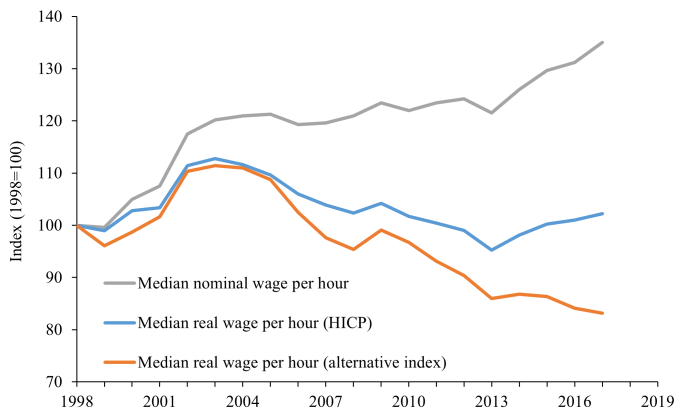
Figure 1: Median Nominal and Real Wages in Germany

The median nominal gross wage per hour increased by 1.59 percent per year between 1999 and 2017, according to data from the Socio-Economic Panel of the German Institute for Economic Research. If the HICP is used to calculate real wages, real wage growth is still positive, but only at a sobering rate of 0.12 percent per year.

However, if we use the alternative inflation measure, real wages fell by 0.97 percent per year between 1999 and 2017. Between 2010 and 2017, the average annual growth rate of real wages was even –2.17 percent. This means that the median wage per hour in 2017 still had about 83 percent of the real purchasing power of the median wage in 1998. On average, people can buy less from their working wages when more than just the goods of everyday consumption are taken into account.

This result is due to disproportionate asset price inflation and a rising tax burden, which of course affect different households differently. Households that live almost exclusively on labor income and have no real assets, but try to build up real savings for the future, suffer from this development. Young families in particular, which cannot count on the material support of their parents' and grandparents' generation, are finding it more difficult to establish a comfortable economic existence. The anxiety and existential fears of the average German household, which one hears about more and more frequently, are not surprising in light of disproportionate asset price inflation. With a broader look at price inflation, it becomes clear that real labor income of the citizens has been devalued substantially beyond direct taxation. Households that cannot increase their income through capital gains are the first to suffer.

  • 1.For more details see Karl-Friedrich Israel and Gunther Schnabl, “Alternative Measures of Price Inflation and the Perception of Real Income in Germany” (CESifo Working Paper 8583, Oct. 2, 2020).
Author: 

Contact Karl-Friedrich Israel

Karl-Friedrich Israel is an assistant professor in the department of economics and business at Western Catholic University in Angers, France. He is an organizing member of the Austrian Economics Meeting Europe and is a Mises Institute Research Fellow.

Friday, 6 March 2020

UK Labour market

British pay hits new peak

INSECURE “GIG” JOBS ARE STILL ON THE RISE
This month’s numbers on the labour market from the Office for National Statistics represent “a landmark moment for living standards”, says Nye Cominetti. Twelve years since the financial crisis, average pay has finally hit a new peak in real terms. Average weekly regular earnings were £511.60 in the three months to December 2019. The previous peak, adjusting for CPI inflation including owner occupiers’ housing costs, was £511.30, set in August 2007.
That’s clearly good news.  But it’s something of “a bittersweet moment”. It means that, in 12 years, the average pay packet has grown by just 30p.  If instead real pay had continued to grow at its pre-recession trend of 2.1% per year, average weekly pay today would be £141 higher in real terms. That’s an “extraordinary amount of lost ground”. According to the Bank of England, the only comparable pay squeeze in the past 150 years was in the 1920s.
A MIXED RECORD ON JOBS
The jobs picture is similarly mixed. The good news is that employment continues to hit new highs. The employment rate for 16- to 64-year-olds is now 76.5%, reversing the dip seen at the end of last year.  The unemployment rate, at 3.8%, remains at its lowest level in more than four decades.
The bad news is that the number of people on zero-hours contracts is also breaking new records. They total 974,000 in the latest data, amounting to 3% of total employment. This is surprising given the tightness of the labour market – four different measures of the amount of slack all show that there is as little or less slack in the labour market as there was before the crisis. Given this, you might expect workers to “use their bargaining power to secure more standard contracts, given the problems associated with unpredictable hours”.
Self-employment – a far bigger proportion of the workforce than the much-hyped subdivision of the so-called “gig economy” – also reached a record high of 5.03 million – up by about one million since the financial crisis. This is a “further reminder that the rise of atypical work is not just a cyclical effect”, but a structural change in the economy.
We can “cheer the good news and scratch our heads over why it’s taken so long … and resolve to avoid it ever happening again”. But the big picture is that the labour market is both growing and changing – and that that change can bring insecurity for some. To change that, action in the form of labour-market regulation and changes to the tax system will be needed.