Quote of the day

“I find economics increasingly satisfactory, and I think I am rather good at it.”– John Maynard Keynes
Showing posts with label growth. Show all posts

Thursday, 27 June 2024

The Growth Agenda for the United Kingdom

 Jun 26, 2024

After years of insufficient investment and sagging productivity in the UK, the Labour Party recognizes that achieving high-quality growth will require a comprehensive policy approach that builds on many intermediate objectives. But devising a strategy is only the first step; the real challenge lies in implementation.


CAMBRIDGE – As in many other developed countries lately, the two major political parties in the United Kingdom have embraced economic growth as their top policy priority. Following the volatile 49-day experience of Liz Truss’s government and its “dash for growth” in 2022, however, both parties emphasize that there are no financial shortcuts. The focus, instead, is on devising measures to boost productivity, resource allocation, and growth over the long term. In this respect, the opposition Labour Party is ahead of the ruling Conservatives, though both are still working out the details of actual implementation.


Buoyant, durable, sustainable, and inclusive growth is essential for a country where the older generations risk seeing their children end up worse off than they are. That has not happened in many decades. Only growth can deliver the resources needed to enhance living standards, improve public services, support sustainable energy initiatives, limit the scale of generalized tax increases, and combat inequality of wealth, income, and opportunity.


In short, it is all about increasing the safe speed limit for economic growth. The Bank of England estimates the UK economy’s potential growth may be as low as 1%. At that speed, much that ails the country is likely to get worse, rather than better, over time. Moreover, this already weak growth potential could deteriorate even further if the problem is left to fester.


There is no singular, silver-bullet initiative that can change this outlook. Many British politicians are still haunted by the Truss saga, when the newly arrived prime minister tried to use unfunded tax cuts as a stimulus, only to create a damaging episode of financial instability that forced a change in government. It is now widely acknowledged that after so many years of insufficient investment and sagging productivity, achieving high-quality growth requires a comprehensive policy approach that builds on many intermediate objectives.


The Labour Party has gone further in specifying such structural reforms. Its program includes proposals to revamp the planning system, boost infrastructure, improve trade links, crowd in domestic and foreign private investment (including through an energized National Wealth Fund), remove tax distortions, and pursue sector-specific initiatives. The party has also identified promising public-private partnerships geared toward enhancing investible funds, while encouraging innovation and efficiency.

Labour has indicated that it would try to “hardwire” many of these reforms by strengthening existing institutions. To ensure that all its policies remain compatible with financial stability, it has committed to adhere to the same public-debt “rule” as the current Conservative Party.

The challenge now is to devise a detailed execution plan, one that includes a high-frequency monitoring system to provide real-time feedback and allow for timely course corrections, if needed. Any economic-policy roadmap must favor comprehensive over piecemeal reforms. Such reforms should be implemented simultaneously, rather than sequentially, and they should come sooner rather than later.

As Labour demonstrated with its successful take-off after coming to power in 1997, a new growth emphasis would benefit from serious credibility-enhancing steps. That is what then-Chancellor of the Exchequer Gordon Brown did with his surprising and insightful decision to hand over the reins of interest-rate policy to the BOE, thus enshrining the principle of central-bank independence.

One must hope that the current Labour leadership has not ruled out too much policy flexibility in its pursuit of a decisive election victory. Some of the most powerful measures that it is proposing would require resources up front, but their growth and financial benefits would materialize only over time. The next government also will find itself confronting a more complicated, increasingly fragmented international system; and it will need to secure consistent buy-in from the private sector, which ultimately must do most of the heavy lifting.

Another, related task is to improve the functioning of existing growth engines while also supporting the development of the sectors and industries that will drive growth in the future. Striking a proper balance may prove to be the most difficult part of the challenge, given the country’s resource constraints and the fact that some key initiatives are better pursued at a regional level. (With its lack of sufficient robust regional initiatives to drive innovation in artificial intelligence, life sciences, and sustainable energy, the European Union currently faces a similar problem.)

Promoting high, durable, sustainable, and inclusive growth was never going to be easy after so many years of neglect. The need to revamp the UK’s existing growth engines and simultaneously kick-start new ones makes the task even more complicated. But to paraphrase US President John F. Kennedy’s famous moonshot speech, the winning party must do these and “other things, not because they are easy, but because they are hard.”


Sunday, 19 November 2023

Is GDP What It’s Made Out to Be?


Is GDP What It’s Made Out to Be?

It is a popular myth that “consumer spending drives the economy,” a statement that comes from a misunderstanding of GDP. Gross domestic product (GDP) is the most common measure of the economy. It accounts for the final purchase of goods and services by consumers, businesses, and governments. Since consumer spending represents the largest sector of GDP — a full two-thirds — many media analysts conclude that it is consumption, rather than investment, that drives the economy.

However, the media and Wall Street analysts forget that GDP is not the same as “total spending in the economy.” GDP measures final output only — the finished goods and services that consumers, businesses, and government buy each year. It amounted to nearly $27 trillion 2022.

GDP is an important measure of our standard of living, but it leaves out some important elements of the economy. Most importantly, it omits the value of the supply chain — all the intermediate stages of production that move products and services along the production, wholesale, and retail sectors to the finished product. The value of the supply chain is larger than GDP itself, around $32 trillion this year!

When you include the supply chain, you get what the government calls gross output (GO). The federal government now publishes GO along with GDP every quarter. GO is a much better, broader definition of total economic activity because it measures spending at all stages of production. GO represents the “top line” of national income accounting, while GDP is the “bottom line.” Both are essential to understanding how the economy works.

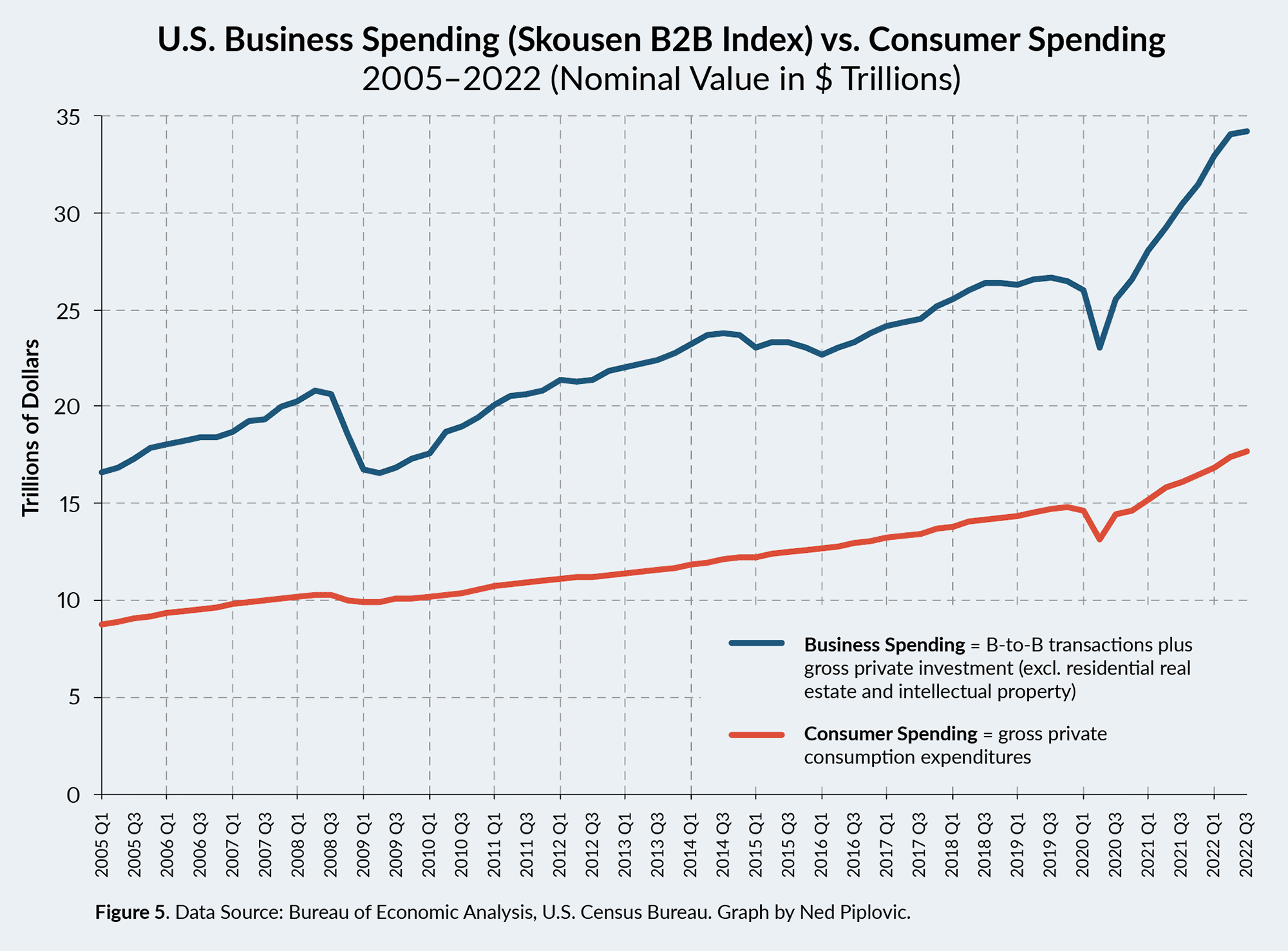
Using GO as the complete measure of total economic activity, we learn that consumer spending is only one-third, not two-thirds, of GO. Thus, consumption is important, but not as important as business spending along the production process.8 Figure 5 demonstrates how much bigger and more volatile business spending (designated as B2B) is compared to consumer spending.

U.S. Business Spending (Skousen B2B Index) vs. Consumer Spending 2005-2022 (Nominal Value in $ Tillions)

Figure 5. Data Source: Bureau of Economic Analysis, U.S. Census Bureau. Graph by Ned Piplovic.

Thus, we see that business activity is the big elephant in the room and it is it that determines the economic success of a nation. Consumption is the effect, not the cause, of prosperity. As MIT professor Shlomo Maital concludes, “The health and wealth of a large number of individual businesses — small, medium and large — determine the economic health and wealth of a nation. When they succeed, managers create wealth, income, and jobs for large numbers of people. When they fail, working people and their families suffer. It is businesses that create wealth, not countries or governments. It is businesses that decide how well or how poorly off we are.”9

In the classroom, I use Seattle as an example. Why is Seattle a booming, prosperous metropolitan city today? Is it because its residents suddenly decided to buy more goods and services with their credit cards? No, it was innovative businesses that came up with new products that consumers didn’t know they wanted until the business engineers came up with the new ideas. I ask students to name these companies. They include Boeing (the 700 commercial jet series), Microsoft (Windows software), Starbucks (new kinds of coffee), and Amazon (the online everything store), among others. Granted, all of these companies needed customers to be profitable and to expand, but which came first, the consumer wanting these products, or creative entrepreneurs who invented the new product? Clearly the catalyst, the first mover, is on the business side of invention — on the supply side.

In economics, this is known as “Say’s Law of Markets,” named after the French economist Jean-Baptiste Say (1767–1832), known as the “French Adam Smith.” Dynamic change and economic growth come from the supply side.

Friday, 17 November 2023

I thought it useful to share this view on AI - an investor's take:


Everyone Is Behind on AI

By Ed D'Agostino | November 17, 2023

Ed D'Agostino


AI is here. Are you ready?

On Tuesday, Cisco released its new AI Readiness Index. The company surveyed over 8,000 senior executives at global companies with 500-plus employees. A full 97% reported increased urgency to leverage AI for their businesses, but only 14% were ready to do so.

Only 30 or so companies have already successfully integrated AI across all aspects of their businesses, according to Tom Davenport and Nitin Mittal’s new book, All In on AI.

We’ll hear from Davenport, a senior advisor to Deloitte’s AI practice, next week on Global Macro Update. But today, instead of an interview, I’m going to share a bit about how we are looking at opportunities in artificial intelligence.

AI is a catalyst for rapid fundamental change. Harvard Business Review estimates that AI could add $13 trillion to the global economy over the next decade. PwC’s estimate is more aggressive: $15.7 trillion by 2030.

Executives will talk about AI on every earnings call for the next several years. With all the hype, how can you identify the companies truly leveraging AI to maintain a competitive edge?

One way is to look at changes in worker productivity. On its own, today’s level of artificial intelligence won’t make entire companies radically more productive. But companies that integrate AI with their enterprise software and automation will boost productivity to a degree not seen in decades. I call this the “holy trinity of technology.”

The success of businesses will depend on if, when, and how well they integrate the holy trinity. For those that get it right, productivity could soar 40%. This goes for companies in healthcare, financial services, legal services, education, entertainment, manufacturing, transportation, and agriculture. Just about everyone.


Source: Bain & Company

Big business has an edge here.

Take law firms, for example. A small firm with one to five lawyers could spend $400 a year for Casetext’s “AI legal assistant” CoCounsel, and the firm might get 30% more done. That’s great, but large, multinational law firms that generate billions in annual revenue won’t settle for a $400 off-the-shelf product. They can afford customized, AI-driven enterprise software to boost productivity.

Multinational law firm Allen & Overy is already doing this. The UK-based firm, which employs over 3,500 lawyers, partnered with Harvey AI to automate some of its legal research and drafting through tailored AI-driven enterprise software. The firm says it’s the first in the world to use generative AI at the enterprise level. Attorneys at bigger firms will become much more productive. (As an aside, I’m not sure that’s such a good thing.)

No one can integrate the holy trinity on that scale without help. This is where facilitators come in…

Facilitators (aka consultants) will lead the process of integrating AI, enterprise software, and automation at most Fortune 500 businesses. Remember, only 14% of large global companies say they’re ready to implement AI, and only 30 or so have fully integrated it. It’s a good time to be an AI facilitator.

Global spending on AI is projected to top $301 billion by 2026, according to Dataiku. Much of that will go to consultants. You can think of them as AI’s “picks and shovels” plays. They’ll make money no matter what.

All the large business consultancies have an AI division. McKinsey’s is called QuantumBlack, and it operates its own in-house AI lab. QuantumBlack has helped clients like Texas energy company Vistra Corp. implement custom AI to improve thermal efficiency, resulting in around $60 million in savings for the company.

It’s also helped the Emirates Team New Zealand build an AI bot that could test new designs by sailing them on the team’s simulator. This helped the team defend its America’s Cup title.


Source: McKinsey

Boston Consulting Group’s GAMMA division helps implement and scale AI solutions. Its clients include fashion retailer H&M Group, which uses AI to better manage its supply chains and predict trends.

Bain & Company offers similar services. So do KPMG, Deloitte, and PwC.

The hurdle for investors is that most facilitators are private companies.

Saturday, 2 September 2023

Housebuilding again - this time looking at the Green Belt (supply-side)

 A strong case from the Leader section of The Economist for hacking away at the green belt:


Britain should scrap its green belt

It has a stranglehold over the economy and protects the wrong bits of land

Kidlington roundabout in the greenbelt.
image: ed nix
Listen to this story.
 Enjoy more audio and podcasts on iOS or Android.

Food rationing is over. People can swear on the bbc. Homosexuality is legal. Thank goodness Britain has left behind the dreary restrictions of the 1950s. Yet the green belt—16 rings around English cities dreamed up 70 years ago—not only persists but is growing. The belt doubled in size in the 1980s. Last year it grew by another 24,000 hectares, or 1.5%. The green belt was never meant to swallow up so much land, yet today makes up 12.6% of England. Another quarter is protected by national parks or other designations.

In its own terms the belt has been wildly effective. English cities do not sprawl. Just 9% of the country’s land is built on—meaning that it is hardly the concrete jungle of popular imagination. These days the government says one point is to spur investment in cities. The green belt certainly makes city life more expensive. By one estimate, house prices in the south-east would be around a quarter cheaper without it. The policy remains terrifically popular. It summons up images of William Blake’s “green and pleasant land”, a place of natural beauty and abundant wildlife. Who could object to that?

The answer is anybody who would swap the 1950s for the 21st century. Despite its name, the green belt is not especially verdant: 7% of it is built-up land that happens to be designated as green belt and only a sliver is open for recreation. Two-thirds is for farming. The country’s remaining gaps of undeveloped land where houses, reservoirs or other infrastructure can be built are ever harder to find.

That helps explain chronic housing shortages inside cities, especially in productive places like Cambridge, London and Oxford. London, lacking brownfield sites, builds less than half of the 85,000 new homes it needs each year. In the countryside the belt leads developers to “leapfrog”, putting up housing for commuters farther away from the cities where the jobs are. The result is urban scattering instead of sprawl, with less agglomeration and a jammed-up labour market. Because many such places lack good public transport, residents spend more time in their cars, leading to more emissions. By some estimates all this costs about 0.5% of England’s gdp each year.

What can be done? Ideally, England would scrap the belt. True greenfield land—the sort the public treasures—could be just as well protected by designating more of it as national parks, or areas of outstanding natural beauty or special scientific interest and the like. More of the rest would then be open for development. Building on green-belt land within 800 metres of railway stations, for example, would provide plots for 850,000 homes. Giving up just 10% of the green belt would provide land for 5m homes. Boldest of all, England could plan whole new towns, just as it once did with Milton Keynes and Welwyn Garden City.

Unfortunately, even politicians who acknowledge that the green belt has a stranglehold over the most productive parts of the economy are unlikely to make such a radical case. Few even dare lay the foundations for reform by challenging popular misconceptions about the green belt’s true value.

Taboo or not taboo, that is the question

Even so, planning is likely to come up in the next election. The Conservatives, stung by their struggles to reform it in the past 13 years, say that building should mostly be on cities’ brownfield sites. They would make it even harder to release green-belt land. To its credit, the Labour Party has said it would “take on the taboo” on the green belt. It claims that a lack of supply, notably of land, explains why British housing is shoddy and costly: developers don’t compete to sell the best homes because desperate buyers will take anything available. Sir Keir Starmer has yet to put flesh on his party’s plans for the belt once in government. But if he wants to preside over a stronger economy, one obvious measure would be to cut the green leash that holds it back. 

Saturday, 28 January 2023

A look at UK's growth sectors:


The UK aerospace, defence and space sector is the second-biggest in the free world. Virgin Orbit aims to send satellites into space from British soil but its first launch ended in failure
VIRGIN ORBIT
Share
Save

In a speech to investors and multinational companies at Bloomberg’s European headquarters in the City, designed to bring greater optimism on the economy, Jeremy Hunt called on businesses to invest in the UK and promised long-term thinking to “turn the UK into the world’s next Silicon Valley”.

The chancellor vowed that growth would be driven by encouraging enterprise, tackling poor productivity and through a focus on key growth sectors including green industries, life sciences, advanced manufacturing, digital technology and financial services, areas where Britain has a competitive advantage.

“When it comes to the innovation industries that will shape and define this century the UK is powerfully positioned to play a leading role,” Hunt said.

Green industries Britain has prided itself on being, as the chancellor put it, a “world leader” in green energy (Emily Gosden writes). It was the first major economy to commit to cutting its emissions to net zero by 2050 and has rapidly deployed some clean technologies, especially offshore wind, of which it had more installed capacity than any other country until being overtaken by China in 2021. However, it has struggled to capitalise in manufacturing with most turbine parts, for instance, made overseas.

Now, as Britain seeks to deliver on highly ambitious goals for a massive scale-up of clean energy deployment this decade, the industry has warned that it must up its game to undo the damage done to electricity generators by the windfall tax and to compete against the huge incentives on offer in America from the Inflation Reduction Act.

Ana Musat, executive director of policy at Renewable UK, said the chancellor should “use the spring budget to announce a reform to our capital allowances regime to avoid Britain losing out in the global race for investment”, with America offering $216 billion in tax credits to those investing in clean energy and transport.

One key request across the energy industry is for reform of the planning system to enable quicker deployment.

Tom Greatrex, chief executive of the Nuclear Industry Association, said the government must establish the promised Great British Nuclear delivery vehicle, which has been delayed amid wrangling over its budget.

Life sciences Successive governments have identified life sciences as one of Britain’s key growth sectors, talking up the idea of creating a “science and technology superpower” (Alex Ralph writes).

The sector, spanning about 282,000 people and £94.2 billion in revenue in 2021, is built on the country’s leading universities, institutions, research base and so-called Golden Triangle of Oxford, Cambridge and London, home to GSK and AstraZeneca, Britain’s two big pharma groups and growing biotech and medtech companies.

Cell and gene therapies, vaccine technology and artificial intelligence, to help drive productivity and the speed of drug discovery, are areas where industry has been investing and focusing.

Jeremy Hunt said the UK had the largest life sciences sector in Europe
TIMES PHOTOGRAPHER JACK HILL

Hunt identified Britain as having the largest sector in Europe, behind only the US and China, for “high-quality” life science papers published; and the world’s top 25 biopharmaceutical companies have operations in the UK. Those bosses agree there are significant opportunities and investment potential for the sector, with research showing an additional £68 billion in gross domestic product can be generated over the next 30 years from increased R&D investment alone.

However, bosses are warning ministers of “real concerns” that the UK’s competitiveness in life sciences is slipping behind global competitors, led by the US. They point to a significant decline in commercial clinical trial activity and a fall in the UK’s share of global R&D investment. Leaders have pinpointed a soaring NHS sales levy on branded medicines as hitting growth in the sector.

Advanced manufacturing The UK aerospace, defence and space sector is the second largest in the free world after the US — data on China’s spend is not readily available — with clusters centred on Lancashire where BAE Systems’ main plants are, the Derby home of Rolls-Royce in the Midlands, and Bristol where Airbus bases it wing technology development (Robert Lea writes).

Airbus employs 14,000 people in Britain
MATTHEW LLOYD/GETTY

The sector employs 400,000 in its supply chain and has been boosted by a multibillion-pound, multi-decade commitment to a next generation Tempest stealth fighter and by the emergence of the small electric aircraft of the future being developed by the likes of Vertical Aerospace.

Rolls-Royce is one of the world’s four big jet engine manufacturers but it has been hit by the operational and production failures of its Trent 1000 engine for the Boeing 787 Dreamliner.

Britain’s automotive industry, which employs 180,000, is in steep decline with the 775,000 cars produced last year putting it way behind Germany, Spain and France. It has fallen well behind the Czech Republic and Slovakia, where Jaguar Land Rover produces the Land Rover Defender.

The sector is going through massive change in the move toward electrification. While Jaguar Land Rover and Aston Martin have been heavily lossmaking, the UK-produced, German-owned luxury marques Rolls-Royce Motor Cars and Bentley have been making record volumes and profits. Volumes at Nissan’s Sunderland plant, once the world’s most efficient, have more than halved in the past six years.

The sector has also been hit hard by the decision of Honda to close its plant in Swindon; by Mini’s decision to shift production of electric cars to China; by the decision of Arrival, the electric van and bus start-up, to quit Britain for better subsidies in America; and most notably recently by the collapse of Britishvolt’s would-be gigafactory.

Digital technology The UK excels in areas such as artificial intelligence, gaming and fintech and exciting developments are spinning out of academia, where Britain is home to ten of the world’s top 100 universities (Katie Prescott writes).

Hunt said Britain has become only the third economy in the world with a trillion-dollar digital technology sector.

“We have created more unicorns [private, start-up companies valued at more than $1 billion] than France and Germany combined with eight UK cities now home to two or more unicorns. The London/Oxford/Cambridge triangle has the largest number of tech businesses in the world outside San Francisco and New York.”

Yet the sector has been buffeted in the past year as the pandemic-induced boom has waned. The industry is deeply frustrated by delays from the government at producing strategies on key areas, in particular semiconductors and artificial intelligence, and recent cuts to research and development tax breaks.

The CBI called for more government subsidies in green technology to combat US incentives, while technology executives want “normal” relations with the EU to foster collaboration.

Financial services Underpinning the chancellor’s plan for the economy is Britain’s vast financial services sector (Ben Martin writes).

“The capability of the City of London combined with the research strengths of our universities makes our aspiration to be a technology superpower not just ambitious but achievable,” Hunt said.

The chancellor name-checked two initiatives that the government hopes will boost financial services. The first was a post-Brexit overhaul of EU insurance capital rules, known as Solvency II, that is aimed at unlocking billions of pounds of capital to invest in the UK. The plans “will begin to be implemented in the coming months”, Hunt said.

The second was the so-called Edinburgh Reforms, a collection of about 30 measures unveiled by the chancellor last month that it is hoped will improve the City’s international competitiveness, an area of particular concern for both ministers and finance executives.

There are worries that London is falling behind other financial centres such as New York, Hong Kong and Amsterdam, particularly for innovative technology companies to list their shares. Yet despite the challenge London is facing, the Edinburgh Reforms took a scattershot approach to turbocharging the City, with measures to tinker with or review a variety of different rules but little in the way of broader strategy.

What many in finance really want is for ministers to move faster. There has been much talk since 2016 about how Britain can seize on Brexit freedoms but it has taken years to push ahead with Solvency II reform, which was identified as an early Brexit dividend.