Quote of the day

“I find economics increasingly satisfactory, and I think I am rather good at it.”– John Maynard Keynes
Showing posts with label consumption. Show all posts

Sunday, 6 October 2024

Fiscal stimulus on top of monetary for CHina?

 Note the point about "re-balancing" - this has been talked about for years:


Xi Jinping is channelling his inner Mario Draghi

Politburo gives China’s shares a boost

The world’s capitalists are feeling cheerful, says John Authers on Bloomberg. Why? Because the “politburo of the world’s largest communist state” is warming to the idea of more welfare spending. There are “enough ironies… to sink the Titanic”. Chinese stocks leapt 8.5% on Monday for their best day since 2008. Over five sessions the CSI 300 index has risen an astounding 24%. In Europe, luxury shares, which are highly exposed to Chinese consumption, also rallied strongly.

Whatever it takes

The excitement came after a statement by the politburo suggesting Beijing is open to using fiscal stimulus to “prod consumers to start buying stuff again”, something economists have been advising for years to little effect. Stronger social-support policies are also on the table. There are as yet “no numbers”, but the declaration of intent from political leaders has been enough to trigger a surge of confidence on stockmarkets.

“Gone is the equivocation on deleveraging, moral hazard and provincial indebtedness, a staple of previous politburo meetings,” says Marko Papic of BCA Research. “This is Beijing’s ‘Whatever It Takes’ moment,” he says, a reference to Mario Draghi’s famous declaration in 2012 during the euro crisis. Investors are dreaming of a repeat of China’s “massive” 2008 stimulus, which helped the country avoid the worst of the global downturn, says James Mackintosh in The Wall Street Journal. But that splurge also left the economy with many of its current problems, including local government debt, overcapacity and excess housing. 

China’s central bank had earlier unveiled a series of measures designed to tackle the housing slump, including easier monetary policy and cuts to mortgage rates for existing housing, says Anthony Anastasi for the South China Morning Post. But making credit cheaper doesn’t address the country’s fundamental “structural imbalance” – consumption is too low, while investment and savings are too high. High investment was a good strategy when China needed to build out its infrastructure and factories, but now all those factories are pumping out products that local households don’t have the cash to buy. What’s needed is a rebalancing towards consumption.

That is why the politburo’s hint of big fiscal stimulus to come has excited markets, says Reshma Kapadia in Barron’s. With the official 5% growth target “in jeopardy”, officials seem to have become “alarmed enough to shift out of slow gear”. For markets, the big question now is whether political statements are followed up with significant cash.

Some foreign investors are cautious, says the Financial Times. “We have seen these fits and starts where China puts in place some kind of stimulus and it has not resulted in a long-term constructive recovery,” says Saira Malik of asset manager Nuveen. “We’d be looking for more follow-through in terms of a pick-up in economic activity.” Others caution that a more immediate threat to the rally is coming into view: a possible Trump victory in the US presidential election and the prospect of a renewed US-China tariff war. 

Sunday, 19 November 2023

Is GDP What It’s Made Out to Be?


Is GDP What It’s Made Out to Be?

It is a popular myth that “consumer spending drives the economy,” a statement that comes from a misunderstanding of GDP. Gross domestic product (GDP) is the most common measure of the economy. It accounts for the final purchase of goods and services by consumers, businesses, and governments. Since consumer spending represents the largest sector of GDP — a full two-thirds — many media analysts conclude that it is consumption, rather than investment, that drives the economy.

However, the media and Wall Street analysts forget that GDP is not the same as “total spending in the economy.” GDP measures final output only — the finished goods and services that consumers, businesses, and government buy each year. It amounted to nearly $27 trillion 2022.

GDP is an important measure of our standard of living, but it leaves out some important elements of the economy. Most importantly, it omits the value of the supply chain — all the intermediate stages of production that move products and services along the production, wholesale, and retail sectors to the finished product. The value of the supply chain is larger than GDP itself, around $32 trillion this year!

When you include the supply chain, you get what the government calls gross output (GO). The federal government now publishes GO along with GDP every quarter. GO is a much better, broader definition of total economic activity because it measures spending at all stages of production. GO represents the “top line” of national income accounting, while GDP is the “bottom line.” Both are essential to understanding how the economy works.

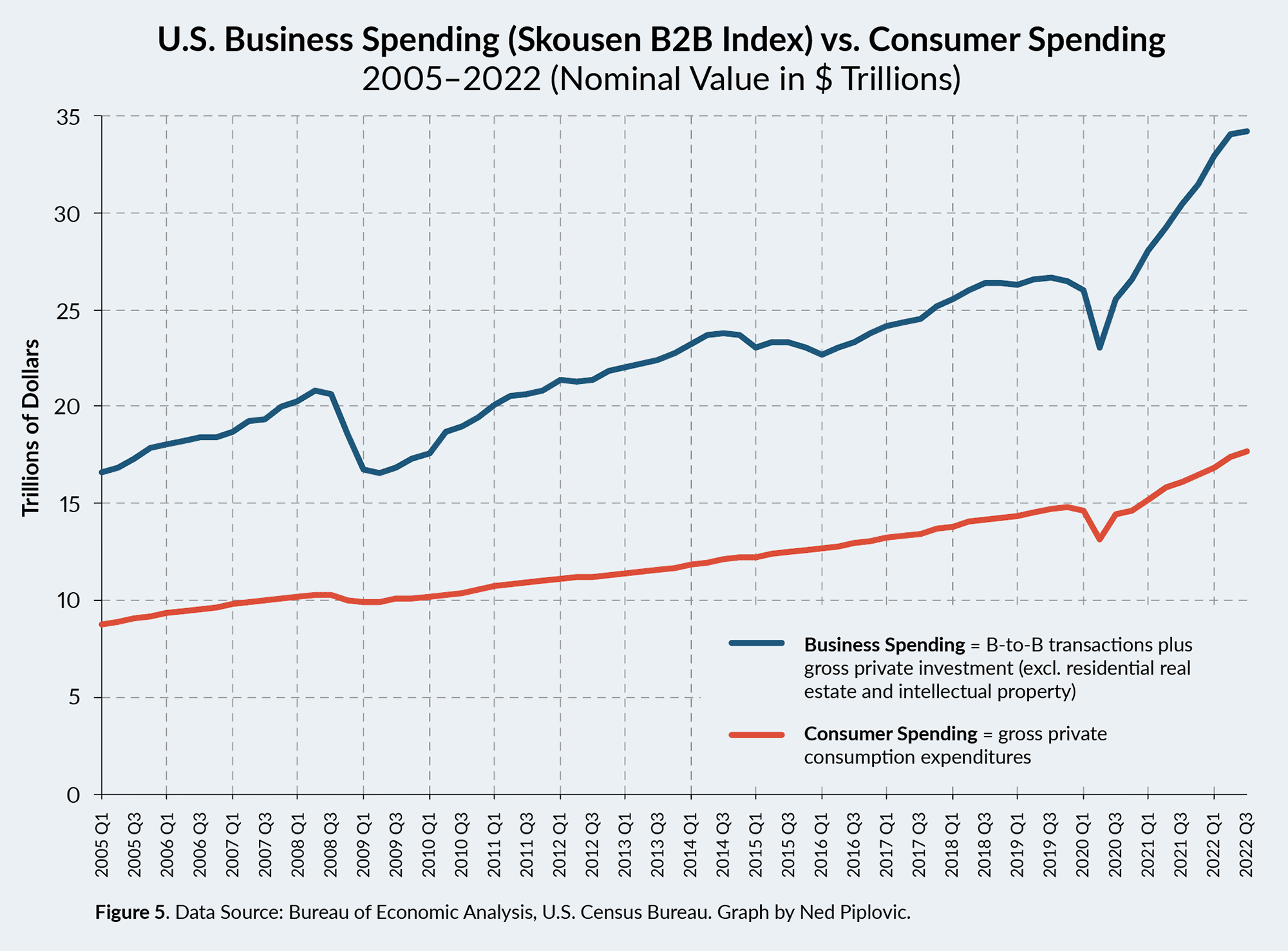
Using GO as the complete measure of total economic activity, we learn that consumer spending is only one-third, not two-thirds, of GO. Thus, consumption is important, but not as important as business spending along the production process.8 Figure 5 demonstrates how much bigger and more volatile business spending (designated as B2B) is compared to consumer spending.

U.S. Business Spending (Skousen B2B Index) vs. Consumer Spending 2005-2022 (Nominal Value in $ Tillions)

Figure 5. Data Source: Bureau of Economic Analysis, U.S. Census Bureau. Graph by Ned Piplovic.

Thus, we see that business activity is the big elephant in the room and it is it that determines the economic success of a nation. Consumption is the effect, not the cause, of prosperity. As MIT professor Shlomo Maital concludes, “The health and wealth of a large number of individual businesses — small, medium and large — determine the economic health and wealth of a nation. When they succeed, managers create wealth, income, and jobs for large numbers of people. When they fail, working people and their families suffer. It is businesses that create wealth, not countries or governments. It is businesses that decide how well or how poorly off we are.”9

In the classroom, I use Seattle as an example. Why is Seattle a booming, prosperous metropolitan city today? Is it because its residents suddenly decided to buy more goods and services with their credit cards? No, it was innovative businesses that came up with new products that consumers didn’t know they wanted until the business engineers came up with the new ideas. I ask students to name these companies. They include Boeing (the 700 commercial jet series), Microsoft (Windows software), Starbucks (new kinds of coffee), and Amazon (the online everything store), among others. Granted, all of these companies needed customers to be profitable and to expand, but which came first, the consumer wanting these products, or creative entrepreneurs who invented the new product? Clearly the catalyst, the first mover, is on the business side of invention — on the supply side.

In economics, this is known as “Say’s Law of Markets,” named after the French economist Jean-Baptiste Say (1767–1832), known as the “French Adam Smith.” Dynamic change and economic growth come from the supply side.

Sunday, 1 May 2016

Shocks Pt2 - Debt and Confidence

Another article from Project Syndicate that crosses over with the prior article; again, I have highlighted key elements that could be brought into a "shocks" essay:

The Next Global Boom – and Bust

WASHINGTON, DC – The mood at the International Monetary Fund-World Bank spring meetings here earlier this month was grim. The latest IMF forecast for global growth has been revised downward yet again – suggesting the world will grow at an annual rate of just over 3% this year and again in 2017.
If realized, this would be a dismal performance. Before 2007, global growth (using the IMF’s methodology) was in the 4.5-5% range, based on steady productivity improvements in industrial countries and rapidly rising living standards in large emerging markets such as China, Brazil, and Russia.
Brazil storm Christ the Redeemer

The Brazil Syndrome

Renowned economist Anders Åslund engages the views of Dani Rodrik, Nouriel Roubini, Joseph Stiglitz, and others on the growing turmoil in emerging markets.

PS On Point: Your review of the world’s leading opinions on global issues.
Now the US faces the uncertainty of a presidential election, weaker parts of the eurozone continue to struggle, and Japan is teetering on the edge of outright economic contraction. Brazil is in the midst of a political crisis, China is dealing with the after effects of prolonged fiscal expansion and explosive growth in its shadow banking system, and lower commodity prices are undermining economic performance in many other emerging markets. On top of all this, the British may vote in June to leave the European Union.
Economic activity is affected by confidence: Do consumers believe their incomes are likely to rise (or even prove secure), and do companies believe that future growth will be buoyant enough to warrant current investment? And today’s macro mood is shared pessimism.
Yet the medium-term scenario is unlikely to be global stagnation. New technologies continue to be invented, and billions of people aspire to improve their standard of living through education and hard work. Leading industrial economies have demonstrated remarkable resilience in the face of large negative financial-sector shocks over the past decade – as has China.
Unemployment in the United States is down to 5%, and parts of Europe are doing fine. And the most important point about the commodity price cycle is that it is indeed a cycle: Demand for commodities rises and falls, while supply changes only slowly. We should expect volatility in commodity prices – as well as in the price of oil.
The biggest question is whether we can get off the economic roller coaster and return to robust global growth without debt-fueled overconsumption (as seen in the pre-2008 US), overinvestment (as in China), and overexpansion of government spending (still an issue in some parts of Europe).
Debt can fund productive investments and improvement in human capital. But why do we always seem to like it too much? Part of the reason stems from tax systems, which in some countries allow some consumer interest payments (for example, mortgages in the US) to be deducted from taxable income. Corporate interest payments are typically deductible, too.
But the main appeal of debt is that it is a very simple contract: Either you pay the agreed amount or you don’t. And when things go well, a highly leveraged enterprise – a company or your house – will show a great return on equity. But those returns are not risk-adjusted, which means that when the economy slumps, big losses are allocated – as American homeowners learned in 2008, Korean conglomerates learned in 1997, and governments in emerging markets learn repeatedly.
Policymakers know that excessive debt brings financial fragility, of course, and some efforts at reform over the past decade have aimed to scale back leverage. But financial reform is hard to do during a slump, when the main task is to revive growth. Official intentions often remain just that; time and again, political leaders find it easier simply to keep in place the existing system of rules, incentives, and guarantees. And, because large financial firms do very well with a great deal of leverage, they continue to devote abundant lobbying resources to resisting efforts to ensure that they are better capitalized (with more shareholder equity relative to their total balance sheets).
Indeed, the largest banks in the US – but also in most other countries – are even bigger today than they were before 2008. All candid accounts indicate their internal incentives are not much changed, and restrictions on their activities are unlikely to prove effective as global growth picks up.
In the US, officials hold out hope that the largest financial firms will eventually be forced to comply with a provision of the 2010 Dodd-Frank financial reform legislation requiring that they draw up credible “living wills.” Yet most big banks have repeatedly failed to produce plausible plansexplaining how they could fail in bankruptcy without any government assistance and without damaging the world economy, and none has faced meaningful consequences for noncompliance.
Growth will return. Entrepreneurs will start new companies, and they will fund their risk-taking with equity investments provided by venture capital funds. Established nonfinancial firms have learned the hard way that they need to be careful with leverage and keep large cash cushions.
It’s the big banks that continue to prefer being highly leveraged. And too many policymakers are deferring to them. Like it or not, that means we are in line for another stomach-turning round on the global economy’s wild ride.

Shocks Pt1 - Debt

I have been trying to come up with a good question so we can tackle a "shock"-style topic appropriate for the exam. I think this works, albeit coming at the issue from an oblique angle:

Assess the implications for an economy of a global slow down when it is heavily in debt/over-leveraged.

I have deliberately not said "the UK" because this leaves the question open to different angles and approaches. Read the following article by Michael Spence on Project Syndicate, which I have highlighted in key areas, and consider your approach. We will look at this in class:

Managing Debt in an Overleveraged World

MILAN – What ever happened to deleveraging? In the years since the 2008 global financial crisis, austerity and balance-sheet repair have been the watchwords of the global economy. And yet today, more than ever, debt is fueling concern about growth prospects worldwide.
The McKinsey Global Institute, in a study of post-crisis debt trends, notes that gross debt has increased about $60 trillion – or 75% of global GDP – since 2008. China’s debt, for example, has increased fourfold since 2007, and its debt-to-GDP ratio is some 282% – higher than in many other major economies, including the United States.
Brazil storm Christ the Redeemer

The Brazil Syndrome

Renowned economist Anders Åslund engages the views of Dani Rodrik, Nouriel Roubini, Joseph Stiglitz, and others on the growing turmoil in emerging markets.

PS On Point: Your review of the world’s leading opinions on global issues.
A global economy that is levering up, while unable to generate enough aggregate demand to achieve potential growth, is on a risky path. But to assess how risky, several factors must be considered.
First, one must consider the composition of the debt across sectors (household, government, non-financial corporate, and the financial sector). After all, distress in these sectors has very different effects on the broader economy.
As it turns out, economies with similar and relatively high levels of gross debt relative to GDP exhibit sharp differences when it comes to the composition of the debt. Excessive household debt is particularly risky, because a shock in the price of assets (especially real estate) translates quickly into reduced consumption, as it weakens growth, employment, and investment. Recovery from such a shock is a long process.
The second factor to consider is nominal growth – that is, real growth plus inflation. Today, real growth is subdued and may even be slowing, while inflation is below target in most places, with some economies even facing the risk of deflation. Because debt is a liability for borrowers and an asset for creditors, these trends have divergent effects, increasing value for the asset holder, while increasing the liability of the debtor. The problem is that, in a low-growth environment, the probability of some form of default rises considerably. In that case, nobody wins.
The third key factor for assessing the risk of growing debt is monetary policy and interest rates. Though no one knows exactly what a “normal” interest-rate environment might look like in the post-crisis world, it is reasonable to assume that it will not look like it does today, when many economies are keeping rates near zero and some have even moved into negative territory.
Sovereigns with high and/or rising debt levels may find them sustainable now, given aggressively accommodative monetary policy. Unfortunately, though such accommodation cannot be sustained forever, today’s conditions are often viewed as semi-permanent, creating the illusion of stability and reducing the incentive to undertake difficult reforms that promote future growth.
The final, and arguably most important, factor shaping debt risk relates to investment. Increasing debt to sustain current consumption, whether in the household or government sector, is rightly viewed as an unsustainable element of a growth pattern. Here, China’s case is instructive.
In a sense, the frequent refrain that China’s debt is on an unsustainable path is true. After all, high levels of debt increase vulnerability to negative shocks. But, in another sense, this misses the point.
Many governments nowadays are accumulating debt in order to buttress public or private consumption. This approach, if overused, can amount to borrowing future demand; in that case, it is clearly unsustainable. But, if used as a transitional measure to help jump-start an economy or to provide a buffer from negative demand shocks, such efforts can be highly beneficial.
Moreover, in a relatively high-growth economy, ostensibly high debt levels are not necessarily a problem, as long as that debt is being used to fund investments that either yield high returns or create assets worth more than the debt. In the case of sovereign debt, the return on investment can be viewed as the increment to future growth.
The good news is that, in China, much of the accumulated leverage has indeed been used to fund investment, which in principle creates assets that will augment future growth. (Whether the results of the government’s recent decision to increase the fiscal deficit to stimulate the economy follow this long-term growth-enhancing pattern remains to be seen.)
The bad news is that directed lending and the relaxation of credit standards in China, particularly after the crisis, have led to investment in assets in real estate and heavy industry with a value well below the cost of creating them. The return on them is negative.
China’s so-called debt problem is thus not really a debt problem, but an investment problem. To address it, China must reform its investment and financial systems, so that low- or negative-return investments are screened out more reliably. That means tackling the mispricing of risk that results from the government’s backing of the country’s state-owned banks (which surely could not be allowed to fail).
Many developed countries are also failing to invest in high-return assets, but for a different reason: Their tight budgets and rising debts are preventing them from investing much at all. As this weakens growth and reduces inflation, the speed at which their sovereign-debt ratios can be reduced declines considerably.
In order to spur growth and employment, these economies must start paying closer attention to the kind of debt they accumulate. If the debt is financing growth-promoting investment, it may be a very good idea. If, however, it is financing “current operations” and raising short-term aggregate demand, it is highly risky.
Of course, the situation is not cut and dried. The return to public investment is affected by the presence or absence of complementary reforms, which vary from country to country. And there is some potential for abuse, with expenditures being misclassified as investments.
Yet, in an environment of low long-term interest rates and deficient short-term aggregate demand (which means there is little risk of crowding out the private sector), it is a mistake not to relax fiscal constraints for investment. In fact, the right kind of public investment would probably spur more private-sector investment. Identifying such investment is where today’s debt debate should be.
A good article that highlights the different types of debt (to boost consumption vs for investment - harking back to our essay on using QE for the real economy), as well as who is incurring the debt. The China situation is very instructive - they are in the process of building new economic zones around brand new huge airports, while at the same time rolling out a huge programme of high speed train development. Will both (funded by debt) earn a good return? It is likely some will not, but we won't know for sure for several years.
The other hugely relevant point is that we have had low interest for so long it now feels normal; it isn't, and rates will have to rise at some point (for numerous reasons), and countries that are heavily in debt will have to allocate more resources to servicing their debt. This is hugely deflationary. So much to write about - structure will be key!

Saturday, 26 March 2016

G7 main expenditure comparisons

NB is 2013 data, but good comparative table:


I note the latest data on household consumption (from OBR) shows households adding to debt at the fast rate for several years - consumption growth is running ahead of income growth by some margin.

Thursday, 11 December 2014

Essential reading on UK economy

Several lessons ago we talked about consumer spending leading growth; this article fills in the gaps:

Telegraph/OBR