


Building a mile of tramway in Britain costs more than double what it does in the rest of Europe (on average). The UK’s high costs have meant that fewer British cities have mass transit than any other wealthy Western country. Otherwise promising tram schemes are frequently canned as a result. Leeds, Bristol, Hampshire, and Liverpool have all seen tram projects cancelled on cost grounds. Many cities don’t even consider tramways because they know how expensive British projects can be.
Britain Remade and Create Streets spent months talking to people who actually build trams to figure out why our costs are so high.
We found that there is no innate reason why French, German or Spanish cities can build trams for a fraction of recent projects in Manchester and Birmingham. Rather, our high costs are the result of policy choices. It is possible to dramatically cut tram-building costs by copying what other countries do right and ditching the things we uniquely do wrong.
Four key factors stood-out. All can be fixed.
Too many utilities are moved at almost entirely the tram project’s expense,
Our planning system creates too many hurdles and slows down projects,
There is no pipeline of projects or shared standards, and
Centralised funding for local transport slows projects down and leads to a misalignment of incentives between funder and promoter.
This post focuses on the first factor (further posts will cover the other three).
Here’s how British tram projects move more pipes and wires than their European equivalents all the while paying more to do it.
“I thought my city was getting a new tram network, but it turns out it is really getting a new utility network”
Before a tram project even begins laying the tracks, the project encounters one of the costliest parts of the whole construction. There are many pipes and wires that run beneath streets and currently a British tram project generally has to dig up the road and move all of them.
All of this digging of the roadway doesn’t come cheap. The utility bill for the Sheffield tram in 1994 was £60 million (£154m in 2024). Moving utilities can regularly cost up to a third of the construction costs.
“When we get the utilities moved they effectively have new for old and that is generally really expensive, [which is] a significant portion of the cost, up to a third of the cost of the track works.” Martin Fleetwood, Board member of UK Tram
While dealing with utilities is always going to be a challenge for any tram project, new trams in Britain face three extra and unnecessary hurdles compared to projects in Europe and America:
Tram projects have to move nearly all of the utilities.
They are required to pay for almost all of the cost of the relocation.
Trackbeds are dug much deeper than in other countries out of excessive caution.
The issue: We replace too many below ground utilities
British tram projects move too many of the utilities that are beneath the future line. This is partly a consequence of utility companies having such favourable terms on the cost division of moving utilities that they prefer to replace as much as possible with new apparatuses. Utilities are moved for two primary reasons: firstly it allows for easier access for repairs, and secondly because the track may physically conflict with utilities. New projects in the UK start from an approach of moving every utility in case access is needed in the future.
“We (the U.K.) just went down the route of you need to move all the utilities to remove disruption risk.” Martin Fleetwood, Board member of UK Tram
Utility diversion is legislated by section 84 part three of the New Roads and Street Works Act 1991 (NRSWA). The legislation is sound, but a code of practice written by the Highway Authorities and Utilities Committee (HAUC), now over thirty years old, has created a cost burden to tram schemes by establishing a default position that all utilities should be moved from beneath new tram tracks at far greater cost to the tram project than the utility company.
As one tram engineer put it, “we’re spending fifteen to twenty million pounds for a once a decade occurrence of repairing utilities.” Another added that ,“It’s more likely the track will be replaced before the utilities.”
The solution: adopt a do not move by default approach to utilities
Future British tram projects should take a more pragmatic approach to diverting utilities and accept that maintenance may close networks overnight. We should only replace what is necessary. While iron Victorian pipes should be replaced, funded to a greater extent by the utility company, modern plastic water pipes, telecoms and electrics should, by default, not be moved.
Update the Code of Practice to give clear rules, based on the principles below, on which utilities to move and which to replace. This will remove the cost and time burden of utility negotiation.
Telecoms: do not move by default. Slew cables and lower if necessary and ensure tram tracks are not built on the pavement.
Electrics: do not move by default. Add backup ducting alongside new track. The default position that anything under one metre deep should be moved should be updated. A National Grid statement should be issued updating this position.
Gas and Water: only move metallic pipes. Leave plastic pipes that are not in physical conflict with track beds.
Waste water: do not move pipes, but align manhole covers between or next to tracks. At the moment, manholes and their pipes are moved further away from tracks to permit access out of a belief that manholes close to the track are more dangerous for workers. If access is needed, night time works should be prioritised, and in emergencies, the line should be severed, and services on each of the branches should run.
Section 82 of the NRSWA 1991 deals with the cost of damaging a utility asset. At present if a utility company were to temporarily need to remove track and access utilities, they may be liable for loss of revenue of the tram company were services suspended or any subsequent repairs to the track. The West Midlands addressed this with Severn Trent via a waiver for section 82. The DfT should adopt a nationwide waiver specific for utilities left in place on tram routes for Section 82 of the NRSWA 1991.
We should accept there will be times when access to buried utilities is needed. Works will be done at night or in some instances, tram services should terminate at the two stops nearest the disruption, enabling a quick walk between them. This is the norm in continental Europe if sections of the tramway have to close for works. When significant work is required on Vienna’s trams, the tramline will be divided into multiple sections that each run services. It is far better to bring down the cost of building a tram line that occasionally must be severed than to build no tram because it is too expensive to replace and move every utility. We are letting the best tram be the enemy of the good tram or indeed of any tram at all.
The issue: The cost and liability burden falls on the developer or council.
Since 2000, tram promoters have had to pay 92.5% of the cost of moving utilities, while the rest is covered by the utility companies. With utility companies only picking up 7.5% of the cost, there is no incentive for them to keep the costs of work down or to be selective about which pipes actually need to be moved or replaced. Instead, the utility companies get newly installed apparatuses, using expensive sub-contractors, at the expense of the tram project. This results in a significant subsidy to utility companies. Perversely, were utilities diverted for highways improvements not tram improvements, companies are obliged to pay 18% of the costs.
Other countries have more reasonable approaches to splitting the costs of any utility diversions. In France, utility diversion costs for private utilities like electricity, gas, and telephones are covered by the private owners of utilities. Of Lyon’s €34 million spend on moving utilities for 16 miles of new tramway, the electricity and gas companies covered €12 million of these costs, while the telecom company covered another €11 million. Utility companies are most able efficiently to reroute their cables and pipes because of their experience and incentive to do so cheaply. Since they are covering the costs, they will only divert the utilities that need to be moved. Private companies are also encouraged to keep detailed records of their utilities, which limits the chances of unexpected delays due to unknown utilities being found.
The solution: ask utility companies to contribute a fairer share of diversion costs
Update the statutory instrument ‘The Streets Works (Sharing of Costs of Works) Regulation 2000’ to rebalance the cost of diverting utilities from tram projects to utility companies.
The issue: we build our tracks too deep.
British tram track beds are often deeper than European or American counterparts. The West Midlands Metro rides on top of 600mm of concrete, which is following British standard practice of protecting utilities which go under tram tracks with large concrete slabs of between 500 to 1000mm in depth. This is borne out of a cautious desire to protect against Heavy Good Vehicles running over the tracks. Yet, digging this deep and pouring this much concrete adds significant cost.
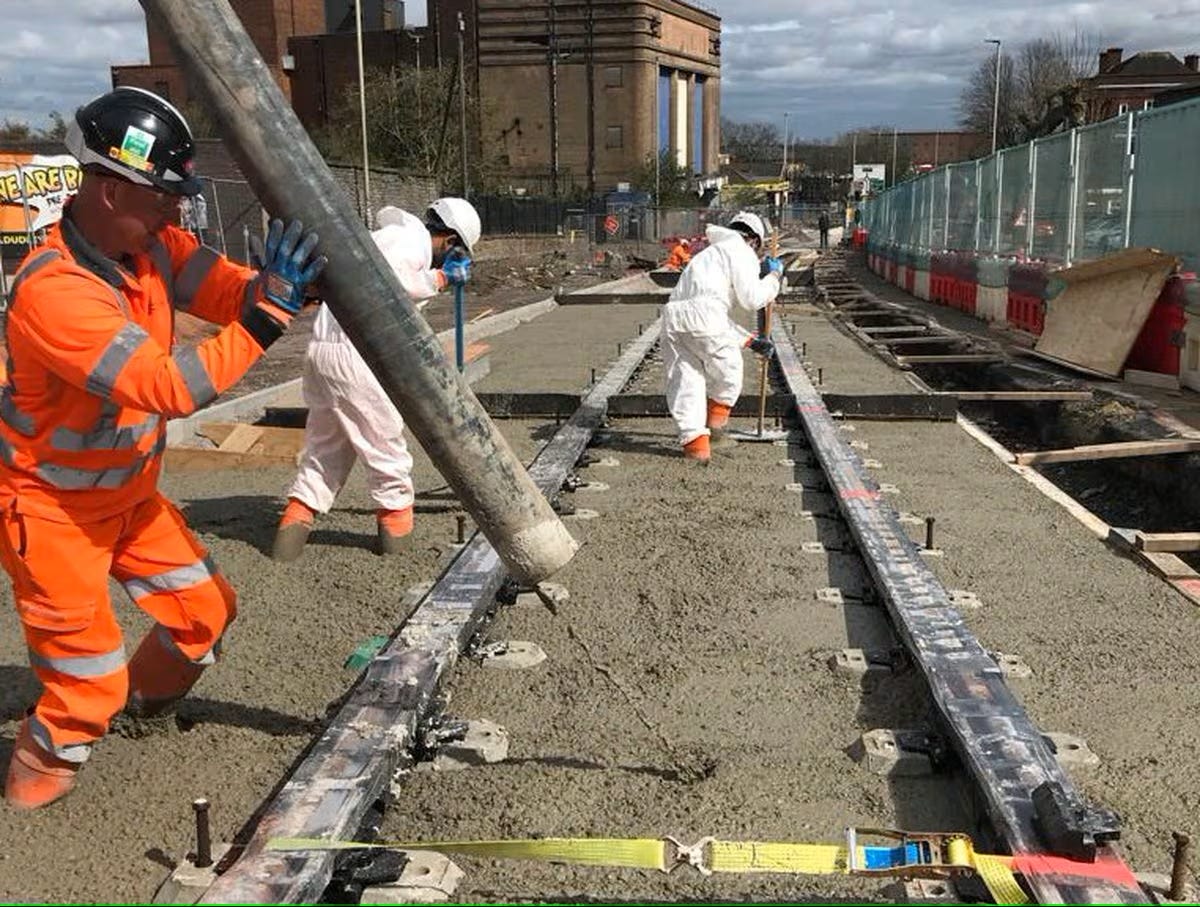 |
Left: workers completing the track bed on the West Midlands Metro, which is deeper than the European norms, requiring significant concrete (source: Midlands Metro Alliance). Right: the shallower and simpler track bed of Vienna’s trams (source: courtesy of Amey ltd).
The solution: take advantage of shallower track beds
Many non-British projects use shallower trackbeds that create fewer conflicts with utilities. Constructed for only one quarter as much per mile as the average British tram, Portland, Oregon’s streetcar, only dug 12 inch (305mm) deep trackbeds, which were built as shallow slabs. Strasbourg, France and Vienna, Austria have both laid tram tracks in a shallow bed and then covered them with grass, which are approximately 300-400mm deep. Coventry’s experimental Very Light Rail uses 300mm trackbeds that can be laid in weeks, not years. These tracks are far easier to remove if future utility access is required and demonstrate resilience to heavier vehicle loads.
Future British tram projects should study and implement cheaper, shallower trackbeds such as Portland and Coventry’s low cost shallow-slab method of track construction. These track beds are proven to sustain heavy HGV vehicles without damage or disruption to utilities.
***
Britain’s high tram-building costs standout, but they’re not inevitable. Updating outdated regulations with unintended consequences and moving our practices in line with the rest of Europe is one way to bring them down.
It’s not the only way however, in the next post, we will cover another of the four factors: planning (or why it takes longer to get spades in the ground in Britain than almost anywhere else).
This post was an edited version of Back on Track: How to Build New Trams in the UK and Get Britain Moving, which was a joint project between Create Streets and Britain Remade.


Don’t expect Rachel Reeves to learn anything from the SNP’s disastrous rule
The fact Scotland’s high earners are fleeing south should be a warning