Quote of the day

“I find economics increasingly satisfactory, and I think I am rather good at it.”– John Maynard Keynes

Tuesday, 22 May 2018

German fiscal surplus

Things are never straightforward - has Germany achieved a budget surplus through fiscal prudence, or is it squeezing spending that is causing problems elsewhere? This fits in to a European stability, fiscal prudence/austerity or government spending question:

Germany’s Great European Heist

Two seemingly reasonable principles guide German thinking about eurozone integration: responsibilities and control must be aligned; and legacy risks must be settled before any pooling of risks among euro members takes place. But what if France applied Germany’s approach to eurozone integration to the question of mutualizing defense commitments?

NEW YORK – Two mantras guide German thinking about eurozone integration: responsibilities and control must be aligned (so no mutualization of risk without shared jurisdiction); and legacy risks must be settled before any pooling of risks among euro members takes place. Since 2010, these two refrains have shaped the entire discussion of how to shore up the euro, and they largely account for the anemic progress being made on the creation of a European banking union. Germany is ready to embark on a common future, its leaders say, but only if Europe starts from a clean slate.

At first sight, that proposition seems reasonable enough. But to understand its full implications, try applying the same logic to another policy field: security and defense.
What if France applied Germany’s approach to eurozone integration to the question of mutualizing defense commitments? What if the French were to insist, as an absolute precondition for further security cooperation, that Germany not only increase its defense budget immediately, but also make good on its accumulated backlog in defense spending from recent decades?

Germany has not always been a free rider on other people’s defense spending. West Germany was a reliable player in NATO’s Cold War system of burden sharing, and the Bundeswehr in the 1980s was a capable force. For better or worse, it stood in the tradition of German armies since the Kaiserreich. National service was the norm. Defense spending ran at 3% of GDP.

Then came the fall of the Berlin Wall in 1989. Germany embraced the peace dividend with a vengeance. Reductions in Germany’s armed forces and disavowal of weapons of mass destruction were written into the treaties that reunified Germany. But demilitarization also reflected societal shifts. Something in the political culture of the Federal Republic had changed.

More and more young men chose civilian over military service. In 2011, conscription was suspended. As a practical matter, that decision probably should have come sooner. Today’s best-functioning militaries are professional, not conscripted. But, in Germany, no positive image of the Bundeswehr’s new role emerged from the end of the Cold War model. Morale and functional capacity collapsed along with spending.

At NATO meeting after NATO meeting, Germany would commit to spending 2% of its GDP on defense. It never delivered. Spending slumped toward 1% of GDP, with the majority going to salaries and pensions. The latest NATO data show German spending on defense equipment and on research and development running at only 0.17% of GDP in 2017, compared to 0.42% in France and 0.47% in the UK.

Germany’s dearth of military investment has created a daunting gap between its defense capacity and that of the rest of Europe. Only a fraction of Germany’s weapons and military vehicles are operational. On Europe’s eastern border, only nine of the 44 tanks promised for the Bundeswehr unit that is supposed to anchor NATO’s 5,000-strong rapid-reaction force in the Baltics next year are fit for use. The unit also lacks other equipment essential for the mission, such as tents, winter clothing, night vision equipment, and body armor.

For the German left, which opposes the use of hard power, there is no reason to lament this lack of resources. But the gutting of the Bundeswehr also disables Germany’s ability to exercise soft power. In 2014, Germany’s humanitarian team to deliver assistance to Ebola-stricken Liberia was stranded in the Canary Islands. The German Navy’s large supply ships – those most useful for refugee rescue operations in the Mediterranean – will be out of commission for 18 months, owing to a lack of spare parts.

If the Bundeswehr’s guns don’t work, its frigates are in dry dock, and its logistical capacity is zero; what other commitments might the French taxpayer be taking on? By agreeing, year after year, to the mutualization of defense costs, what sort of incentives is France providing to Germany to undertake reform?

If the French were to apply a simple spending rule, they would find that since 1990 they had cumulatively spent 30% of GDP more than Germany on defense. If what the Germans are most interested in is France’s nuclear deterrence, the costs over the same period total approximately 4.5-5 % of French GDP.

So the legacy issues are considerable. Furthermore, given Germany’s ingrained post-military habits, backsliding is to be expected. What is French President Emmanuel Macron to make of the German budget announced earlier this month, which shows a marginal increase in defense spending but not enough to meet the NATO target, let alone to close past deficits?

German Chancellor Angela Merkel’s new grand coalition government may not look like a reliable security partner, but does that mean France should hold out until Germany has made good on its legacy defense debt before considering defense investments and mutualization in Europe?

Europe’s need to develop a twenty-first century security strategy is urgent, not only because Donald Trump’s America is unreliable, but also because humanitarian emergencies demand it. It must develop a shared culture and build democratic governance to decide on the deployment of its defense forces. That will involve deep cultural and political adjustments on all sides. Both Germany’s habit of free riding and France’s tendency toward trigger-happy postcolonial forays will have to be debated.

These issues are at the heart of developing a European sovereign, backed by democratic institutions and decision-making processes that enable the common use of force. But Europe cannot start from some imaginary tabula rasa. It must start from the place to which history has brought it. The quid pro quo that France should demand for cooperation on security policy is that Germany recognizes the same reality with regard to economic policy.
Here, too, the past must be taken as given. Starting positions are unequal and incentive structures are imperfect. But Europe must agree to move forward together nonetheless, or risk being torn apart.

Friday, 18 May 2018

EU/US Steel tariff update


From The Times Friday 18th May. Good analysis of the options open to the EU, which is great material for an essay:
Time is running out at the EU’s trade department. Donald Trump has promised that by June 1 he will make a final decision on whether to grant the EU an exemption from his steel and aluminium tariffs. In public Brussels has been talking tough, refusing to consider concessions in return for a reprieve from Washington. Behind the scenes, however, member states are considering just how much ground to give.
Mr Trump wants the EU to impose voluntary export restraints (VERs) on its steel producers, forcing them to send less steel to the US than at present. Washington has managed to strike this sort of deal with South Korea, which secured an exemption from America’s steel tariffs in return for a promise that it would cut steel exports to roughly 70 per cent of current volumes.
Some in the industry would not mind a carefully managed export restraint but a cynic would say that a VER is just a state-sponsored cartel. In private some European steel executives have suggested that the EU adopt a fallback along these lines: agreeing to restrict tariff-free exports to the volumes of the past few years. The French government is said to be open to the idea.
Brussels beware. Economists hate VERs and for good reason. Not only do they distort the market — Peter Holmes at the University of Sussex said the old web of VERs for textiles was “a form of Stalinist central planning” — but by placing the burden for restricting trade on the exporters’ government they create opportunities for rent seeking. If the European Commission starts doling out export licences to specific companies the potential for pork barrel politics is huge.
Lawyers hate VERs even more. “You can construct legal arguments for them but none is very convincing,” Holger Hestermeyer, of King’s College London, said. “There is a very specific prohibition in WTO law”.
To grant the US its VERs would, therefore, dent the EU’s diplomatic brand as a defender of the rules-based system. It would also send a dangerous message. Mr Trump could come back with new demands.
A better idea, says Germany, would be to subsume the conversation about steel into new scoping talks on a slimmed-down US-EU trade deal covering only some goods. No one believes that a trade deal is just around the corner but the hope is that this might work as a delaying tactic. By the time negotiators got past scoping, say EU officials, there would be a new commission in Brussels and, probably, a new president in the White House. Problem solved.
The Americans have signalled that they will not bite. In that case there are two options left. The EU could just do nothing: let the steel tariffs fall where they may, offer assistance to the worst-hit companies and hope that the industry can bear the pain until Trump disappears. Retaliation is not worth the risk of a trade war, according to this theory. Italy, politically rudderless as it has been of late, is reported to favour this approach, but few others agree. It would be too great a loss of face.
The final approach is the purist’s. The US has probably broken the law. This licenses the EU to retaliate with tariffs of its own while pursuing a challenge at the WTO. When the EU did this in response to George W Bush’s steel tariffs in 2003, Bush caved. This is how the rules-based system is supposed to work and if Europe wants to defend that system, Europe must use it.
The European Commission has been pushing that argument since day one. In truth, though, an issue like this is above the commission’s pay grade. Hosuk Lee-Makiyama, a Brussels trade wonk, said that the decision had been pushed up to the principal member states, even to heads of government. Those politicians are used to disappointing purists. They want a deal.

Thursday, 17 May 2018

Something to consider if global economy stumbles

From a 2014 blog, but the highlighted bit on the UK economy (and the bits about other big economies) could fit straight into an essay on "Assess the impact of...." covering trade, slowdowns etc. This is important because the monetary tightening that the US Fed is leading is already producing negative impacts elsewhere, particularly in emerging markets (and South Africa is still struggling, as a student pointed out):

Which major economy has performed the worst since 2007?

Who gets the prize? It’s Italy, the ninth largest economy in the world. Italy’s real GDP in Q3 2013 was some 9% below where it was at the end of 2007. And the next worst is the UK, now 1.3% down (Q4 2013). But which country’s workers have suffered the most in lost incomes and jobs since 2007? The prize goes to the UK, the 6th largest, with a combined loss of over 7%.

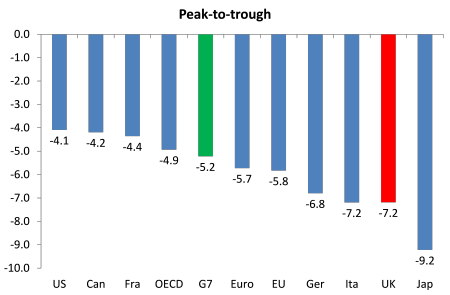
What the comparative data show is that real GDP in the UK underwent the joint-second largest contraction of the G7 economies during the 2008-09 economic downturn. Following the global financial shock, GDP in the UK fell by 7.2% between Q1 2008 and Q2 2009; this was the joint-second largest peak-to-trough fall among G7 economies. This is bigger than the fall in GDP in the G7 economies on average and bigger than in the European Union.


I think this confirms my forecast back in 2005 that if world capitalism went into a slump that the UK would suffer more than most because it was, more than any other, a rentier economy, i.e. its prosperity depended on its importance as a global financial centre where it could extract rent, interest and dividends out of the surplus value created by other economies. In the global financial crash, such economies were likely to take a bigger hit that those with a more productive base.

The drop in real GDP was even greater in Japan, which is not a rentier economy like the UK. But this was because Japan, of all the G7 top capitalist economies, is dependent on world trade, which took an almighty plunge in 2009. That other major trading economy, Germany, also dropped sharply, but by not as much as the UK. And the US, with a relatively small trade component in its GDP and not quite so dependent on its financial services sector, fell less, even though the world financial crash began there.

In the recovery period, the UK’s growth in the period following the recession has been slower than in other major economies. Average growth in the UK has also been slightly lower than that of the OECD total. Only Italy has been worse. Indeed, Italy has just stagnated at the level it reached in the trough of the GR. It is clearly the weakest of the top ten capitalist economies in the world.

Monday, 7 May 2018

Tutor2U study notes on key areas

Full page with many more study note sections at the bottom is here.

Here are some short summaries of key exam context for topical economics exam issues ahead of the June 2018 papers. We will be adding to this resource on a daily basis.

Brexit and EU/UK Trade

Importance of trade with the EU:
  • 44% of all UK exports were sold to the EU
  • 53% of all UK imports came from the EU
Trade balance:
  • UK ran a trade deficit with the EU in 2017 of £72 billion
Regional importance of trade with the EU
  • 60% of Welsh exports go to the EU
  • 59% of North East exports go to the EU
Average EU import tariffs (%) – relevant if a trade deal cannot be reached
  • Dairy products 35%
  • Cereals 13%
  • Sugar and confectionery 24%
  • Clothing 11%

Overseas aid from the UK

In each year since 2013, UK overseas aid spending has been 0.7% of GNI
In 2016, the UK spent £13.4 billion on overseas aid
Five biggest recipients of bilateral aid are Pakistan, Syria, Ethiopia, Nigeria and Afghanistan. Aid to India has fallen sharply.
Spending on humanitarian aid and supporting refugees has risen
Spending on cancelling debt is now zero
Most UK aid is project aid
  • Building antimicrobial resistance 
  • Sanitation and hygiene research
  • Forest governance to help reduce the impact of deforestation

Unemployment in the UK Labour Market

  • Unemployment continues to fall reaching 4.2% of the labour force in Feb 2018, 1.4 million people
  • Youth unemployment has declined from 20% in 2012 to 12% in 2018 (520K people aged 16-24)
  • Unemployment currently at lowest rate since 1975
  • Long-term jobless rate also declining to 1.1% of labour force (less than 25% of total jobless)
  • Estimated NAIRU has dropped to 4.5% of labour force – has the Phillips Curve flattened?
However … dig underneath the aggregate data:
  • Continued high levels of economic inactivity
  • Under-employment remains a major factor - where workers stay in part-time, temporary or zero-hours contract roles because they cannot access full-time jobs - Under-employment estimated to be above Unemployment
  • Declining median real wages and also many people who have a job experience in-work poverty and continue to rely on benefits

Youth Unemployment

Unemployment for 16-24 year olds in UK is 12%, down from 20% in 2010
This is 525,000 young people
72,000 of young people have been unemployed for over a year
EU youth unemployment rates:
  • Greece 44%
  • Spain 37%
  • Italy 34%
  • UK 12%
  • Germany 6%
  • EU average is 16%

Relative poverty in the UK

Relative poverty line for UK – households with income < 60% of median income in that year
2017 – 10.4 million people in relative low income before housing costs
That figure rises to 14.3 million after housing costs (22% of the population)
2.7 million children live in relatively poor households, 4.1 million after housing costs
This is 30% of all children
Highest relative poverty is in London (28% of individuals)

The Minimum Wage

National Living Wage (NLW) replaced the adult minimum wage in 2016
Current rates from April 2018:
  • Aged 25 and over £7.83 per hour
  • Aged 21-24 years £7.38 per hour
  • Aged 18-20 years £5.90 per hour
  • Under 18 years £4.20 per hour
  • Apprentice rate £3.70 per hour
NLW is not tied to changes in inflation
Living Wage is voluntary currently £10.20 per hour in London and £8.75 per hour elsewhere (employers can choose to pay)
Government target is that NLW must reach 60% of median earnings by 2020. It is currently at 57% of median earnings.

Sub prime credit & household debt

The UK Financial Conduct Authority is now responsible for monitoring high cost credit companies including pay-day lenders
2015 - price cap imposed on pay-day loans.
Interest capped at 0.8% per day
Default fees on a loan fixed at £15
Total cost cap of 100% of loan value in default fees and interest
Only two “roll-overs” allowed on each loan
Results:
  • Market for loans has got a lot smaller
  • Many lenders have left the market – sub-normal profits cause firms to exit
  • Loan sizes remain similar, longer repayment
  • Default rates have halved
  • Signs of shift to credit unions but some groups of consumers no longer have access to credit

Inflation

CPI inflation was 2.5% in March 2018
UK inflation was 2.7% in 2017, peaking at 3.0% in January 2018
Contrasting inflation rates in 2017 (Source: IMF)
  • Germany 1.5%
  • Cyprus -0.4% (deflation)
  • Emerging market & developing nations 4.5%
  • Venezuela 8,500% (March 2018)
  • Argentina 25% (April 2018)
  • India 4.5%
Central banks have different inflation targets
  • Argentina: 15%
  • India: 4% (+ or – 2%)
  • Kenya: 5% (+ or – 2.5%)
  • UK: 2%, Euro Zone: 2%, Japan: 2%
  • Zambia: 9%

UK Current Account (BoP)

UK ran a record deficit of 5.6% of GDP in 2016. In 2017, the deficit came down to 4.1% = £82.9 billion
  • UK trade deficit in goods: £136 billion
  • UK trade surplus in services £107 billion
  • UK trade balance in goods & services -£29bn
Current account deficit was amplified by a deficit in primary income (investment income) and secondary income (transfers)
Trade imbalances in the global economy (2017)
Current account surpluses:
  • Germany 8.2% of GDP
  • Singapore 19.6% of GDP
  • South Korea 5.5% of GDP
  • Taiwan 13.6% of GDP
Current account deficits:
  • UK: 4.1% of GDP
  • United States 3.0% of GDP
  • Rwanda 9.6% of GDP
  • Ethiopia 6.5% of GDP

The Productivity Gap

The UK continues to lag behind many other advanced economies in terms of output per hour worked. Productivity growth has been sluggish since the recession ended in 2010.
Some key factors behind the productivity gap:
  1. Low rate of investment – many UK firms do not operate at the cutting edge of new technologies
  2. Legacy effects of the banking crisis affecting lending to businesses who want to expand
  3. Slowing rates of  innovation – UK has low level of R&D spending (<2% of GDP annually)
  4. Deep skills shortages in key industries
  5. Relatively low levels of market competition – persistence of inefficient monopolies
  6. Long tail of under-performing businesses and relative absence of globally-scaled corporations
  7. Poor infrastructure e.g. in transport, telecoms and power leading to congestion & higher costs

Sunday, 6 May 2018

Sunday morning must-read on global outlook

Ambrose Evans Pritchard in the Telegraph gives a quick run through of important data, and the potential risks facing the global economy. Plenty of take-away in here - data, current conditions, forward-looking indicators, comparisons etc.

The whole world is slowing and Europe is just as vulnerable as Britain

World trade contracted in February as China cooled. It may be an early warning sign that monetary tightening by central banks is starting to bite  CREDIT:  AP
This has reduced the growth rate of the eurozone’s broad M3 money supply to 2pc (three-month annualised). It is close to stall speed. Tim Congdon from the Institute of International Monetary Research says Europe faces a “monetary cliff” when QE ends. It risks sliding back into the quagmire of 2011-2014.

A parallel saga is underway in the US where "quantitative tightening" is underway and the Federal Reserve is draining dollar liquidity at an accelerating rate. By the September the Fed will be shrinking its balance sheet by $50bn (£36bn) a month. It is also raising rates at a brisk pace, lifting the worldwide cost of corporate capital.

Three-month Libor – used to price $9 trillion of US and global contracts – has risen by 60 basis points since early February to a nine-year high of 2.36pc. This is causing international tremors. Hong Kong has had to intervene at five times in the exchange markets and is squeezing its leveraged financial system. Local Hibor rates are soaring. This will soon show who has been swimming naked in the frothy waters of the Pacific Rim.
In China, proxy indicators suggest that the true rate of economic growth dropped to 4.5pc at the start of the year as pollution controls combined with the delayed effects of tighter credit. It is why the People’s Bank (PBOC) cut the reserve requirement ratio for lenders by 100 basis points two weeks ago and signaled more to come.

The Dutch CPB index of world trade contracted by 0.4pc in February, the most recent month available. Data on US road freight volume is more recent and it is hardly glorious. The American Trucking Association says its gauge of tonnage fell 0.8pc in February and a further 1.1pc in March.

Contrary to general belief, commodity prices have been falling this year. The broad IHS index of raw materials – including items such as rubber or fibres that are free from the distorting effects of financial speculation – peaked in early January and has been sliding fitfully ever since.

Oil is rising but not because of any acceleration in world demand. Brent crude prices have spiked to a three-year highnear $75 a barrel because production cuts by Opec and Russia have at last cleared the glut. This leaves the global economy more vulnerable to supply shocks, and there are plenty of geostrategic storms coming into view.

The implosion of the Maduro regime in Venezuela is causing a collapse in oil output. If Donald Trump re-imposes sanctions on Iran in May – now highly likely – it might reduce global supply by 700,000 barrels a day within a year.

The effect of rising energy costs on a slowing global economy is toxic. Consumers in the US, Europe, China, and India enjoyed a $1.6 trillion annual windfall when prices slumped in 2015 and 2016. This year they have been hit with an $800bn headwind.

Should we worry about a possible British recession? Yes, we should. The growth rate of real M1 money (three-month) has collapsed. The Bank of England’s Governor, Mark Carney, is right to back away from a rate rise in May.
We do not yet have the full first quarter readings from the eurozone. French GDP growth slid from 0.7pc to 0.3pc. The Bundesbank says only that the German economy has slowed “noticeably”. The Macroeconomic Policy Institute (IMK) in Düsseldorf says its recession risk indicator has jumped to 32.4pc, higher than in March 2008.

My guess is that Europe will muddle through the next few months in better shape than Britain, winning the immediate beauty contest. Those who want to turn this into a larger indictment of Brexit will have a field day. But note a caveat: the UK is still imposing austerity. Europe is adding fiscal stimulus.

The IMF estimates that Britain is tightening budget policy this year by 0.3pc of GDP, based on the "cyclically adjusted primary balance". The eurozone is loosening by 0.3pc. “It could go some way to explain the UK/euro area growth differences,” said David Owen from Jefferies.

Such subtleties will be lost in the political shouting match over Brexit, just as they were last year when the eurozone’s growth rate was flattered by the closure of its post-depression "output gap". 
This year may be treacherous. “It has been an extremely long cycle and everybody is asking when the next crisis is coming,” said Garth Williams, head of credit conditions for Standard & Poor’s.

“We are at an extremely difficult stage in the transition. Central banks have been absorbing a lot of debt supply and nobody knows what will happen when they are not there anymore,” he said.

Let us hope the first quarter turns out to be an "air pocket", with global growth picking up again over the rest of the year as Donald Trump’s tax cuts feed through into the US economy.

If not, Britain will start to face its Brexit ordeal in earnest. And Europe will start to pay the existential price of its own great failure: neglecting to fortify monetary union with the fiscal machinery needed to survive the next downturn. Pick your drama.

Wednesday, 2 May 2018

Interesting visual articles on China's Silk Road initiative

I tagged on to this after reading about funding problems for various parts of the very ambitious plan - countries that are getting this new infrastructure are borrowing lots of money from China, but some are not very good at paying it back (or something like that).

the infographic-style articles are here: http://multimedia.scmp.com/news/china/article/One-Belt-One-Road/index.html

and the other article is here: http://www.scmp.com/news/china/economy/article/2141739/chinas-belt-and-road-infrastructure-development-plan-about-run

This is more about background reading - it is very interesting, but not easily applicable to the course.