Quote of the day

“I find economics increasingly satisfactory, and I think I am rather good at it.”– John Maynard Keynes
Showing posts with label currency. Show all posts

Saturday, 21 January 2023

Lenin was right (debasing the currency)...

In the days of Henry VIII, England seemed to be falling apart. There had never been so many beggars, witnesses reported, many of whom would cut your throat given half a chance. Everyone suspected, rightly it turns out, that the currency was being debased. Morals were as degraded as the coinage. At one infamous funeral in Kent midway through Henry’s reign, an observer reported that “the burial was turned to boozing and belly-cheer”, with an orgy involving “seven score persons of men, every one of them having his woman”. 

The feeling that something was not quite right was shared across Europe, which by the 1590s was consumed by financial crisis, social unrest and war. 

The root of the chaos was a wholly unexpected, and wholly unfamiliar, surge in inflation. For at least the 300 years leading up to the 1500s, western Europe made modern-day Japan look like Zimbabwe. In England in 1500 the price of a standard basket of goods facing consumers (largely food, but including other things such as clothing and light) was no higher than it had been in 1275, suggests work by Gregory Clark, a historian, and researchers at the Bank of England. All this changed after 1500.

 Sustained price inflation, once unthinkable, became unstoppable. Within 50 years average prices across England had doubled. Before long Italian prices were rising by 5% a year, research by Paul Schmelzing of Boston College suggests. In France and Holland, inflation hit 4% by the end of the century. In Russia the inflationary trend picked up from the 1530s. The global rate of inflation peaked in the 1590s at close to 3% a year. 

If 3% does not sound too painful, bear in mind that growth in nominal incomes in a pre-capitalist world was basically zero: almost any level of inflation made people poorer. Just as with today’s inflation, pundits in the 1500s furiously disagreed over the causes The inflationary surge also lasted a long time—longer, even, than the galloping-inflation era in the early 19th century caused by the Napoleonic wars, or that of the 1970s. 

Some countries suffered more than others. Scottish inflation was often a lot worse than English. Dutch inflation might have been the worst of all. Just as with today’s inflation, pundits in the 1500s furiously disagreed over the causes. Nowhere was this debate more heated than in France in the 1560s and 1570s. Jean Cherruyer de Malestroit, one pundit, played the role of Larry Summers, a former American treasury secretary, arguing that price pressure was the result of excessive spending. Jean Bodin, the Paul Krugman of his day, argued that unexpected shocks to the global economic system were to blame. Both economists wrote pamphlets attacking the other’s position. 

Historians continue to disagree. Like Messrs Summers and Krugman today, both Malestroit and Bodin had a point. Excess demand certainly played a role. The population had grown fast after the Black Death; many of those people had moved to cities. This raised demand for food even as it cut the number of farmers producing it. And some monarchs goosed the economy by manipulating the currency. 

 Henry VIII’s “great debasement” of the 1540s involved taking one gold coin, melting it down, adding worthless metal, and then recasting it as two “golden” coins. Using this method Henry plucked coins out of thin air worth about 2% of gdp in some years. Henry spent the extra cash on wars and palaces. The resulting boost to nominal demand provoked merchants to raise their prices. 

It was not just Henry, or his successor, Edward VI, who debased the currency. Scotland started doing it in 1538 and then doubled down on the strategy in 1560. In the southern Lowlands, or today’s Netherlands, Belgium and Luxembourg, the silver coinage was debased 12 times from 1521 to 1644.

 But debasement alone does not explain the great inflation, whatever Malestroit might have argued. It was not a new strategy, for one thing. It is reckoned that France debased its silver coins 123 times between 1285 and 1490. Between those years there was no inflation. And yet in the 1500s, even as many countries slowed down their debasements, they all saw inflation. Spain stopped debasing entirely from 1497 to 1686. 

Some historians, therefore, follow Bodin and say that demand-side explanations by themselves are insufficient. They also look at what was happening across the Atlantic, the source of a huge supply shock to Europe’s economy. In about 1545 people discovered vast silver deposits in Bolivia. Potosí, the centre of this lucrative new industry, became perhaps the fifth-largest city in the Christian world by population (after London, Naples, Paris and Venice). 

In the first quarter of the 1500s just ten tonnes of silver had arrived on Europe’s shores. By the third quarter of the century Europe imported 173 tonnes. Spain, where much of the metal arrived, initially experienced especially high inflation—but it then spread across the rest of Europe, as far as Russia.

 Today’s surge in inflation, only a year or so old, has already had profound social and political consequences. Consumer confidence is at rock bottom as real wages decline; incumbent politicians are unpopular; and protests about the cost of living are mushrooming. All that is peanuts, however, compared with the effects of the 16th-century inflation. 

Average real wages, which at the start of the 1500s were at the princely level of about seven pence a week, then fell, and fell, and fell. They would not regain their purchasing power until the late 19th century. The consequences of this almighty squeeze on living standards went beyond rampant beggary and orgies at funerals. 

Across Europe, society and politics became radically unstable. In a paper published in 1986 Jack Goldstone, now of George Mason University, asked why from 1550 to 1650 “states broke down on a wide scale”. In France in 1572 the Saint Bartholomew’s Day massacre involved Catholic-on-Protestant assassinations, resulting in thousands of deaths. The 1590s were years of revolt in Austria, Finland, Hungary and Ukraine. Russia experienced its “time of troubles”, a 15-year period of lawlessness from 1598. The Thirty Years War started in 1618, and the period culminated with the execution of England’s Charles I in 1649. 

In each year of the first quarter of the 1500s, about six in every 100,000 people globally died in conflict. From the 1620s to the 1640s, about 60 in 100,000 were perishing annually. The number of people tried and executed for witchcraft surged. 

Unhappy elites were, in part, responsible for the chaos. The gentry often depended on fixed payments (such as rents) for their income, and so may have experienced the effects of the great inflation more than those who could simply raise prices. In northern France and Belgium inequality fell in the 1560s and 1570s as middle-income people did fine while rich landlords were squeezed. Plutocrats, not used to economic strife, agitated for change. 

Ruff and tumble 

More importantly governments suffered. Centuries of zero or low inflation affected how they structured state finances. Monarchs often leased plots of land on fixed rents for as long as 99 years. Customs duties were held at nominal prices. This was a problem once inflation took off. From the mid-1570s to the mid-1590s Spain’s tax revenues were constant in cash terms, but they had less purchasing power. And governments’ expenses, which were not fixed, soared. In the century after 1530 the price of putting a soldier in the field rose fivefold. 

 The inflation thus, over time, contributed towards weaker states and a debt crisis. Governments did what they could to raise revenue. In 1544 and 1545 Henry VIII offloaded state assets, such as plots of land, worth over £150,000 (or more than 2% of gdp), and there were smaller sales under Elizabeth I in the early 1600s. Knighthoods were granted “in unprecedented numbers”, most for large fees, pointed out Mr Goldstone. Borrowing exploded, just at a time when many lenders were starting to raise interest rates. 

Defaults, rare in the 1300s and 1400s, multiplied, with France (in 1558, 1624 and 1648), Portugal (in 1560) and Spain (in 1557, 1575, 1596, 1607, 1627 and 1647) reneging on claims to foreign investors. Eventually, the great inflation came to an end. Population growth slowed, reducing demand for goods and services. Monarchs got a handle on monetary and fiscal policy, promising to default and debase less frequently than they used to. And the flow of precious metals from the Americas slowed. Yet the lessons from the century are clear. No matter the cause, societies which let inflation set in should expect more than just their living standards to be debased.

Tuesday, 7 December 2021

More on currency - debasement this time


When Fiat Currency Stops Being Money

TAGS Money and Banks

12/04/2021

Most emerging and developed market currencies have devalued significantly relative to the United States dollar in 2021 despite the Federal Reserve’s aggressive monetary policy. Furthermore, emerging economies that have benefitted from rising commodity prices have also seen their currencies weaken despite strong exports. As such, inflation in developing economies is much higher than the already elevated figures posted in the United States and the eurozone.

The main reason behind this is a global currency debasement problem that is making citizens poorer.

Most central banks globally are implementing the same expansionary policies of the European Central Bank and the Federal Reserve System but the results are disproportionately hurting the poor as inflation rises, particularly in essential goods and services, while fiscal and monetary imbalances are increasing.

Many emerging economies have implemented a very dangerous policy of boosting twin deficits—fiscal and trade deficits—under the misguided idea that it will accelerate growth. Now growth and recovery estimates are coming down but monetary imbalances remain.

Therefore, most currencies are falling relative to the US dollar. The policies implemented by global central banks are as aggressive or even more so than those of the Federal Reserve but without the global demand that the US dollar enjoys. If global nations with sovereign currencies continue to play this dangerous game, local and international demand for their currency will evaporate and dependence on the US dollar will rise. More importantly, if the Federal Reserve continues to put its global reserve status to the test, all fiat currencies may suffer a loss of confidence and a move to other alternatives.

If the private sector does not accept this currency as a unit of measure, a generalized means of payment, and a store of value backed by reserves and demand from the mentioned private sector, the currency becomes worthless and ceases to be money. Ultimately, it becomes useless paper.

Examples of state currencies that are neither a store of value nor a generally accepted means of payment are many. From the sucre in Ecuador, which disappeared, to the Argentine peso or the Venezuela bolivar, the examples in history are innumerable.

In Cuba inflation is now estimated at 6,900 percent due to the lack of demand for a worthless currency with no real demand or reserves to back it.

Once this sort of thing happens, the state does not create money, it simply issues a means of payment—the currency—using the credibility of private sector demand to issue its promissory note. Like a debt issuer who loses repayment credibility, the value of this promise fades if the currency does not have private backing.

More importantly, the value of the currency and its use is not decided by the government. It is decided by the last private sector agent who accepts the promise of payment because they assume that it will maintain its value and its acceptance as a medium of payment.

As such, when a government creates many more of these increasingly worthless promissory notes, far outstripping the real local and international demand, the effect is the same as a massive default. The government is simply impoverishing the citizens, who are forced to use the currency, and destroying the credibility of the value of the government’s promissory notes.

When a state creates a currency without real reserve backing or demand, it destroys money.

When the government issues currency—promises of payment—that are neither a store of value nor a generally accepted means of payment nor a unit of measure, it not only does not create money, it destroys it by sinking the purchasing power of the poor captive citizens, who are forced to accept its notes and little pieces of paper (government officials, pensioners, etc.).

This is what we are seeing in many nations all over the world, a massive salary and savings slash created by government intervention on the monetary balance to its own benefit. Governments benefit from inflation because they pay their debt in a currency of diminishing value and they impose a cut to the price they pay for wages and the services of the sectors that provide service to the issuer of currency. Even in developed nations with relatively stable currencies, inflation is a big benefit for governments that collect higher revenues from the money-based taxes (wage, profit, and sales taxes) … and a big negative for savers and real wages.

Some say that workers may benefit because wages will rise in tandem with inflation. This is simply incorrect. Wages, at best, may rise with the consumer price index, which is a very weak measure of inflation and is a basket created by government bodies to lower real inflation in an average of combined goods and services. However, even if you consider the consumer price index, the vast majority of workers do not even see a rise in wages that compensates for the index rise. That is why median real wages are falling in the United States.

Those who say that the state can always “create money and spend it”—and only has to create the money it needs to finance the public sector because it will be accepted by the rest of the economic agents—should be obliged to receive their salaries in Argentine pesos and enjoy the experience.

Author: 

Daniel Lacalle

Daniel Lacalle, PhD, economist and fund manager, is the author of the bestselling books Freedom or Equality (2020), Escape from the Central Bank Trap (2017), The Energy World Is Flat (2015), and Life in the Financial Markets (2014).

He is a professor of global economy at IE Business School in Madrid.

Thursday, 2 December 2021

Currency intervention


Turkey acts to support plunging lira for first time in seven years

Central bank intervention pushes the lira up as much as 8.5pc against the dollar after the currency plunged in recent weeks

Turkey’s central bank has intervened to support the lira for the first time in seven years after weeks of sharp falls that dragged the currency to a record low against the dollar.

Policymakers intervened in foreign exchange markets following what they called “unhealthy price formations”, pushing the lira up as much as 8.5pc.

The currency has been into freefall in recent weeks, after President Recep Tayyip Erdogan started pushing for interest rate cuts despite surging inflation in the country.

In a speech ahead of the central bank’s announcement, he said rate cuts would continue in the run-up to the elections in 2023, causing the currency to drop further.

Mr Erdogan, who has undermined the central bank’s independence in recent years,  said Turkey needed to wean itself off “hot money” from foreign investment that could be quickly withdrawn and focus on home-grown industry.

Sunday, 28 November 2021

Currency crisis?

Alex Rankine author headshot

Alex Rankine

Turkey heads for currency crisis

“CANUTE-LIKE EFFORTS” TO DEFY ECONOMIC LOGIC HAVE LED TO A CURRENCY COLLAPSE

Turkey is heading for “a vicious cycle of inflation and depreciation”, Timothy  Ash of BlueBay Asset Management tells  Tommy Stubbington in the Financial Times. With inflation running at 19.89% and the Turkish lira plummeting, there is talk of a new currency crisis. 

The lira has lost 40% of its value so far this year. As of Tuesday it had recorded 11 successive record lows against the dollar in as many days, say Daren Butler and Nevzat Devranoglu on Reuters.   

BACK TO 2018 

The latest sell-off came after the central bank cut interest rates to 15%, the third  cut since September. Interest-rate cuts reduce the attractiveness of lira-denominated assets, causing investors to sell them in favour of other currencies. At the new interest rate, savings in a Turkish bank account would earn a real return of -4.89%. 

President Recep Tayyip Erdogan continues to believe that high interest rates cause inflation, despite ample evidence – not only in his own country – that the opposite is true. He has fired central bankers who didn’t toe the line on easy money. 

“THE MSCI EMERGING MARKETS INDEX HAS FLATLINED THIS YEAR DESPITE GLOBAL REFLATION”

Things are starting to look a lot like 2018 again, when the lira “dropped precipitously amid a crisis in relations with the US”, say Jared Malsin and Patricia Kowsmann in The Wall Street Journal. 

A plunging currency is “driving up the cost of [imported] food, medicine and other essentials for average Turks”. Some commentators fear a bank run. Yet despite growing signs of discontent, Erdogan appears determined to stay the course; indeed “he has intensified his calls for low interest rates”. 

Things got so bad in 2018 that policymakers were eventually forced to reverse course with emergency interest-rate hikes, says Craig Mellow in Barron’s. That sent local stocks up by “a third in four months”. Yet few are betting on a repeat this time. 

Since 2018, “Erdogan has replaced professionals at the central bank with yes men”. Global inflationary pressures are amplifying domestic problems, while Covid-19 continues to weigh on the important tourist sector. 

EMERGING MARKETS DISAPPOINT 

Trouble in one emerging market can quickly spread to others, says Shilan Shah of Capital Economics. Investors in the asset class may panic and sell indiscriminately. Yet any such “financial contagion” is likely to be “much more limited” this time than in 2018. 

Turkey aside, most big emerging countries appear to have the foreign-exchange reserves they need to ride out any turmoil. What’s more, non-residents’ holdings of Turkish stocks and government bonds are down by two-thirds since 2018. Foreign investors won’t be panicking and pulling funds from Turkey – most of them have already left.

Saturday, 12 December 2020

Challenging read - QE, exchange rates, dilemmas


ECB adds another half trillion in QE, even as Italy eyes debt cancellation

The central bank is in effect holding the fort through the worst of the crisis and shielding vulnerable states from markets until late 2021

The European Central Bank has stepped up pandemic emergency stimulus by another €500bn to counter a double-dip recession, but stopped short of ‘shock-and-awe’ measures to reverse a corrosive slide into deflation.

Bond purchases will be stretched out to 2022,  clearing the way for the ECB to mop up three quarters of all fresh debt issuance by eurozone governments next year. This further obliterates the line between fiscal and monetary policy, and pushes the ECB’s balance sheet beyond 70pc of GDP. 

The central bank is in effect holding the fort through the worst of the pandemic and shielding vulnerable states from the markets until the EU’s €750bn Recovery Funds starts to feed through in late 2021. 

The package of measures amounts to Japanese-style "yield control", sending a message to markets that the ECB will hold down long-term interest rates across the board and for the foreseeable future, regardless of underlying credit worthiness or moral hazard. 

The policy was signalled weeks ago and has set off a speculative ‘convergence play’ as funds rush to buy southern European debt and reap quick gains on capital appreciation. 

“The ECB is telling us that their job is to keep borrowing costs as low as possible and these bonds are an absolutely safe investment. We’ve never had that kind of explicit message before,” said Marchel Alexandrovich from Jefferies. 

Yields on 10-year Spanish bonds touched zero for the first time on Thursday. Italian bonds were trading at negative yields on maturities out to five years, even though Italy’s debt has rocketed to nosebleed levels of 161pc of GDP this year and the country is implicitly insolvent.

Professor Moritz Kraemer from Frankfurt’s Goethe University said the ECB has already pushed QE long past the point of diminishing returns and that further purchases will gain little economic traction. “Its strategy has stopped stimulating credit and demand. The only thing that it is achieving now is pushing yields even lower and blowing bubbles,” he said.Any benefits may be overwhelmed by the surging euro, which is fast turning into a terms of trade shock . The trade-weighted euro index has jumped 7pc this year and is flirting with an all-time high.

This is vastly complicating the ECB’s attempts to stave off deflation, with all the destructive pathologies that come in its wake. Headline inflation has dropped to minus 0.3pc and core prices may go negative over the winter. 

Christine Lagarde, the ECB’s president, said the bank is monitoring the exchange rate “very carefully” but attempts to talk down the euro are likely to fail.

The ECB lacks the tools to fight appreciation in the face of a structural bear market for the US dollar and other currencies linked to it, directly or indirectly, including the Chinese yuan. Europe risks being the region that ends up holding the unwanted parcel that everybody else manages to pass on.

Frankfurt resisted the temptation to cut interest rates further below minus 0.5pc, knowing that Washington would deem this to be thinly-disguised currency manipulation. The Bank of Japan was warned in harsh terms when it tried to play this game.

In any case, negative rates have serious side-effects and erode the bread-and-butter business model of banks. The ECB has sought to blunt this with a technical device known as ‘tiering’ and has now extended ultra-cheap loans to commercial lenders at rates of minus 1pc for another year.  

Nevertheless, there are signs of an incipient credit crunch in Europe as the delayed effects of the Covid recession become apparent and moratoria expire. Banks have begun to choke lending. They are demanding more collateral to protect themselves from a cascade of defaults. 

The European regulator warns that bad debts in the banking system could hit €1.4 trillion, dwarfing the damage from the global financial crisis in 2008 and leaving many lenders under water.

The ECB’s blanket of QE has bought time but it has also made the system inherently more unstable. It has induced banks to feast on eurozone sovereign debt, two-thirds of it issued by their own national governments. Holdings have surged by €400bn this year to a record €1.86 trillion.

The unresolved ‘doom-loop’ of sovereigns and banks - each dragging the other down in times of stress  - is now bigger than ever. EU leaders vowed eight years ago to sort out this systemic design-flaw but lost interest after the debt crisis faded. They never completed the banking union and there is still no pan-EMU deposit insurance. 

The ECB is in an invidious position. It cannot easily stop buying Club Med bonds without risking a financial chain-reaction. Italy, Spain, or Portugal could turn to the EU bail-out fund (ESM) for support in extremis but they would not do so lightly given the conditions attached. Any move to push Italy into this sort of troika regime might destabilize the current pro-EU government and set off fresh calls for a return to the lira.

For now Germany is going along with ever more QE. It has reshuffled €140bn of its own internal debt to make the latest move easier. This sleight of hand allows the ECB to keep buying more bonds without deviating so visibly from its sacred capital key. 

While the details are abstruse, the political signal is not. Chancellor Angela Merkel has clearly opted to let the ECB continue carrying the load for the whole EMU system - faute de mieux -  even if that stores up large problems for the future. 

However, it is an open question whether this implicit strategy will pass muster at the German Constitutional Court - or the anti-elite  ‘people’s court’, as the chief justice called it after its last thunderous ruling against QE.  

There is a strange dissonance to extra bond purchases at a time when Italian leaders and politicians are calling ever more loudly for cancellation of the ECB’s existing holdings. Demands for debt forgiveness on pandemic QE come from across the political spectrum, including close aides of premier Giuseppe Conte. 

Matteo Salvini’s Lega party says the digital debt is an accounting fiction and should be wiped clean with the click of a mouse. The European Parliament’s Italian president David Sassoli is flirting with the idea. The demands have reached the front page of Avvenire, the voice of the Italian Catholic bishops’ conference.

Holger Schmieding from Berenberg Bank said the concept is lunacy and would backfire horribly. “People calling for this either don’t understand what they are asking for, or there is really something else behind it, and that is what could set off a run on the debt markets,” he said.

Legally and technically, it is the Bank of Italy that would be on the hook for most of the €550bn of Italian debt bought under the various QE schemes, not the ECB as such. One branch of the Italian state would therefore be forgiving another branch. The Italian treasury would have to issue extra debt to recapitalize a bankrupt Bank of Italy.    

Mr Schmieding said investors would see the gambit as a “trial run for a broader debt restructuring at their expense”. Risk spreads would soar and Southern Europe would be thrown back into a debt crisis.

For Italy, such a radical move would make sense only if it was part of a much larger debt restructuring and a lira redenomination. That would entail a partial default by the Bank of Italy on its €520bn of Target2 liabilities to the ECB under the principle of Lex Monetae. This would be a financial earthquake for Europe and the world. 

For the time being, the ECB is doomed to keep sinking deeper into this debt trap even though everybody knows that QE has become a disguised monetary bail-out for insolvent states. In other respects it probably has no more economic potency at this juncture than a rain dance.

Friday, 4 December 2020

Currencies & Currency Wars


Is a post-COVID currency war coming?

Emerging market currencies have surged since June.

Financial markets' euphoric reaction to the recent COVID-19 vaccine breakthroughs and U.S. election results is pushing some currencies up so fast that rumblings have begun about a potential new FX war.

Almost a decade after Brazil's finance minister likened Western central bank money-printing to economic warfare, some of the conditions that led countries to weaken their currencies then look to be forming again.

Investors' growing eagerness to buy into risky assets gave emerging market currencies their best month in nearly two years in November, stretching a run of gains that started in June.

A further extension -- seen as likely after the dollar hit a two-year low on Thursday -- would mark be their longest uninterrupted climb since 2012.

South Korea, Taiwan and Thailand are already worried enough that they have either intervened in their foreign exchange markets or taken other steps to try to prevent fragile economic recoveries being snuffed out.

In Sweden, whose crown is this year's best-performing currency, the central bank unexpectedly increased its money-printing programme last week.

"I think currency war would be a bit of a dramatic term to use right now, but you could say there have been some early warning shots," said UBS's head of emerging market strategy Manik Narain. "And if this currency strength continues, these countries could start to push back harder."

Competitive currency devaluations are blamed by economists for exacerbating the 1930s Great Depression and dragging for decades on world trade by fostering protectionism.

The cycle usually starts with tit-for-tat interest rate cuts and interventions, but can quickly escalate into capital controls or investment taxes to ward off hot foreign money like that now flooding into emerging markets.

Institute of International Finance data on Tuesday showed investors splurged a record $40 billion on stocks and $37 billion on bonds in emerging markets last month, a spree that was more than the previous three months combined.

The Mexican peso, Brazilian real, Turkish Lira, South African rand, Russian rouble and Polish zloty all jumped between 5% and 10%, adding to 5%-12% leaps in China, Taiwan and Korea's currencies since June.

Room to boom

It is not only the expectation that COVID-19 vaccines will normalise trade, travel and commodity prices driving the trend.

Low global interest rates mean developing countries are among the few places left where investors make positive returns on bonds, while the boom in electric cars and automation has seen money pour into Asia's big microchip makers.

Global trade is expected to see the first expansion next year in three years, with the hope too that U.S. President-elect Joe Biden's government will be more predictable on that front.

"If you look at the areas in which potential currency wars could break out it would be the areas which have attracted the most capital flows or the most equity flows," PIMCO's head of emerging markets portfolio management Pramol Dhawan said.

He cited Taiwan, South Korea and China as the main hotspots, and potentially India going forward. It has already stacked up $85 billion worth of dollar reserves this year, Narain at UBS added, helping keep the rupee on the leash.

Don't worry, be happy

It is usually the pace rather than the extent of FX moves that lead countries to act.

When Brazil's Guido Mantega declared a currency war had broken out in September 2010, the dollar had lost more than 10% in around three months. And it didn't stop there, falling 17% by June 2011.

This time around the greenback is down 11% in eight months. But U.S. investment bank Morgan Stanley thinks it is still 10% overvalued and Citi forecasts a record 20% drop next year as economies recover and the Federal Reserve continues stimulus.

IIF chief economist Robin Brooks doubts even that kind of move would trigger a full-blown currency war.

Taking away the 8% leap in China's yuan, EM currencies are still down 5% this year, and some of the hardest hit, like Brazil's real and Turkey's lira, are down 25% and worth a fraction of what they were a decade ago.

"Honestly, if I were an EM policymaker, every day where my currency was strengthening I would be happy," Brooks said, noting that a stronger currency also makes it cheaper to repay the dollar-denominated debt that has been piling up.

Nevertheless, he thinks the euro and the yen will be shoved higher, requiring the European Central Bank and Bank of Japan to respond. China's reaction will also be watched closely, while Thailand's statement that it is watching the baht's rise "24 hours a day" highlights the building tensions.

"Our concern is the speed of the adjustment," Thailand's central bank governor, Sethaput Suthiwart-Narueput, said last week. "It has been largely nothing to do with us".

(Reporting by Marc Jones and Elizabeth Howcroft; Editing by Catherine Evans)


Copyright (2020) Thomson Reuters. This article was written by Marc Jones and Elizabeth Howcroft from Reuters and was legally licensed through the Industry Dive publisher network. Please direct all licensing questions to legal@industrydive.com.

Monday, 6 February 2017

Long and short term credit cycles

This is one for those who really like to be challenged, and who want a really high grade; it's core thesis is not difficult, and is what we have just covered - during a long credit cycle we borrow, spend, and build up debt; when it gets a bit much we slow our borrowing. As we slow our borrowing, the central bank cuts rates to boost consumption - but (and here's the bit that you can use), we're still in debt from the first round, so rates have to go lower in order to drive borrowing and spending. The next time we slow down, we have MORE debt, so rates have to go even lower, and this process continues through "short" credit cycles, until we get the daddy of all blowouts - which we are in the process of trying to work our way through now.

There is a lot in here, and if you do read it it should give you a sense of satisfaction, and some useful material for essays. At the very least, when the next crisis comes, and they ask who saw it coming, you can put your hand up and say: "Me!"

Conventional economic “wisdom” fails to understand the role of credit/debt in our market based system.

Mainstream economics completely neglects to understand not only credits affect on demand, but also how this credit demand fluctuates in both short and long-term cycles. A debt cycle is simply the logical progression of large economic sequences that follow a certain order. These sequences arise due to predictable human nature and the inherent structure of our monetary system.

Here’s a quick overview of how the economic machine and debt cycles work: 

The economic machine starts with money, or more specifically, what we think of as money; which is cash + credit. Mainstream economics tends to focus solely on physical hard cash. But it is credit that makes up the majority of transactions in the world. In the US, the supply of physical cash amounts to roughly $3 trillion. But total credit is near $60 trillion. Most buying (demand) is through credit, not cash. It’s important to know this because though many people mistakenly think of credit as cash, the two actually work very differently. And it’s this difference that has compounding second and third order large scale effects.

You see, when you buy something with cash, you exchange that cash for a service or good. The transaction is closed. Complete. There is no further obligation between the two parties. 

When you buy something with credit, you exchange credit (a promise to pay in the future) for a good or service now. That transaction is not complete until the borrower pays off that debt. So in this instance, credit or money is created out of thin air, without the help of the central bank or US treasury. 

All you need is two willing parties and credit (money) can be created. An asset to the lender is created, as well as a liability to the debtor, that lasts until the transaction is closed by the debt being repaid. It is this ability to create “money” independently through credit purchases that compounds over time and builds cycles. And it is these credit cycles that drive the economic machine. 

 There are three primary forces that drive the economy over time. These are: 


 (Charts via Bridgewater “How The Economic Machine Works”) 


 Long-Term Productivity Growth 

Over time, the economy (real GDP per capita) averages 2% growth. This is the result of efficiency gains born from the accumulation of knowledge — we become more productive over time. It’s this steady build up of knowledge (advancements in our technology and know how) that drives productivity and results in the continuous improvement of our living standards. 

 Many of us love to be pessimistic about the current state of the world, complaining that “things were so much better back in the day”. But were they? Truth is, we as a society have it pretty good when compared to the generations before us. 

But we are interesting creatures. We’re not satisfied with just a 2% average increase in living standards. We base the quality of our lives in comparison to those around us (usually those who are wealthier than us). And in addition to our instinctual pettiness, we’re actually neurologically wired with the propensity to live beyond our means. 

Jason Zweig explains this phenomena in his excellent book Your Money and Your Brain: How the New Science of Neuroeconomics Can Help Make You Rich: “You would expect logically that the borrowing and spending of money would be emotionally painful to people because having money is intrinsically a good thing, and having less money would have to be worse… Going from more money to less would be painful. When people borrow and spend money, it’s really the reward centers of the brain that become activated… When you borrow money, you are thinking not about the long-term consequences but the short-term result: You have more cash in your pocket. The pain you are going to experience down the road of having to pay — that’s in the future, it’s remote, it’s abstract.” 

 So credit is like a drug… we’re addicted to shots of dopamine that we receive every time we purchase something. We are literally programmed to overvalue present rewards and greatly underestimate future costs. 

Credit allows us to delude ourselves into thinking we can outpace this 2% trend. But in the long run we can only consume (spend) as much as we produce (earn). When we spend more than we earn we create bad debts — debts that will not be repaid. The way we’re wired and the structure of our credit system clashes with the limits of our average long-term productivity growth. This irreconcilable difference creates cycles. These cycles, that oscillate around the 2% productivity trendline are called debt cycles. They’re comprised of leveragings and deleveragings of debt/credit. 

 A debt leveraging occurs as we increase our debt spending over time (total debt load relative to income). By doing so we pull future consumption forward while causing temporary increases in productivity above the 2% trendline average. Eventually these leveragings reach a saturation point where debt servicing costs relative to incomes grow too large. They begin to hamper demand growth. When that point is reached, the economy will begin a deleveraging. 

In a deleveraging, we fall below the 2% productivity trendline. The chart below (again, via Bridgewater) shows the overlay of all three forces over the last 100 years.  


These leveragings and deleveragings are the result of the long-term and short-term debt cycles. 

The Short-Term Debt Cycle 

The short-term debt cycle (otherwise known as the business cycle) is fairly well understood, since it tends to occur every 5-7 years. These short-term cycles result from the easing and tightening of money by the Federal Reserve Bank. 

Here’s a quick rundown of what happens when the Fed eases (lowers interest rates). The three immediate impacts of lower interest rates are: 
1.New credit becomes more attractive, so people and businesses borrow more money. 2.Existing debt becomes cheaper to service, since its interest payments are now lower. 3.The discount rate at which businesses and financial assets are valued is lowered (a lower discount rate increases present value, making an asset more attractive). Investors then bid up these assets, moving further out on the risk curve, causing spreads between financial instruments (ie, cash, bonds, equities) to tighten. 


The beautifully hand drawn chart above shows the spread between financial assets. When spreads widen (higher interest rates), risk premiums go up and investors get more return for assuming risk. And when spreads tighten (lower interest rates) the risk premiums go down and investors get less return for assuming risk. 

Cheaper debt increases borrowing and boosts demand. People and businesses borrow and spend more. And since one person’s spending is another’s income, incomes rise, further driving demand. Increasing demand inflates asset prices (ie, homes, business, stocks etc.). 

When asset prices rise, people’s net worth rises, as well as their credit profiles. This allows them to borrow more. And since we’re strongly affected by recency bias and myopia, we extrapolate this current income growth into the future. We expect it to continue and borrow even more. This is a reflexive process. Increased borrowing raises demand which drives up incomes and inflates asset prices. Higher asset prices result in stronger credit profiles which lead to more lending/borrowing. A positive feedback loop is created. 

This process goes on until rising demand bumps up against productive capacity and we get demand-pull inflation. Productive capacity is the limit of what an economy can produce. 

Credit demand can be created much faster than what an economy can realistically support. When this happens, inflation begins to accelerate because there’s more demand than what suppliers can handle. Too much money begins chasing after too few goods (which drives up prices). The result is demand-pull inflation. One of the Federal Reserve’s mandates is to regulate inflation. So when inflation begins to rise, the Fed is forced to raise interest rates. Once they do, the feedback loop goes into reverse. 

The cost of debt increases due to higher interest rates. This causes money to tighten and demand to fall as people and businesses borrow and spend less. And since one person’s spending is another’s income, incomes drop, further decreasing demand. The fall in demand causes asset prices to drop which lowers the credit profiles of borrowers, resulting in less lending. The discount rate rises and widens the spread between financial assets (ie, stocks and bonds sell off and become less attractive)… and on and on it goes. 

Until the Fed cuts rates once again. But this time, since debts are now higher than they were when the Fed previously lowered rates (meaning more income has to go to debt servicing), the Fed has to cut interest rates even lower than they were before. 

You can see this logical sequence of events in the chart below. It shows the Fed Funds Rate over two short-term business cycles. Debt Cycles From 99’ to 00’ the Fed raised interest rates until demand and asset prices started to fall and the economy went into recession. 


The Fed then quickly cut interest rates to a point lower than the previous cycle low. 

The short-term cycle repeated itself again in 04’ to 07’, when the Fed raised rates to subdue inflation. But interest rates were raised to a lower point than the previous cycle. And then in 08’ the Fed was forced to lower them again to fight off recession — and they were dropped to a new secular low. 

Short-term business cycles repeat over time. Each time, interest rates move lower. Interest rates have to move lower because debt (and the costs to service it) keep on rising, in both the public and private sector. 

This sequence continues until rates cannot be lowered any more (they reach zero or negative). This is the point at which a pivot in the long-term debt cycle takes place. 

 The Long-Term Debt Cycle 

 Longer term debt cycles are not well understood by the public. This is because they operate on a longer timeframe (hence the name). The cycle only becomes very noticeable at transition points, which generally occur once every generation, about every 25-50 years. 


Looking at the chart above, you can see the long-term debt cycle at work. Interest rates peaked in 1920 and then turned over and began trending lower (which led to the roaring 20’s). 

They bottomed out in the 30’s – 40’s before trending higher again for the next 40 years. In 1981 they peaked again and have been trending lower ever since. 

Total debt accumulates over the long-term as shown in the chart below. 


You can see two debt mountain peaks. One in 1929 where total debt peaked at 260% to GDP. And then the peak today where debt is at 380% to GDP. 

Most people focus on public debt (debt owed by the government) at the exclusion of private debt (debt owed by households and corporations). This is wrong. Though public debt is important, private debt is the primary driver of debt cycles. Private debt is where the demand comes from that propels the economy. Also, governments can more easily manage their debt by monetizing it through central banks. 

Unfortunately, the private side doesn’t have this option. The accumulation of debt cannot go on ad infinitum. The reason being that eventually interest rates cannot be lowered any further to keep things going. They reach the zero bound and no amount of credit easing can induce people to borrow and spend more. Accumulated debt levels become too high and the servicing costs too large. The credit system literally becomes maxed out. And that’s a summary of the role that both short and long-term debt cycles play in markets. It’s a significant one… especially at the turning points.


And this is where we are now. We’re at the turning point of the long-term debt cycle. The last time we were here was in the 1930’s… the Great Depression.
Interest rates across the majority of the developed world are now at or below zero. There is over $7 trillion in negative yielding debt! $7 trillion dollars! This is not how a true capitalistic system should work. But it’s exactly how our current system is expected to work.
Global Negative Bond Rates
One thing that is different this time around versus the 1930s is that the global economy on a whole is much… much… much more leveraged. In fact, the world has never had as much debt relative to GDP as it does now… not even close.
Global Debt Levels
The deleveraging that everybody thought was happening in 2009 was just kicked down the road to today. This was possible because there was still room for interest rates to fall to squeeze a bit more credit demand into the system.
Now, with rates at zero and the efficacy of quantitative easing maxed out, the can cannot be kicked any further.
Since 2009, both the developed and developing world have seen their debt-to-GDP levels rise on average by 35%. A report done by Mckinsey last year suggested the world had added an additional $57 trillion of new debt since 08’ — a figure which is undoubtedly higher today.
In 2009, China and emerging markets were the key to boosting global demand to help stave off a global depression. But this time around they’re a major part of the problem.
Over the last seven years, China has seen its debt-to-GDP level increase from 160% to over 250%. Their total debt accounts for over half the debt of the developing world. It’s estimated that China is adding to this debt at the rate of $6-7 trillion a year. You may be thinking “well, maybe this credit is being invested in high-return projects”, but you’d be wrong. Our estimates (and those of others) have well over half of China’s new debt issuance in the last few years going to pay interest on existing debt!
It appears the Chinese truly believe in the maxim, “a rolling loan gathers no loss”. We’ll see how long they can keep that up…
Economist and central bankers have been scratching their heads as to why global growth has been so sluggish and inflation so difficult to create. Well if they just understood the dynamics of the long-term debt cycle as I’ve described to you here, it wouldn’t be such a mystery.
This oppressive level of debt is pulling current demand lower through debt servicing costs. The lower demand combined with an economy that has a capacity glut (built on credit) results in deflation. The kind of deflation that will take a decade to work through.
What about Piketty? Is he right? Are our current woes the result of capitalism being a broken system? Not exactly…
The fuss over income inequality and the strain it puts on our society is a definitely real. Income inequality has been steadily increasing since the late 70’s. You can see this on the chart below.
Wealth Gap In US
But income inequality is not due to return on capital outpacing the rate of growth (meaning the return on invested money outpaces real growth; the rich get richer faster than the overall growth of the economy) as Piketty argues.
This is a correlative link, not a causative one. Return on capital has been outpacing the return on growth over the last 45 years because of the long-term debt cycle and the continuous lowering of interest rates by the Fed. Remember, interest rates have been steadily falling since 1981 (right when income inequality began rising).
The rich are richer because they own (mainly through credit) more assets (ie, financial, property, business etc). These assets have been inflated on the back of credit/debt growth over the course of the leveraging part of this long-term debt cycle.
Knowing this, it should be of no surprise that some of the people we think of as super-rich are in reality not very wealthy at all, meaning their assets don’t outweigh their liabilities. They just have access to far more credit than most people. They’re drowning in debt… cough… Kanye… cough.
Celebrity Debtor
And it’s not just Kanye… over the last 35 years, we as a society have pulled a lot of future consumption forward. We’ve been enjoying the future fruits of our labor today, by going crazy for those shots of credit induced dopamine. We’ve mistaken increasing debt for rising prosperity. But now the future is banging on our door demanding we pay our bill.
Bill Gross of Janus Capital commented on this in his recent investors letter (emphasis added is ours):
“What readers should know is that the global economy has been powered by credit – its expansion in the U.S. alone since the early 1970’s has been 58 fold – that is, we now have $58 trillion of official credit outstanding whereas in 1970 we only had $1 trillion.”
A 58 fold increase in credit in just under 50 years is a huge leveraging. This build up in debt is going to have a large impact on the US and the world moving forward. It’s going to affect everything from growth, to living standards, to domestic politics (ummm… Trump & Sanders), and geopolitics (ie, international conflict).
Think of the period following the 30’s. We are likely in for some interesting times ahead.
This is what’s going to happen going forward
We are at the beginnings of both a secular (long-term) and cyclical (short-term) deleveraging. And this is happening all around the globe.
This short-term deleveraging cycle began last year. That’s why volatility has come back in force. What many people (including central bankers) don’t realize is that the Fed has already tightened by over 3.25%, far more than just the 25bps hike from last December. This is because of the easing effect of QE and the tightening that resulted by ending it in October, 2014. This tightening effect can be seen in the Shadow Federal Funds rate (ironically, created by researchers at the Fed).
Wu-Xia Tightening
This hiking cycle is now likely over and the Fed’s next actions will be to cut — but they won’t be able to cut much because they’re straight outta ammunition (hence why we’re at the transition point of the longer-term cycle).
The tightening effects of the Fed’s rate hikes take a while to work their way through the economic system. You can expect further volatility and evaporating demand as the effect of these increased rates is felt, while at the same time the deleveraging picks up steam.
Remember, deleveragings are the destruction of demand. Falling demand means lower asset prices — creating that deflationary feedback loop. This is why commodity prices have been cratering since 2014. And this is why they will continue to fall over the coming year.
Commodity Crash
At this point, traditional monetary easing has become equivalent to “pushing on a string”… it’s just not working. Negative rates don’t work, and in fact, they have a net-negative impact on lending and demand. Central bank policy aimed at getting investors to assume more risk has contracted spreads as tight as they’ll go. So we can expect negative real-returns over the next decade.
The only option left for many central banks is the route they’ve taken EVERY SINGLE TIME throughout history when faced with a secular deflationary deleveraging. And that is: unorthodox monetary policy. Otherwise known as straight up debt monetization through haircuts/restructurings and inflation.
Since debt deleveragings are a deflationary force, the central banks need to create enough of an inflationary force to counteract it. They need to monetize the debt (using inflation to devalue it) so nominal asset prices remain somewhat stable as borrowers are relieved of their debt burdens. The goal is to keep nominal GDP above nominal interest rates. Keeping nominal growth above the nominal cost of debt allows debt to be properly monetized over time.
This will be accomplished through more quantitative easing and something akin to a “helicopter drop”, where the government does a wealth transfer and assumes a lot of private debt. If this is carried out perfectly (and that’s a BIG “if”), where inflation is created in just the right amount to counteract deflationary pressures, then we’ll have what Dalio calls a “beautiful deleveraging”.
A beautiful deleveraging is the least-worst option (the others being a deflationary deleveraging and a runaway-inflationary deleveraging like 1930s Weimar Germany).
There is no easy way out of this. A beautiful deleveraging will still be very painful and is not easy to carry out. This is a point that many fail to understand. You can’t just raise interest rates right now. It’s toolate. It would result in a deflationary deleveraging — which is the most painful option of all. We have over a generation of debt built up. Much of which is just bad debt. It’s worthless and will not be repaid.
This long-term cycle of debt accumulation and then debt monetization is so ingrained and prevalent throughout human history, that even the Bible talks about having a year of “Jubilee” every 50 years, where all debts are all wiped clean.
Well, our global jubilee is upon us. But unlike biblical times, creditors will not willingly forgive debts out of the goodness of their hearts. The debts will be forgiven in the most opaque way possible, so we can all still remain in denial of the reality of our monetary system. The debt will be inflated away through the devaluation of currencies.
But the inflationary period caused by this devaluation will not start for another couple of years, at least not in the US. There are two primary reasons for this:

  1. The Fed does not understand the secular dynamics at work. They’re committed to maintaining their credibility by following their planned rate hikes — of which they will be lucky to get even one more in.
  2. Because of the Fed’s mandate and the current political environment, they will not have the political capital to enact unorthodox monetary policies until things get very… very… bad.
We are at the very start of that very bad part. Despite recent volatility, US financial assets are still near record high levels. Markets are in the beginning stages of rectifying this valuation discrepancy and are about to get knee-capped back down to earth (or their 2008 lows).
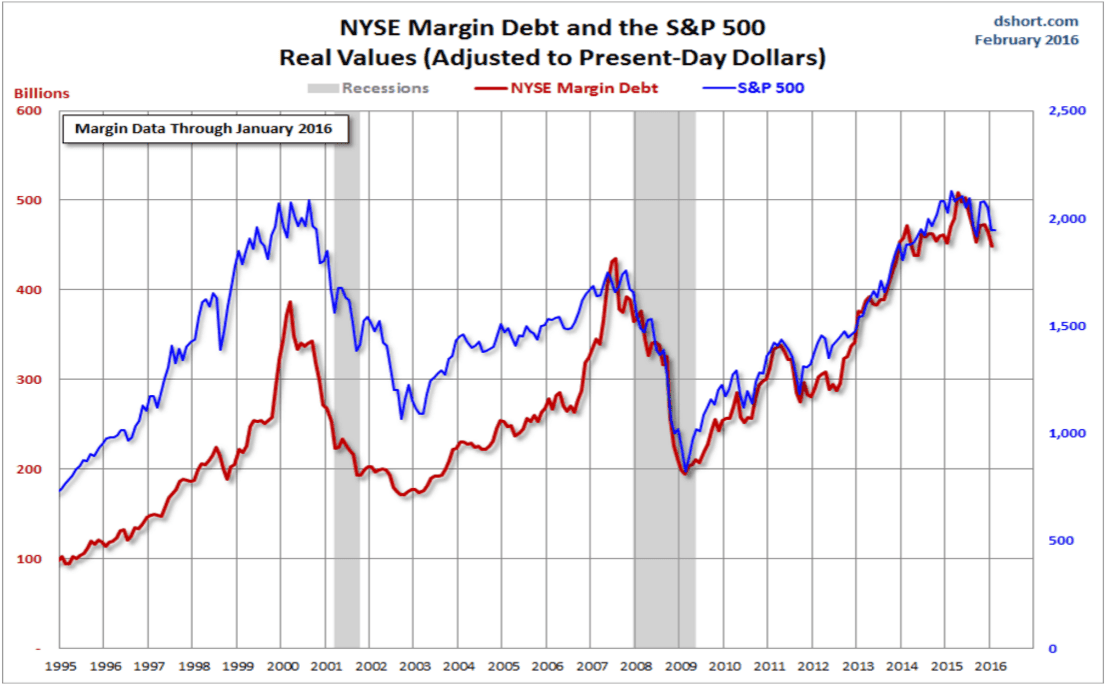
The chart below shows the inflation adjusted S&P 500 overlaid on NYSE margin debt. This margin debt (most stock buying is done with debt) is starting to unwind (from record high levels). This has preceded the last two market crashes and is flashing signs of the next one, soon to come.
Margin Reduction Sign Of Coming Crash
An interesting side note: It is the buying of financial assets on margin (with debt) that creates massive amounts of instability and liquidity issues within markets. Margin buying increases as markets rise. Players become more leveraged as equity valuations become more unsustainable. When the cycle turns, you have a lot of margin-bought-securities trying to squeeze through a narrow exit at the same time. Selling begets forced selling and so on. (Pay attention and you’ll notice how “reflexivity” as described by George Soros, is a recurring part of the inherent nature of markets and economies.)
Credit markets, which serve as the canary in the coal mine to the broader economy, have been sounding cries of warning for some time. And as yields creep higher, liquidity is squeezed, and we quicken our march towards the proverbial cliff.
High Yield Debt Rates
The US dollar will grow stronger during the beginning stages of this global deleveraging.
There is over $12 trillion in outstanding USD denominated debt held outside of the US. This is the result of a popular carry trade driven by the Fed’s loose monetary policy. USD debt is essentially a short position on the dollar (as the dollar falls, USD debt becomes cheaper to service).
The trade worked well when the dollar was weakening, but now that its strengthening, companies and other institutions have an incentive to pay off their debt faster than before to avoid rising servicing costs. To pay off that debt, the debtors have to trade their currency for dollars. This boosts demand for dollars, which raises USD value compared to other currencies. It turns into a reflexive process that goes on and on.
We’re only in the middle of this dollar move. It’s been experiencing an expected and healthy retracement that will continue over the next month as weak hands get shaken out, but it will get back to its bullish trend very shortly.
Bullish Dollar Trend
Since the dollar is the reserve currency of the world, a strengthening dollar impacts global assets in interesting ways.
First, all commodities are priced in USD. So when the dollar rises, it acts as a weight on commodities. It is no coincidence that the dollar bull market coincided perfectly with the collapse in oil. Historically, the dollar accounts for 30-50% of the larger trend in oil.
It is our understanding of this correlation that allowed us to anticipate and profit from the collapse in oil and other commodities that began in 2014. And it is also this understanding that leads us to believe that the fall in commodities is not yet over.
We predict that oil won’t bottom until it hits the teens. The carnage won’t stop until there’s blood in the oil streets. Though things are bad in the oil patch now… they are going to get much worse.
And for you gold bugs out there, the recent rally in gold is an epic bull-trap. The dollar has macro drivers equivalent to an Atlas-V rocket and liftoff is just beginning. Since gold is priced in dollars, it cannot maintain a bullish rally while the dollar stays strong. This is why the gold rally will be short-lived.1
There will be a time to own gold, but that time won’t be for at least another year when dollar inflation really kicks in through the “unconventional monetary policy” we discussed before.
As the world’s reserve currency (USD) strengthens, it acts as a monetary tightening on the rest of the system. This is because, as we discussed, the world is net-short dollars since it is a large funding currency. So when the dollar rises, it sucks liquidity away from credit markets around the world. This further spurs deflation, driving asset prices and markets lower (which is why emerging markets have fallen into the crapper).
The beginnings of the next global crisis have already been put in motion. It’s inevitable and cannot be stopped. It can only be managed.
The crisis will begin in Europe, where banks have admitted to holding over $1 trillion in non-performing loans — we believe the actualnumber to be much higher. The western European continent is awash in bad debt and saddled with a bloated bureaucracy that is ill-equipped to handle the coming storm. Look at the state of Ireland in the charts below… I mean, Dear God… how did that happen?
Irish Debt Problems
The coming crisis will lead to the slow fracture and breakup of the European Union as we now know it.
Countries like Greece, Ireland, Italy, Portugal, Spain, and possibly even France (though many believe it impossible) will be found insolvent. The euro will continue to fall which will boost the dollar even more.
This rising dollar will force China’s hand into floating the Yuan to manage their exports, bad debts, etc. This contagion will spread across the world, as developing countries from Brazil to South Africa try to do the same. They will likely all lose control of their currencies a la 1997 asian financial crisis… but this time on steroids.
This will cause the deflationary tidal wave (which we discussed in the first Horseman piece) that will crash upon US shores in the coming year.
Jim Rogers, legendary investor and former partner of George Soros at the Quantum Fund, recently said in an interview that there “is a 100% chance of a U.S. recession within a year.” He also discussed various drivers causing the start of a bubble in the dollar.
We couldn’t agree more. We predict the US will start a recession in the fourth quarter. And the dollar will be significantly higher than it is today by the end of the year (after a quick retracement in the near-term).