Quote of the day

“I find economics increasingly satisfactory, and I think I am rather good at it.”– John Maynard Keynes

Thursday, 13 December 2018

Inflation targeting - Y13


Silent Inflation

 
Inflation targeting is supposed to reduce uncertainty about prices. But keeping the inflation target at 2% or more, might actually increase a sense of uncertainty about real things like home values or investments.
NEW HAVEN – In many countries, inflation has become so low and stable in recent decades that it appears to have faded into the woodwork. Whereas galloping inflation was once widely viewed as the number one economic problem, today most people – at least in the developed countries – hardly ever talk about it or even pay attention to it. But “silent inflation” still has subtle effects on our judgment, and it may still lead to some consequential mistakes.
Since New Zealand’s central bank set the first example in 1989, monetary authorities around the world have increasingly pursued a policy of setting inflation targets (or target ranges) that are substantially above zero. That is, policymakers plan to have inflation, but steady inflation. What used to be a dirty word is now announced publicly, and moderation is enforced.
Central Bank News tabulates these targets for 68 countries. The European Central Bank targets annual inflation in 2018 at “below, but close to, 2%.” In Canada, Japan, South Korea, Sweden, the United Kingdom, and the United States, the 2018 inflation target is 2%. China and Mexico target 3% annual price growth. In India and Russia, the target rate is 4%. It is 5% in Ukraine and Vietnam, and 6% in Azerbaijan and Pakistan.
Some countries have had double-digit inflation targets. Egypt has set a target of 13%, plus or minus 3%, for this year. But most countries have set their 2018 inflation targets at between 2% and 6%.
It is worth translating these annual inflation targets to longer-term inflation, assuming that the target is not changed in coming years. Inflation of 2% per year implies 22% inflation over a decade, or 81% inflation over 30 years. That will make numbers measured in currency look a lot bigger over time, even if nothing real is changing.
It is a lot worse if one considers a 6% inflation rate. At that pace, prices would rise 79% in ten years and almost six-fold in 30 years.
 Such policies cause a sort of magnification of the present in the minds of most people. Suppose you ask someone who has been living in the same house for 30 years what he or she paid for it. The purchase price will probably look ridiculously small. If one is not careful to remember the effects of inflation on all prices, it might seem that we are living in a magnificently successful new era. With silent inflation, it can be easy to forget that the truth is much less dramatic.
At the same time, in an age of Internet rumors and fake news, the world today can look a little unmoored from history. That might create a sense of real risk.
Inflation targeting has other effects, too, which seem to be more on the minds of central bankers.
In his influential 1998 book Inflation Targeting, Ben Bernanke and his co-authors advised policymakers to announce a target inflation rate because it “communicates the central bank’s intentions,” which would “reduce uncertainty.” The announced rate should be substantially positive, they wrote, because if officials tried to get it close to zero, any mistake could result in deflation, which “might endanger the financial system and precipitate an economic contraction.” As Federal Reserve Chair from 2006 to 2014, Bernanke formally introduced inflation targeting in the United States in 2012, setting the annual rate at 2%, where it has remained ever since.1
But reducing uncertainty about prices by keeping the inflation target at 2% or more might actually increase a sense of uncertainty about real things like home values or investments. While it is right to worry about massive deflation, the historical relationship between deflation and recession is not all that strong. In a 2004 paper, the economists Andrew Atkeson and Patrick Kehoe concluded that most of the evidence of a relationship comes from just one case: the Great Depression of the 1930s.
The news media’s tendency to fixate on new records serves their short-term interest in creating the impression that something really important has happened that justifies readers’ or viewers’ attention. But sometimes there is a bit of fakery in the record, especially when the record is described in nominal terms and we have steady inflation. As a result, the emphasis on records can encourage a disrespect for history and nurture a sort of disoriented feeling that we live in exceptionally uncertain times.
For example, sometimes the stock market has set a new record, whether up or down, which is nothing more than the result of inflation. On February 5 of this year, the Dow Jones Industrial Average fell 4.6%, far below the record 22.6% decline on October 19, 1987. But media reports chose to point out that the February 5 drop was the biggest-ever one-day decline in absolute terms (1,175 points on the DJIA). Presenting a drop this way is misleading, and might encourage some panic selling. The amplitude of stock-market point swings invariably grows with general inflation in all prices.
The money illusion even bleeds into impressions of the “strength” of the economy, as if a high level of GDP growth or a bull market are indicators of the health of something called the economy. GDP growth numbers are conventionally reported in real (inflation-adjusted) terms, and unemployment numbers are unit-free. But reporting of just about every other major economic indicator is generally not corrected for inflation.
An inflation target of a few percentage points may seem to promote stability, and perhaps it really does. But we need to consider the possibility that it may lead to subtle misperceptions that have the opposite effect on the stability of our judgments.
Writing for PS since 2003 
123 Commentaries
Subscribe
Robert J. Shiller, a 2013 Nobel laureate in economics, is Professor of Economics at Yale University and the co-creator of the Case-Shiller Index of US house prices. He is the author of Irrational Exuberance, the third edition of which was published in January 2015, and, most recently, Phishing for Phools: The Economics of Manipulation and Deceptionco-authored with George Akerlof.

Tuesday, 11 December 2018

A biting critique of monetary policy

The Mises Institute is named after Ludwig von Mises, a leading thinker of the Austrian School. You do not need to know about Austrian economics (it is way too liberal for the current crop of exam syllabi), but this short article gives some key material as to why monetary policy, seen from a distance, is flawed through and through:

Europe Struggles as the ECB Pretends to Know What It's Doing

The European Central Bank (ECB) is rumored to be planning a halt  to its four-year quantitative easing program at the end of this week when it will stop its asset purchases while continuing to keep interest rates at current near-zero levels through 2019. The Economist laments this ‘rash’ decision, arguing that the European economy is still ‘faltering’, showing only very feeble and unstable signs of growth.
Since 2015, the ECB has bought bonds worth almost $3trn. However, core inflation has remained fairly low, exports have waxed and waned, and the Euro area has shown no clear signs of recovery after the 2008 financial collapse. Groping in the dark, The Economistblames “[p]oor weather, strikes and a bad flu season” for the shaky start of 2018, and low demand, both domestic and foreign, for the overall bleak outlook.
But in fact, the European economy is a very sick patient whose self-appointed doctor, the ECB, is treating it with the same poison that made it ill in the first place. It is also judging the health of its patient by monitoring the wrong signs, i.e. looking for some color in its cheeks rather than a strong heartbeat.
Mises (2009, 20) pointed out as early as 1934 that
[…] the inevitable and ineluctable consequence of the expansion of credit… was bound to lead eventually to a collapse. And the thing which is chiefly advocated as a remedy is nothing but another expansion of credit, such as certainly might lead to a transitory boom, but would be bound to end in a correspondingly severer crisis. 
Underlying the current sluggish performance of the European economies are the malinvestments prior to the 2008 collapse that were not allowed to be purged through the normal market process, and all the malinvestments brought about by the rounds of QE undertaken since then. Capital goods erroneously invested in more roundabout processes during the boom and after the bust remain locked in unproductive purposes. The suffocating regulations the EU is known for have only made it harder for entrepreneurs to salvage some losses from the crisis and embark on new and actually productive endeavors. As Mises (2009, 364) explained,
Economic goods which could have satisfied more important wants have been employed for the satisfaction of less important; only in so far as the mistake that has been made can be rectified by diversion into another channel can loss be prevented.
It’s nothing unexpected to see the Euro economies struggling to regain any strength. The blame lies with monetary policy. As much as The Economist tries to put a positive or even glamourous spin on central banking—by referring to it as an ‘agonizing’ task, requiring ‘soul-searching’ and ‘keeping the faith’—they only manage to underscore a rather embarrassing truth: central banking is just old-fashioned tomfoolery. Forecasts on which policy decisions are made are vague at best and epistemologically flawed, while the experts are groping in the dark with only a minimum knowledge of economic truths. Add politics to the mix—for no central bank is really independent—and you’ve got an institution that is both inept and dangerous.
As always, it is worth coming back to Mises’s poignant analysis (Mises 2009, 21-22) unfortunately ignored for almost a century now, and instead of awaiting recovery, rather prepare for a bust in the future:
Recurring economic crises are nothing but the consequence of attempts, despite all the teachings of experience and all the warnings of the economists, to stimulate economic activity by means of additional credit. […] And although the conclusion to which my investigations lead, that expansion of credit cannot form a substitute for capital, may well be a conclusion that some may find uncomfortable, yet I do not believe that any logical disproof of it can be brought forward.
For a more light-hearted take on the issue, you can spend a few minutes playing the ECB’s game, €conomia, which I believe approximates very well, in its simplicity, the actual work of a central bank. As you can see below, I made it to ‘central banker of the year’ on my first try, after choosing some values at random.
Ironically, they tell you you’ve ‘struck gold’. If only.
haha.jpg
Dr. Carmen Elena Dorobăț is a Fellow of the Mises Institute and assistant professor of business and economics at Leeds Trinity University in the United Kingdom. She has a PhD in economics from the University of Angers, and is the recipient of the 2015 O.P. Alford III Prize in Political Economy and the 2017 Gary G. Schlarbaum Prize for Excellence in Research and Teaching. Her research interests include international trade, monetary theory and policy, and the history of economic thought.

Saturday, 24 November 2018

Lots of good Macro(n) in this:

Emmanuel Macron, the French president, presents himself internationally as a bold statesman – yet his much-needed domestic reforms are remarkable for their timidity, says Frédéric Guirinec.
Last weekend was a good one for Emmanuel Macron on the world stage. The French president’s speech at a ceremony in Paris to mark 100 years since the end of World War I, in which he warned of the dangers of nationalism, won him praise in much of the international media. His reputation as a global statesman got a significant boost – helped by the contrast with US president Donald Trump, who was mercilessly mocked for missing a memorial visit to an American military ceremony in France the previous day because it was raining too hard.
At times like this, Macron, who is just 40, often manages to look like the leader Europe – and the world – will need for the next couple of decades as German chancellor Angela Merkel comes to the end of her time in power. But domestically, it’s a very different story. Just three days before his speech, Macron was booed by workers at a Renault factory as he tried to defend his economic policies. The previous day, he was criticised for praising Marshal Pétain, the World War I general, as a “great soldier”. Pétain’s reputation was irreparably sullied when he later headed the Vichy government that collaborated with Germany in World War II. At the end of October, his decision to take a few days off for a break in Normandy led to speculation that he was burning out under the pressure of the job (rumours that seemed entirely credible given that he is reported to be an obsessive micromanager who sleeps just four hours a night). Next weekend, he faces nationwide protests that aim to bring traffic on motorways to a halt over high fuel prices.
His approval ratings are dire: just 21% of voters said they have confidence in him in one poll last week – less than François Hollande, his hapless predecessor, at the same stage of his presidency. And his En Marche party has slipped behind the far-right Rassemblement National (RN – formerly the Front National) in opinion polls for next May’s European elections. France is disenchanted and discouraged with its president, once again. So why has the new man who promised to transform a sclerotic and over-taxed French economy failed to deliver?

Meet the new boss, same as the last boss

The simple answer is that Macron, who was finance minister under Hollande, has so far continued the same policies: increasing taxes, maintaining the same eye-watering level of public spending and unsurprisingly getting the same poor economic results. The fruit never falls far from the tree. That has contributed to his collapse in popularity and the rapid departure of many of his ministers. Over the past 16 months, seven ministers have left the government including Gérard Collomb, the interior minister, last month. That departure was especially notable – Collomb was the first major supporter of Macron during his presidential campaign, so it is telling that even he has become completely disillusioned.
Admittedly, the roots of Macron’s rapid fall from grace are multiple and complex. They result in part from a deepening cultural identity crisis and nostalgia in France (as underlined by the huge success a few years ago of Le Suicide français, a book by the right-wing writer Eric Zemmour that argues that four decades of change have destroyed France) and a profound and growing distrust by the public in what they see as an arrogant and self-interested governing elite (a distrust compounded by Macron’s disastrous communication and leadership).
Meanwhile, the country has fallen in global stature, from the fourth to the seventh largest economy in the world. France is also isolated in Europe on the two major topics of the euro – where Macron wants to strengthen the eurozone through greater integration of the banking and financial system – and immigration, where he has tried to position himself as the main defender of open borders against increasingly anti-immigration parties elsewhere in Europe.

Tax, spend and regulate

To be fair, utter inconsistency in what the electorate demands also plays a role: they press for reforms to improve the economy but baulk when pensions are nearly frozen or public spending curbed, as they must be to improve the public finances. Still, finding a way to sort out the economy was considered Macron’s core competence, given that he was formerly an investment banker at Rothschild. Hence voters have become disenchanted by the continued huge tax burden, amounting to 45% of GDP, the slow pace of structural reforms and, above all, the lack of economic results.
The total tax take in 2018 is expected to reach €1.05trn, up from €1.038trn last year (the first time it passed the symbolic €1trn level), despite lower growth compared with 2017, when France benefited from the short-lived synchronised global growth. But even as tax continues to rise, the budget deficit remains stubbornly wide – France has not run a surplus since 1974 – and hence public debt is closing in on 100% of GDP. Efforts to manage the budget rather than reform it lead to short-term, trivial decisions – a controversial reduction of the speed limit on regional roads, officially to reduce accidents, is expected to generate €1.2bn in revenue through more speeding tickets.
Meanwhile, corporate leaders now doubt Macron’s capacity to unshackle the economy. French industry is suffering heavily from competition between Germany (which produces higher added-value products) and Spain and eastern Europe (which have lower costs). Locked into the eurozone, France cannot devaluate its currency to compensate for its deteriorating competitiveness. This has resulted in structural and deep trade deficits since 2003. The trade deficit amounted to €62bn in 2017, of which more than 70% is generated within the eurozone. This compares with a surplus of €250bn for Germany during the same period. This imbalance is also the result of too many French companies that are structurally too small to export – a problem that is linked to excessive taxation that make it harder for them to invest for growth in the first place. Hence some 40% of France’s exports are made by just 100 companies, such as Airbus, Dassault, LVMH, Sanofi, Renault and Peugeot.
Meanwhile, Macron has yet to deliver on many of his promises to loosen the grip of an oversized and inefficient state on the economy. The gap between theatrical speeches about a “start-up nation” and the reality is huge. Dealing with the URSAFF, the network of organisations in charge of collecting social taxes, quickly saps entrepreneurial spirits. More widely, the huge number of civil servants, at 5.5 million or nearly 20% of the working population, is broadly unchanged despite modernisation of public services that are now available online. The president complained in June that France spends “a crazy amount of dough” on welfare, yet has taken few steps that will help to solve that. The labour market is still extremely rigid and unemployment is unchanged at 9%. His only major move has been changes to working conditions and benefits for railway workers and efforts to open up the network to competition from 2023, as dictated by the European Union.

A striking lack of ambition

France recorded the lowest economic growth in Europe in the first half of 2018 at 0.4%, mainly driven by build-up of inventories. Third-quarter growth, which also came in at 0.4%, was better than many European peers, but still trailed expectations. So targeted growth of 1.5% for 2018 – steadily cut from initial forecasts of 2% – is now unrealistic given oil prices, rising bond yields and global macroeconomic headwinds. No wonder finance minister Bruno Le Maire had to admit that “our economic results are unsatisfactory compared to our European neighbours” when presenting his 2019 budget in September. So, too, are the measures proposed in his budget.
The overall budget deficit is set to reach €100bn (2.8% of GDP), meaning France will have to borrow a total of €228bn in 2019, including refinancing of maturing loans. Le Maire claims the wider deficit reflects changes to the way income tax is collected and that otherwise it would shrink to 1.9% – but with public spending at 55% of GDP, the highest level in the developed world, expectations for smaller deficits in future should be tempered. Corporate tax will be lowered from 33%, the highest in Europe, to… 32%. That’s still far off Macron’s promise of 25% (and the 19% rate in the UK). There have been some small steps in the right direction such as the flat tax of 30% on capital gains introduced last year, while proposed legislation that gathers together 70 laws covering cryptocurrencies and autonomous cars includes some pro-business elements.
But it is not an ambitious budget at this stage, and that is hard to understand since Macron has little effective opposition. The centre-left Parti Socialiste seems close to liquidation, the far left makes Jeremy Corbyn look like an unfettered capitalist, the centre-right Les Republicains are more divided than ever and the far-right RN has hardly any MPs. Trade unions, often the stumbling block to reform in France, represent only 9% of employees. So despite having a moment of opportunity, Macron continues to disappoint everyone, including pensioners, who are the most affected by tax increases, workers and commuters, public employees, councils and the corporate world.

For all his ambitions to be an international statesman, Macron is overlooking the advice of Charles de Gaulle, France’s most famous modern leader – a man he professes to admire and whose war memoirs were carefully positioned on his desk in his official photograph. “La politique la plus coûteuse, la plus ruineuse, c’est d’être petit,” wrote de Gaulle: the most expensive and ruinous policy is to be small. Macron needs to think big and pursue real reforms.

Wednesday, 14 November 2018

Big movements in the oil market

This blogger covers a lot of important issues relating to the UK economy, and bearing in mind the importance of oil (and related markets) this is quite timely; the blog can be found here - https://notayesmanseconomics.wordpress.com/:

The fall in the price of crude oil is a welcome development for UK inflation

One of the problems of official statistics is that we have to wait to get them. Of course numbers have to be collected, collated and checked and in the case of inflation data it does not take that long. After all we receive October’s data today. But yesterday saw some ch-ch-changes which will impact heavily on future producer price trends as you can see below.
Oil traders’ worries over record supplies arriving in Asia just as the outlook for its key growth economies weakens have pulled down global crude benchmarks by a quarter since early October. Ship-tracking data shows a record of more than 22 million barrels per day (bpd) of crude oil hitting Asia’s main markets in November, up around 15 percent since January 2017, and an increase of nearly 5 percent since the start of this year.
Not only is supply higher but there are issues over likely demand.
China, Asia’s biggest economy, may see its first fall in car sales on record in 2018 as consumption is stifled amid a trade war between Washington and Beijing.
In Japan, the economy contracted in the third quarter, hit by natural disasters but also by a decline in exports amid the rising protectionism that is starting to take its toll on global trade.
And in India, a plunging rupee has resulted in surging import costs, including for oil, stifling purchases in one of Asia’s biggest emerging markets. India’s car sales are also set to register a fall this year.
You may note along the way that this is a bad year for the car industry as we add India to the list of countries with lower demand. But as we now look forwards supply seems to be higher partly because the restrictions on Iran are nor as severe as expected and demand lower. Does that add up to the around 7% fall in crude oil benchmarks yesterday? Well it does if we allow for the fact that it seems the market has been manipulated again.
Hedge funds and other speculative money have swiftly changed from the long to the short side.
When the bank trading desks mostly withdrew from punting this market it would seem all they did was replace others. Of course OPEC is the official rigger of this market but its effort last weekend did not cut any mustard. So we advance with Brent Crude Oil around US $66 per barrel and before we move on let us take a moment for some humour.
As recently as September and October, leading oil traders and analysts were forecasting oil prices of $90 or even $100 a barrel by year-end.
Leading or lagging?
The UK Pound £
This can be and indeed often is a powerful influence except right now as the film Snatch put it, “All bets are off!” This is because it will be bounced around in the short-term ( and who knows about the long-term) by what we might call Brexit Bingo Bongo. Personally I think the deal was done weeks and maybe months ago and that in Yes Prime Minister style the Armistice celebrations gave a perfect opportunity to settle how it would be presented to us plebs. For those who have not seen Yes Prime Minister its point was such meetings are perfect because everybody thinks you are doing something else. The issue was whether it could be got through Parliament which for now is unknown hence the likely volatility.
Producer Prices
These are the official guide to what is coming down the inflation pipeline.
The headline rate of output inflation for goods leaving the factory gate was 3.3% on the year to October 2018, up from 3.1% in September 2018. The growth rate of prices for materials and fuels used in the manufacturing process slowed to 10.0% on the year to October 2018, from 10.5% in September 2018.
Except if we now bring in what we discussed above you can see the issue at play.
Petroleum and crude oil provided the largest contribution to both the annual and monthly rates of inflation for output and input inflation respectively.
They bounce the input number around and also impact on the output series.
The monthly rate of output inflation was 0.3%, with the largest upward contribution from petroleum products (0.14 percentage points). The monthly growth for petroleum products rose by 0.5 percentage points to 2.0% in October 2018.
Actually the impact is higher than that because if we look at another influence which is chemical and pharmaceutical products they too are influenced by energy costs and the price of oil. So next month will see quite a swing the other way if oil price remain where they are. We have had a 2018 where oil prices have been well above their 2017 equivalent whereas now they are not far from level ( ~3% higher).
Inflation now
We saw a series of the same old song.
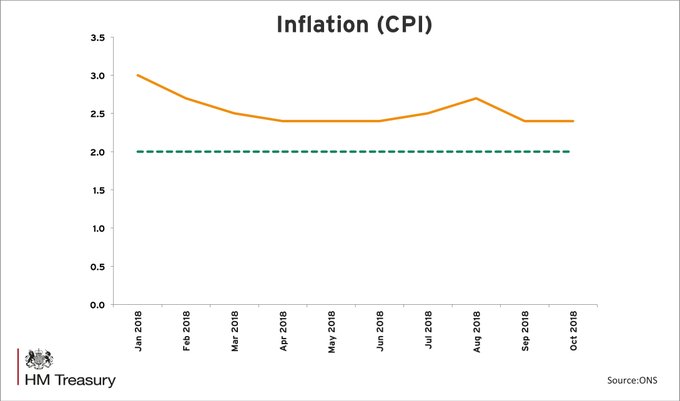
The all items CPI annual rate is 2.4%, unchanged from last month……..The all items RPI annual rate is 3.3%, unchanged from last month.
This was helped by something especially welcome to all but central bankers who of course do not partake in any non-core activities.
Food prices remain little changed since the start of 2018 and fell by 0.1% between September and October 2018 compared with a rise of 0.5% between the same
two months a year ago.
Happy days in particular if you are a fan of yoghurt and cheese. The other factor was something which an inflation geek like me will be zeroing in on.
Clothing and footwear, where prices fell between September and October 2018 but rose between
the same two months a year ago.
There is an issue of timing as we are in the Taylor Swift zone of “trouble,trouble,trouble” on that front but this area is a big issue in the inflation measurement debate. Let me look at this from a new perspective presented by Sarah O’Connor of the FT.
Online fast-fashion brands have enjoyed success catering to what Boohoo calls the “aspirational thrift” of young millennials. They sell clothes that are often made close to home so that they can be produced more quickly in response to customer trends. “Our recent evidence hearing raised alarm bells about the fast-growing online-only retail sector,” said Mary Creagh, the committee’s chair. “Low-quality £5 dresses aimed at young people are said to be made by workers on illegally low wages and are discarded almost instantly, causing mountains of non-recycled waste to pile up.”
This is a direct view on the area of fast and often disposable fashion which is one of the problem areas of UK inflation measurement. There are issues here of poverty wages and recycling. But the inability of our official statisticians to keep up with this area is a large component of the gap between CPI and RPI, otherwise known as the “formula effect”.
Comment
The fall in the price of crude oil is a very welcome development for the trajectory of UK inflation. Should it be sustained then we may yet see UK inflation fall back to its target of 2% per annum. For example the price of fuel at the pump is some 10 pence per litre higher than a year ago for petrol and 14 pence per litre higher than a year ago for diesel, so the drop is not in the price yet. That may rule out an influence for November’s figures but we could see an impact in December. Other prices will be influenced too although probably not domestic energy costs which for other reasons only seem to go up. But as we looked at yesterday the development would be good for real wages where we scrabble for every decimal point.
Meanwhile I have left the “most comprehensive” measure of inflation to last which is what it deserves. This is because the CPIH measure ignores a well understood and real price – what you pay for a house – which is rising at an annual rate of 3.5% and replaces it with Imputed Rents which are never paid to get this.
The OOH component annual rate is 1.1%, up from 1.0% last month.
But I do not need to go on because the body that has pushed for this which is Her Majesty’s Treasury which plans to save a fortune by using it may be having second thoughts if it’s media output is any guide.

Friday, 9 November 2018

Brexit & Productivity - serendipity?

Brexit has plenty of unexpected bonuses

We’re tackling problems like poor productivity thanks to our imminent departure from the EU
Why does Brexit make so many people so cross? The more you think about it, the odder it is. Leaving the EU is not Iraq or Vietnam. Nobody will be killed by Brexit, except perhaps those who are bored to death by it.
For all the adjectives you could use to describe Brexit — confounding, frustrating, momentous and historic — it is, above all, desperately boring. I’m talking not just about the endless soap opera of negotiations, though that’s up there with the collected works of Thomas Hardy in the boredom stakes. Brexit is boring because it turns out the European Union itself is mostly boring.
Consider the powers that will be returned to Westminster after we finally leave: to negotiate trade deals with other countries; to impose tariffs; to introduce new regulations on employment and product standards; to set quotas for migration and visas. For the past four decades the EU has functioned in large part as a legislative black hole into which we have outsourced some of the more tedious levers of the state.
Yes this stuff matters, in much the same boring but worthy way that it matters what diameter of sewage pipes we use. In some sectors, such as agriculture, Brexit has the potential for exciting innovations. But consider the most important powers at the government’s disposal: defence of the realm, fixing levels of tax and public spending, managing the welfare state and deciding interest rate policy. Set against this it is hard not to find the powers returned from Brussels rather piffling.
True: you can make the case that big constitutional decisions should be taken at home. You can argue that throwing sand into the wheels of trade between Britain and Europe will only make both of us poorer. You can point to the possibility that Britain leaves without a deal, something that would not be boring in the slightest, at least for a few months. Except that the likelihood of it happening is far smaller than you might assume. It suits everyone concerned, for all sorts of reasons, to ramp up the drama.
The most likely outcome is no big deal, rather than no deal at all. Whatever the nature of our transition period, the long-term impact of Brexit will probably be smaller than you think. The degree of extra sovereignty Britain gains on leaving will be minimal. The degree of economic damage directly attributable to leaving will be similar: a couple of percentage points off gross domestic product over the long run. Ten years hence we may look back and realise that this was the moment we became moderately poorer, but there will be no big bang.
These are unfashionable views, especially given that every ounce of energy in Whitehall and much reporting in the media is being expended on Brexit. How tragic to think we might have wasted nearly three years tearing the country apart, ruining the careers of some of our ablest politicians and consigning several pressing economic problems to the backburner for something which will make little difference to Britain’s productive potential.
Of course, this is slightly to miss the point. Brexit is all-consuming not because of what it is but because of what it stands for: a break with the past and a controversy magnet that attracts and repels those who value cosmopolitanism and those who think national identity has been eroded. But in some respects it has also been very good for us.
For the past decade, economists have moaned about three problems in particular: a productivity crisis, austerity and the dominance of London over the rest of the country. Guess what: since the referendum in 2016, huge strides have been made to address each of these challenges.
Productivity is rising again, though it is too early to say whether this will be sustained, let alone whether it has anything to do with Brexit. And much as economists might dislike the end of free movement of people, depriving Britain of limitless cheap labour from the Continent might finally force our notoriously parsimonious businesses into investing more in robots and programmes to increase their staff’s productivity. Then again, free movement has not prevented the Germans from investing, so we shall have to see.
Then there’s the government’s spending plans. For all the fanfare when Theresa May announced the end of austerity last month, in reality it has been on its way out since just after the Brexit vote. Our departure from the EU was the excuse Philip Hammond needed to postpone George Osborne’s plan to eliminate the deficit, perhaps indefinitely. It is hard to conceive of any other event which could have given the Tories the political cover to make such a dramatic shift while remaining in government.
And having dominated the property market and the GDP figures for years, London is now the country’s great laggard. House prices are falling faster in the capital than anywhere else in Britain. The financial sector has shrunk. True: banks have been beleaguered for a decade and the property market is suffering partly because of higher stamp duty and more stringent capital gains tax for high-end properties. But Brexit has probably exacerbated these trends.
Few economists seem to have noticed. Consumed with fury about Brexit, they have failed to recognise that it has unleashed all sorts of genies which are changing the economy. Brexit may be boring, but the journey it is taking us on is not.
Ed Conway is economics editor of Sky News

Tuesday, 6 November 2018

UK housing market an oligopoly?

Housebuilding has become an oligopoly that distorts the market

Share
Save
What follows may sound completely ludicrous, and so it should. Persimmon, the country’s largest housebuilder, has a strong claim to be Britain’s Google. No, Persimmon has not developed a world-changing algorithm. It is not experimenting with new technologies. Its business ethic is not to solve problems first and work out how to monetise them later. Persimmon lays bricks and runs copper pipes under floors, just as housebuilders have done for ever.
So what does it have in common with the world’s digital pioneer? The answer is in the accounts. Last year Persimmon reported an operating profit margin of 28.2 per cent and had £1.3 billion of cash. Alphabet, Google’s parent company, managed a margin of 24 per cent and had $100 billion of cash. The similarities go on. Jeff Fairburn, chief executive of Persimmon, pocketed £75 million while Sundar Pichai, Google’s boss, made roughly £270 million.
It doesn’t take a software engineer to see something is wrong with that picture. Housebuilding is not complicated. Builders buy land, secure planning permissions, put up a few boxes and flog them. It’s been done for hundreds of years. There should be zero barriers to entry. Instead, the accounts resemble those of the oligopolistic tech giants — complete with offensive bonuses.
With a cost of capital starting around 5 per cent and margins around 20 per cent, builders today are money-printing machines. Choosing to invest in Google or Persimmon, on these metrics, would be tough. Or perhaps not. Competition regulators are going after big tech but no one gives two hoots about the builders.
Last week they were let off the hook again. Sir Oliver Letwin’s “review of build out” rejected claims that they were causing “intentional delay” to prop up prices, despite its finding that build rates are just 6.5 per cent of a site a year. Development is slow, the former Tory minister concluded, due to the “homogeneity of the tenures on offer”. In other words, builders choose to build expensive homes and develop them no faster than the demand for that limited product can absorb. It may not technically be land-banking, but it is rationing by price selection.
Sir Oliver’s remedy is to require a mix of build-to-rent, shared ownership and affordable housing. Broader appeal would generate more demand and thereby speed up supply, he argued. To ensure diversity, and prevent builders erecting premium houses where smaller homes are needed, local authorities should cap the development value of big sites at ten times “existing use value”.
It’s a clever proposal but the bureaucracy may play into big builders’ hands. Small firms don’t have the pockets to absorb the costs of our arcane planning system. So much so, they have been dying off. In the 1980s, 10,000 small builders produced 57 per cent of new homes. Today, 2,800 produce 27 per cent.
A more frank assessment than Sir Oliver’s would be that the housebuilding market has been stitched up since the consolidation of the early 2000s. Mergers concentrated power with the big nine, who used land acquisition efficiencies to lift profits while cutting supply. As planning grew more complicated, and big builders trapped sites under option in their “strategic” land banks, smaller developers found it harder to compete.
Today the big builders are the only game in town and, as Sir Oliver acknowledged, the only way to increase supply is to play their game and raise demand. Hence Help-to-Buy, a subsidised mortgage scheme to attract buyers. Yet, as the Google-type returns attest, the ultimate beneficiaries have been the builders. There is nothing sophisticated going on here. Housebuilding is a plain old oligopoly protected by a backwards planning system that raises barriers to entry, and needs to be shaken up.
Philip Aldrick is Economics Editor of The Times