Quote of the day

“I find economics increasingly satisfactory, and I think I am rather good at it.”– John Maynard Keynes

Sunday, 19 November 2023

Is GDP What It’s Made Out to Be?


Is GDP What It’s Made Out to Be?

It is a popular myth that “consumer spending drives the economy,” a statement that comes from a misunderstanding of GDP. Gross domestic product (GDP) is the most common measure of the economy. It accounts for the final purchase of goods and services by consumers, businesses, and governments. Since consumer spending represents the largest sector of GDP — a full two-thirds — many media analysts conclude that it is consumption, rather than investment, that drives the economy.

However, the media and Wall Street analysts forget that GDP is not the same as “total spending in the economy.” GDP measures final output only — the finished goods and services that consumers, businesses, and government buy each year. It amounted to nearly $27 trillion 2022.

GDP is an important measure of our standard of living, but it leaves out some important elements of the economy. Most importantly, it omits the value of the supply chain — all the intermediate stages of production that move products and services along the production, wholesale, and retail sectors to the finished product. The value of the supply chain is larger than GDP itself, around $32 trillion this year!

When you include the supply chain, you get what the government calls gross output (GO). The federal government now publishes GO along with GDP every quarter. GO is a much better, broader definition of total economic activity because it measures spending at all stages of production. GO represents the “top line” of national income accounting, while GDP is the “bottom line.” Both are essential to understanding how the economy works.

Using GO as the complete measure of total economic activity, we learn that consumer spending is only one-third, not two-thirds, of GO. Thus, consumption is important, but not as important as business spending along the production process.8 Figure 5 demonstrates how much bigger and more volatile business spending (designated as B2B) is compared to consumer spending.
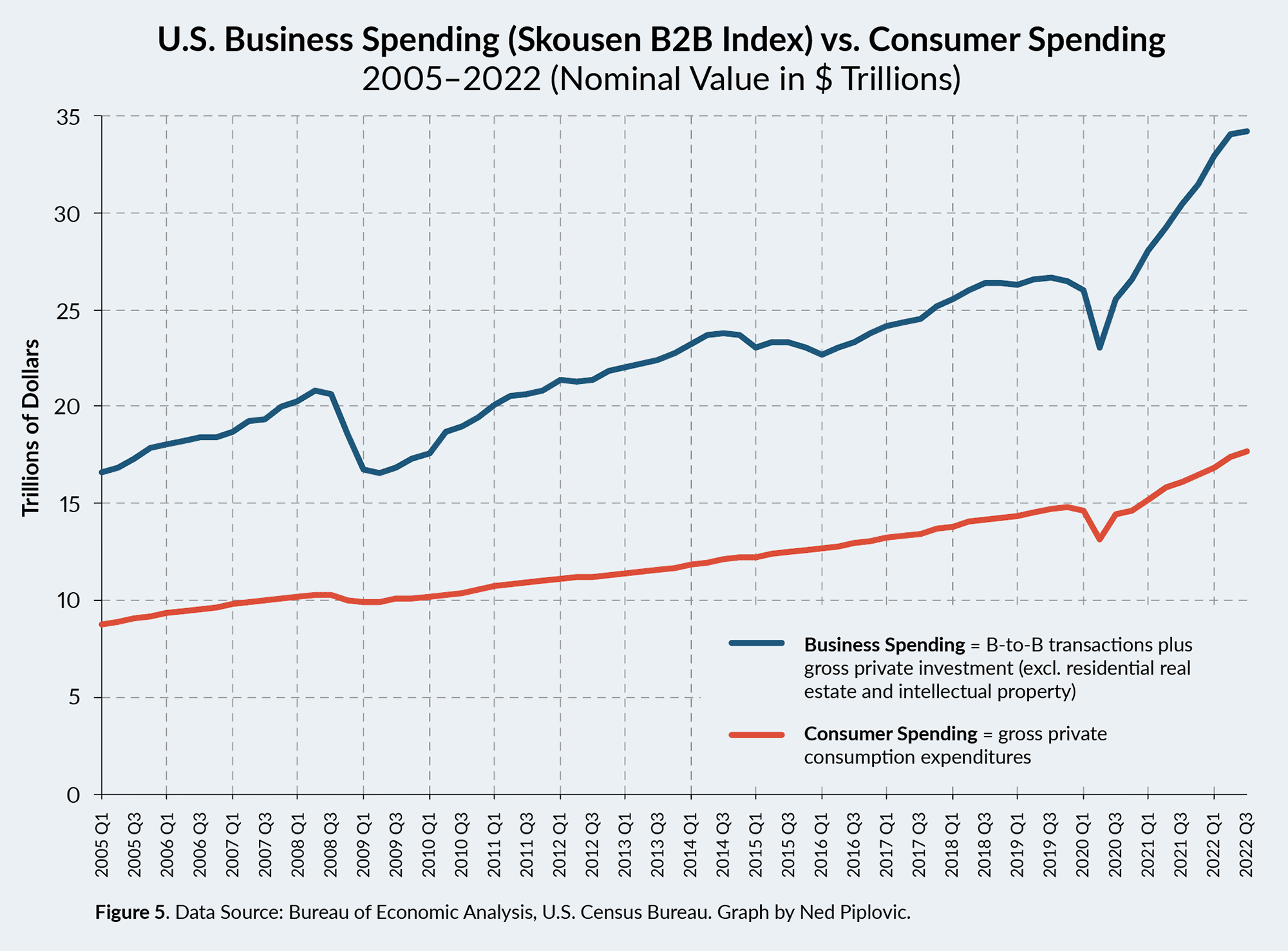
U.S. Business Spending (Skousen B2B Index) vs. Consumer Spending 2005-2022 (Nominal Value in $ Tillions)

Figure 5. Data Source: Bureau of Economic Analysis, U.S. Census Bureau. Graph by Ned Piplovic.

Thus, we see that business activity is the big elephant in the room and it is it that determines the economic success of a nation. Consumption is the effect, not the cause, of prosperity. As MIT professor Shlomo Maital concludes, “The health and wealth of a large number of individual businesses — small, medium and large — determine the economic health and wealth of a nation. When they succeed, managers create wealth, income, and jobs for large numbers of people. When they fail, working people and their families suffer. It is businesses that create wealth, not countries or governments. It is businesses that decide how well or how poorly off we are.”9

In the classroom, I use Seattle as an example. Why is Seattle a booming, prosperous metropolitan city today? Is it because its residents suddenly decided to buy more goods and services with their credit cards? No, it was innovative businesses that came up with new products that consumers didn’t know they wanted until the business engineers came up with the new ideas. I ask students to name these companies. They include Boeing (the 700 commercial jet series), Microsoft (Windows software), Starbucks (new kinds of coffee), and Amazon (the online everything store), among others. Granted, all of these companies needed customers to be profitable and to expand, but which came first, the consumer wanting these products, or creative entrepreneurs who invented the new product? Clearly the catalyst, the first mover, is on the business side of invention — on the supply side.

In economics, this is known as “Say’s Law of Markets,” named after the French economist Jean-Baptiste Say (1767–1832), known as the “French Adam Smith.” Dynamic change and economic growth come from the supply side.


Friday, 17 November 2023

I thought it useful to share this view on AI - an investor's take:


Everyone Is Behind on AI

By Ed D'Agostino | November 17, 2023

Ed D'Agostino


AI is here. Are you ready?

On Tuesday, Cisco released its new AI Readiness Index. The company surveyed over 8,000 senior executives at global companies with 500-plus employees. A full 97% reported increased urgency to leverage AI for their businesses, but only 14% were ready to do so.

Only 30 or so companies have already successfully integrated AI across all aspects of their businesses, according to Tom Davenport and Nitin Mittal’s new book, All In on AI.

We’ll hear from Davenport, a senior advisor to Deloitte’s AI practice, next week on Global Macro Update. But today, instead of an interview, I’m going to share a bit about how we are looking at opportunities in artificial intelligence.

AI is a catalyst for rapid fundamental change. Harvard Business Review estimates that AI could add $13 trillion to the global economy over the next decade. PwC’s estimate is more aggressive: $15.7 trillion by 2030.

Executives will talk about AI on every earnings call for the next several years. With all the hype, how can you identify the companies truly leveraging AI to maintain a competitive edge?

One way is to look at changes in worker productivity. On its own, today’s level of artificial intelligence won’t make entire companies radically more productive. But companies that integrate AI with their enterprise software and automation will boost productivity to a degree not seen in decades. I call this the “holy trinity of technology.”

The success of businesses will depend on if, when, and how well they integrate the holy trinity. For those that get it right, productivity could soar 40%. This goes for companies in healthcare, financial services, legal services, education, entertainment, manufacturing, transportation, and agriculture. Just about everyone.


Source: Bain & Company

Big business has an edge here.

Take law firms, for example. A small firm with one to five lawyers could spend $400 a year for Casetext’s “AI legal assistant” CoCounsel, and the firm might get 30% more done. That’s great, but large, multinational law firms that generate billions in annual revenue won’t settle for a $400 off-the-shelf product. They can afford customized, AI-driven enterprise software to boost productivity.

Multinational law firm Allen & Overy is already doing this. The UK-based firm, which employs over 3,500 lawyers, partnered with Harvey AI to automate some of its legal research and drafting through tailored AI-driven enterprise software. The firm says it’s the first in the world to use generative AI at the enterprise level. Attorneys at bigger firms will become much more productive. (As an aside, I’m not sure that’s such a good thing.)

No one can integrate the holy trinity on that scale without help. This is where facilitators come in…

Facilitators (aka consultants) will lead the process of integrating AI, enterprise software, and automation at most Fortune 500 businesses. Remember, only 14% of large global companies say they’re ready to implement AI, and only 30 or so have fully integrated it. It’s a good time to be an AI facilitator.

Global spending on AI is projected to top $301 billion by 2026, according to Dataiku. Much of that will go to consultants. You can think of them as AI’s “picks and shovels” plays. They’ll make money no matter what.

All the large business consultancies have an AI division. McKinsey’s is called QuantumBlack, and it operates its own in-house AI lab. QuantumBlack has helped clients like Texas energy company Vistra Corp. implement custom AI to improve thermal efficiency, resulting in around $60 million in savings for the company.

It’s also helped the Emirates Team New Zealand build an AI bot that could test new designs by sailing them on the team’s simulator. This helped the team defend its America’s Cup title.


Source: McKinsey

Boston Consulting Group’s GAMMA division helps implement and scale AI solutions. Its clients include fashion retailer H&M Group, which uses AI to better manage its supply chains and predict trends.

Bain & Company offers similar services. So do KPMG, Deloitte, and PwC.

The hurdle for investors is that most facilitators are private companies.

Sunday, 12 November 2023

Why I don't like subsidies - important read from The Economist


Europe should not copy Bidenomics

It needs a deeper, greener single market—not more state handouts

An illustration of a standard EU electrical plug feeling a jolt from an American socket.

It is not hard to see why Europe feels the urge to copy President Joe Biden’s economic policies. The loss of cheap Russian fossil fuels has made the clean-energy transition feel like a matter of national security. Germany, Europe’s biggest economy, fears its automotive industry will lose market share to state-subsidised electric carmakers in China and America. And the euro zone’s economy is increasingly falling behind America’s. As we report, the worst-suffering European economies are grappling with inflation of over 10%, rapid ageing, high public and private debts and exposure to autocracies. This week the imf said the euro-zone economy would grow by only 0.7% in 2023. It expects America to grow three times as fast.

Europeans increasingly see Biden-style industrial policy as the answer. The eu has loosened state-aid rules that restrict subsidised investment, and aims to set targets for the bloc’s production of green goods. France and Germany are at loggerheads over how (not whether) to subsidise electricity for industrial users. Britain’s Labour Party, which will probably form its next government in 2024, also aims to spend lavishly on industry.

image: the economist

Yet copying Bidenomics is a mistake. As in America, luring manufacturing with subsidies will waste money and, over time, encourage firms to compete for subsidies rather than customers. And though it is true that France, whose dirigiste economic philosophy is in the ascendant in Brussels, has had some successes with industrial policy, the web of institutions and norms that restrain the excesses of French interventionism are difficult to copy—just as Germany’s economic model could not be transplanted elsewhere when it was held up as a paragon.

Europe’s recent experiences are in fact a case study of the power of markets. After Russia invaded Ukraine, German industry claimed that the loss of Russian gas would cause an economic catastrophe. Instead, industrial production held up as firms quickly adapted. Unlike America, the eu already has a uniform carbon-price mechanism in place. After a rocky start in the 2000s the emissions-trading scheme (ets) has in recent years become the gold standard for carbon pricing, incentivising the private sector to find the most efficient ways to cut emissions.

The best policies for Europe would build on its past market-friendly approach. The eu should foster a common and contested green single market—including services and capital—which means restraining state aid. It should let the carbon price for new sectors increase faster than planned, and get serious about a climate dividend for citizens. And it should trade freely with allies so that the vast tasks of decarbonisation, de-risking sensitive supply chains and boosting defence can be undertaken at the lowest cost. The eu would be neither more secure nor richer if it had national champions producing 27 different types of tank.

To boost growth, new government spending should focus on infrastructure, not handouts. Germany should fix a railway system that has rotted to the point of collapse. France should stop blocking interconnectors that could channel solar power from sunny Spain to the rest of Europe. And governments could write procurement rules that insist on greenery or security but which respect the single market and the principles of free trade.

It might be tempting for Europeans to think that if America is protectionist, everyone else must follow suit or be left in the dust. Actually, America’s long-running economic advantage over the rest of the world stems from the fact that it has been more committed to markets, not less. That makes its recent turn towards statism an aberration rather than an example to follow. 

Thursday, 9 November 2023

Extension material - "financial engineering":

 
The financial addiction that is slowly killing Britain’s economy

Share buybacks are bleeding the UK of funds that could fuel much-needed investment

Share buybacks – the practice of reducing a company’s share capital by buying the stock in the market and then cancelling it – has always divided investment opinion.

On the plus side, they are theoretically more tax efficient than dividends, since the seller pays capital gains tax on the distribution rather than income tax, which is what dividends are subject to. They should also be earnings accretive, in that they reduce the number of shares in issue.

But there is another reason executives find buybacks preferable to dividends. They are much easier to cancel without anyone really noticing compared to the annual dividend payment, where any cut tends to be regarded as a manifestation of management failure. 

Anecdotally, moreover, buyback activity tends to be at its greatest when share prices are at their peak, not as it should be when prices are down in the dumps. As such, they can be a classic top-of-the-market signal, more so a case of irrational exuberance than efficient use of capital.

As often as not, companies waste capital by overpaying for their shares, disadvantaging the shareholders left behind. Management confidence that the shares are cheaper than they should be is frequently misplaced. The manipulation of earnings per share via buybacks becomes an even more contentious issue when incentive schemes are directly related to earnings performance.

And finally, money spent buying back shares is money not reinvested in the underlying business, and can therefore be seen as part of Britain’s underinvestment problem.

All these negative considerations should worry us, since right now, buyback activity in the UK market is close to record levels. According to collations by Russ Mould, investment director at AJ Bell, share buyback programmes in the UK market this year have already reached £46.6bn.

With some 30 trading statements still to come from FTSE 100 companies over the next couple of weeks, the total for the year is likely to come close to last year’s record of £58.2bn, and may even exceed it.

This may of course be largely yesterday’s story. Much higher interest rates make share buybacks more expensive to finance, so you’d expect the numbers to fall quite significantly next year. As I say, managements are on the whole keener to protect the dividend than the buyback programme.

But there is also a wider reason to worry. Over the past 30 years, there has been a remarkable shift in share ownership for UK companies, with international ownership of the FTSE 100 increasing from around 12pc to 56pc. UK Pension Fund and Insurance Company ownership has meanwhile fallen from 52pc to just 4pc. Even retail and unit trust ownership has plummeted.

The upshot is that the bulk of the money from UK buybacks and dividends goes overseas these days, rather than being recycled back into the domestic economy.

As such, the explosive growth of buybacks can reasonably be seen as at least some part of Britain’s shamefully low overall level of business investment. Capital that is notionally available for investment within the company, or alternatively through dividends in the wider economy, is instead being syphoned off and invested elsewhere by overseas shareholders.

British companies have in other words become a kind of wasting asset, with their lifeblood being slowly sucked out of the UK economy.

Gross fixed capital formation (GFCF) – a measure of both public and private investment – in the UK is already one of the lowest in the OECD. Rishi Sunak and Jeremy Hunt have made it their mission to improve on that position, even if slashing the Government’s capital spending budget scarcely helps them achieve it.

Even so, there is some evidence to suggest that Downing Street’s strategy of significantly raising the rate of corporation tax for larger companies so as to patch up public finances, while at the same time increasing allowances for investment, is working.

Since the Government introduced super deductions in the spring of 2021, replaced this year by “full expensing”, business investment in the UK has risen faster than any other G7 economy, albeit from a much lower base.

The Chancellor has said he’d very much like to make “full expensing” – a 100pc offset against tax for investment in plant and machinery – permanent once Britain’s public finances can afford it. For the time being, however, his fiscal rules limit the initiative to just three years.

The CBI has estimated that permanent “full expensing” could boost business investment by £50bn annually. But just consider this: if all the money currently spent on buybacks was instead invested back into the UK economy, we’d already be there. Instead, it ends up in America, Europe and beyond.

On the whole, it’s a good thing that Britain is one of the world’s most open economies, where investors and companies are free to do what they like with their money. The benefits probably outweigh the negatives. Yet downsides there most definitely are.

Sunday, 5 November 2023

Get with the (monetary) programme:


author-image
DAVID SMITH | ECONOMIC OUTLOOK

Higher interest rates are working, but beware the risks of overkill

The Sunday Times
Share
Save

It has been hard to ignore the actions of central banks, even after a week in which the Bank of England and the US Federal Reserve merely held interest rates steady. In time, the rate-setters will get less attention than over the past couple of years, when they have been racing to catch up with runaway inflation.

We should soon be entering a period when the main question about the current central bank mantra — “higher for longer” — will be how much longer? When you have reached peak rates, the issue is when they will come down again — and that should be the case at some stage next year, if not for a few months.

In the meantime, not far from where I am writing this, there is a living example of a textbook monetary policy experiment at work. I am not talking here about our own dear Bank, which is still troubled by aspects of inflationary pressure. Three members of its monetary policy committee (MPC) voted to raise Bank rate from 5.25 to 5.5 per cent on Thursday, though they were outvoted by the six who opted to hold. In what was described by analysts as “a hawkish hold”, Andrew Bailey, the governor, reiterated that the Bank “will be watching closely” to see whether further hikes are needed.

No, my attention was grabbed by developments a little farther away, across the Channel. Figures published a few days ago by Eurostat, the EU’s statistical agency, showed two things. One was that eurozone inflation is dropping sharply, and on its preferred measure fell to just 2.9 per cent last month, from 4.3 per cent in September.

The other was that this has been achieved by snuffing out growth. Gross domestic product in the eurozone fell by 0.1 per cent in the third quarter and rose by 0.1 per cent in the EU as a whole. In both cases, GDP was up by a tiny 0.1 per cent on a year earlier, implying an absence of growth. You can debate whether this was achieved by tighter monetary policy — higher interest rates – alone, but this is what central banks would be looking for if they were seeking to drive inflation out of the economy: significant weakness in demand.

As always, there were big variations in the performance of individual countries in the eurozone, and the quarterly figures for the bloc were dragged negative by another big fall in Ireland’s volatile GDP figures. Some countries are showing negative annual inflation rates, including Belgium and the Netherlands.

Europe’s performance contrasts with America, where the Federal Reserve held rates despite an acceleration in GDP growth to an annualised 4.9 per cent in the third quarter, its best for nearly two years, and where analysts cannot be sure that the job is done.

It also contrasts with the UK, where the Bank appears to have done better with the snuffing out growth part, predicting the economy will be “broadly flat” for the next few quarters, than the inflation bit, which it does not expect to drop below 3 per cent until early 2025.

A flat economy, with zero growth predicted next year (election year) and the risk that it could be worse, means the issue of whether the Bank has over-tightened — raised interest rates too much — has become a live one. I used to feature the Institute of Economic Affairs’ (IEA) shadow MPC a lot in these pages, and indeed was instrumental in getting it to announce a “decision” before each actual MPC meeting — but we lost touch.

The latest recommendation from the IEA was very interesting. It called on the Bank to cut rates by a quarter of a point to 5 per cent on Thursday, and to scale back its “quantitative tightening” — the reversal of the earlier quantitative easing. It is worried by the downturn in M4 money-supply growth, broad money, which has turned significantly negative.

“There is mounting evidence that the UK’s monetary policy is too tight and could lead to price deflation in a few years and potential recession in the interim,” said Trevor Williams, who chairs the IEA committee. “The Bank of England should lower interest rates.”

There was never any real possibility of that happening on Thursday, not least because the money supply does not feature prominently, if at all, in the actual MPC’s decisions. It was also too soon for a majority on the MPC to contemplate a cut in rates after running them up so aggressively.

This will, however, become very relevant in the coming months. We will know more about what is happening to the UK economy, despite uncertainty over the data, this week. Friday will bring monthly GDP figures for September and the first release of GDP data for the third quarter as a whole.

The context is that monthly GDP rose 0.2 per cent in August after a 0.6 per cent fall in July. If previously published figures are not revised, this means September must show a rise of 0.4 per cent or more for GDP not to have fallen in the third quarter. The Bank thinks third-quarter GDP will have been flat.

If it were to show a small fall, this would not be a huge moment — quarterly GDP dropped slightly in July-September last year, though the Queen’s death and funeral was a factor. A weak third quarter would confirm the view that UK monetary policy is hurting, with many sectors in retreat.

It would also add to the belief that it is working, and not before time. But the Bank, and its central bank counterparts, must be sure that it is not working too well. A flatlining economy is one thing, a proper recession another.

A former MPC member I was talking to the other day described the problem the Bank would face if over-tightening led to recession. It would be caught on the other side of the problem it has faced up till now, which is that the lags between its actions and their impact have got longer.

That is true when raising rates, as so many people are now on fixed-rate borrowing, but it would also be true for rate reductions. Rate cuts used to offer a speedy economic stimulus, heading off recession or lifting the economy out of it. That is harder now. Despite its hawkish tone, the Bank has a vested interest in avoiding too much pain.

Thursday, 2 November 2023

Some microeconomics for you - taxes on sugary drinks:

 This piece comes from Conversable Economist Conversable Economist - Conversable Economist - In Hume’s spirit, I will attempt to serve as an ambassador from my world of economics, and help in “finding topics of conversation fit for the entertainment of rational creatures.” Conversable Economist

It has lots of interesting pieces - take a look.

The Limited Effects of Taxes on Sugar-Sweetened Beverages

Here’s the case for imposing a tax on sugar-sweetened beverages: 1) Obesity is a major public health problem, through its effects on diabetes, cardiovascular diseases, asthma, certain cancers, and mental health; 2) Consumption of sugar-sweetened beverages is an outsized contributor to obesity; 3) Taxing sugar-sweetened beverages will raise the cost that consumers pay, and thus diminish their consumption. This logic is sufficiently powerful that taxes on sugary drinks have been imposed, sometimes locally and sometimes at that national level, in 50 countries. The average American (average!) consumes about 200 calories per day in the form of sugar-sweetened beverages, among the highest of any country in the world.

So how is it going? Kristin Kiesel, Hairu Lang, and Richard J. Sexton discuss the evidence in “A New Wave of Sugar-Sweetened Beverage Taxes: Are They Meeting Policy Goals and Can We Do Better?” (Annual Review of Resource Economics, 2023, pp. 407-432). Here are a few of their findings:

1) The effect of taxes on sugar-sweetened beverages (SSBs) on calories consumed is often pretty small. They write:

Eating two extra fries, chips, gummy bears or a single teaspoon of ice cream on a given day cancels out the calorie effect of reduced purchases of SSBs due to taxes measured by Dickson et al. (2021) for the United Kingdom. SSBs have been identified as a major contributor to obesity by many, including the World Bank (2020), but it is unhealthy diets overall, a lack of exercise, a variety of environmental factors, and genetics that determine gaining and retaining excess weight (NICHD 2021).

2) Details of the tax matter considerably. For example, a tax imposed at the city level means that sellers in the city will be aware that, when selling sugar-sweetened beverages, they are competing against untaxed sellers of such beverages outside the city limits. Thus, national taxes will tend to have larger effects than local ones., because sellers will be less likely to pass on a large share of the tax to consumers. Some taxes exclude “fruit drinks,” even though they may have added sugar , while others tax diet soda. Consumption of some types of sugar-sweetened beverages seems more responsive to price increases, like sodas, while consumption of others is less responsive, like energy drinks.

3) If drinking sugared beverages is in part a self-control problem, there are lots of alternative sources of calories that can readily replace sugary drinks, from candy bars to fast food.

4)Unsurprisingly, the revenues from taxes on sugar-sweetened beverages are not especially large compared with other tax sources. The authors write:

The estimate that $133.9 million in tax revenue is collected annually across the seven US cities with local SSB taxes amounts to about $33 per capita within the taxing jurisdictions (Krieger et al. 2021b). A tax implemented nationally that generated similar per capita revenue would amount to 0.32% of the US total tax revenue. Thus, revenues generated from current SSB taxes are rather trivial as a share of revenues, and beneficial purposes to which these funds are devoted could be supported from a modest redirection of funds from more broad-based taxes.

5) The taxes on sugar-sweetened beverages are probably regressive: that is, they cost a greater share of income for the poor than the rich. Indeed, such taxes tend to be less favored by the poor than the rich.

It is well documented that it is easier to be in favor of policy measures that mainly affect others (e.g., Diepeveen et al. 2013) and that at-risk groups whose behaviors are targeted by SSB taxes remain strongly opposed to them (Hagmann et al. 2018). Lang (2022) showed that tax pass-through for local SSB taxes was higher and demand was more inelastic in low-income and more racially diverse neighborhoods than in wealthier and predominantly white neighborhoods. These outcomes exacerbate the disproportionate burden on low-income consumers of raising revenue via SSB taxes. Even when modeled to be socially optimal under consideration of heterogeneous and time-inconsistent preferences (e.g., Allcott et al. 2019a,Dubois et al. 2020), SSB taxes remain mildly regressive at best.

This study isn’t the final word. As the authors are careful to point out, some studies of this literature suggest more optimism about carefully designed taxes on sugar-sweetened beverages as a policy tool. Those interested in more positive estimates might begin with Hunt Allcott, Benjamin B. Lockwood, and Dmitry Taubinsky, “Should We Tax Sugar-Sweetened Beverages? An Overview of Theory and Evidence,” in the Summer 2019 issue of the Journal of Economic Perspectives, or with the 2020 World Bank study, “Taxes on Sugar-Sweetened Beverages: International Evidence and Experiences.”

But I suspect that even those who are more optimistic about the virtues of taxes on sugar-sweetened beverages would agree that they are best-viewed as part of a broader effort to reduce obesity, not as a substitute for a broader effort. Kiesel, Hairu , and Sexton conclude in this way:

Indeed, it will take the knowledge and expertise of public health officials and scholars, economists, psychologists, and those most affected by health inequities and SSB taxes to carefully design multifaceted policies that alter our food environments and nudge both producers and consumers toward improved behavioral responses, health outcomes, and greater social welfare. Carefully designed taxes on added sugars and unhealthy foods implemented countrywide could be part of combined policies aimed at reducing the obesity epidemic and related health harms.Given their regressivity, limited impact on consumption of SSBs, and failure to incentivize product reformulations, we find little basis to support further implementation of local SSB taxes.