Quote of the day

“I find economics increasingly satisfactory, and I think I am rather good at it.”– John Maynard Keynes

Monday, 19 March 2018

Cracking article on our tech hub

This article is one of a series, contains video clips and more, and is too big to take in in one hit.

The link to the article is  here: https://www.telegraph.co.uk/technology/the-silicon-joke/

It covers supply-side policy, entrepreneurialism, creative destruction - and is just a cracking read; I recommend you really try to work through it, if only to give yourself a sense of how some people persisted to make their businesses work. If nothing else, read the last paragraph.

The Silicon joke?


From roundabout to revolution

By Harry de Quetteville 18 MARCH 2018 • 6:00PM
Exactly 10 years ago, in March 2008, a small technology company called Dopplr waved goodbye to its cramped premises above a pub in Hoxton, in London’s East End, and relocated to a bigger office nearby, on 100 City Road. For Dopplr’s 32 year-old chief technology officer, Matt Biddulph, the move offered a double advantage. Not only was there more space, but it also opened a door into a young, energetic social world of pub nights and parties, where coders, software engineers, budding entrepreneurs and digital wannabes gathered to gossip and share tales of triumph and disaster in their efforts to build online businesses. At the heart of this world was Moo.com, which was developing both a customised printing business and a reputation for great booze-ups. And it just so happened that Dopplr’s new office space was sublet from Moo. “It was very sociable,” Matt Biddulph recalls now. “There were a good number of companies in the area. Friday nights we would always go round to someone’s place go for a few drinks, a barbecue on the roof.”
After a few months, it dawned on Biddulph that this disorganised but congenial congregation of digital companies amounted to London’s very own technology hub. He reckoned that if Britain had an equivalent to California’s all-conquering Silicon Valley - home to Google, Facebook, and Apple - he was at the heart of it. Directly out of his window was Old Street’s grey, dreary, deeply uninspiring, traffic-clogged junction - gleaming City towers and Georgian Bloomsbury facades to the south and west, Hackney Marshes and London Fields to the north and east. California, it wasn’t. So, tongue firmly in his cheek, he took to the then new social media platform, Twitter, and wrote: “‘Silicon Roundabout’: the ever-growing community of fun startups in London’s Old Street area.”
It was meant to be funny, a very British acknowledgement of the gulf that existed between the scale and ambition of America’s technology titans - which promised nothing less than a revolution in human communication and commerce - and our own, rather more humble aspirations, to print nice stationery, perhaps, like moo.com. “It was absolutely a joke,” says Biddulph. “There was this classically British community of people, creating a bunch of great things, but with a healthy dose of cynicism.”
Ten years on, Silicon Roundabout is no longer a joke.Ten years on, Silicon Roundabout is no longer a joke. In fact, after the continent-economies of America and China, this country has become - by almost any metric - the most powerful technology hub in the world. Indeed by some measures, like start-ups per capita, Britain now beats the United States. Last year London raised more than twice the amount of money to fund digital companies than any other city in Europe. Between 2012 and 2016, total investment in Britain reached £28bn, as much as our closest three rivals - France, Germany, the Netherlands - combined.
One reason is obvious. Britain is home to eight of Europe’s top 20 universities. The “golden triangle” of Oxbridge and London alone offers six within a 60-mile radius. The results are equally evident: some 40 per cent of Europe’s “unicorns” - new tech companies worth $1bn or more - are British. If their names - Deliveroo, Rightmove, Transferwise - are not familiar to you yet, they will be soon, changing everything about the way you eat, live, and spend.
Growth is phenomenal. According to the Government’s digital strategy, published last year, fixed internet traffic in Britain is doubling every two years, while mobile data traffic increases by more than 40 per cent annually. Around the world, the volume of global internet traffic in 2020 will be almost 100-fold greater than it was shortly before Matt Biddulph coined the phrase Silicon Roundabout, and connected devices will outnumber the global population by nearly seven to one. To fuel that astonishing development, Britain’s so-called digital economy, already home to 1.6million workers, will suck in an estimated half million new recruits in the next four years. It is a high-growth, high-productivity sector in a country where, for the last decade at least, both have been been a problem. Average salaries for British tech workers - more than £50,000 - are half as much again as the typical annual wage.
The bashful, forlock-tugging Silicon Roundabout of a decade ago now attracts global tech titans to its door. The world’s largest technology fund, run by Japan’s Softbank, with $100bn to invest, set up shop in Mayfair last year. Meanwhile Google is developing a huge campus around King’s Cross, much of it devoted to its British artificial intelligence (AI) offshoot, DeepMind, which it acquired in 2014 for $500m. And Facebook is finalising plans to open a huge new headquarters in the same area. When Matt Biddulph drew up a map of Old Street startups in 2008, it featured 16 companies. Now London has an estimated 6,000. Far from being a road to nowhere, Silicon Roundabout has taken this country a long way.
Not that the cultural chasm to Silicon Valley has been completely bridged. According to Saul Klein, one of the most influential investors in British technology, “Silicon Valley is a mindset, not a location. It’s about energy, ambition - an almost on the spectrum desire to make something without really thinking about the consequences of what you’re trying to do.” Harry Briggs, a venture capitalist specialising in early stage technology companies, puts it more bluntly: “In Britain if you’re offered $50m or $100m to sell your company you think ‘I can be one of the richest people I know, and a big success. In Silicon Valley if you sell for $100m you’re a nobody, you’re a loser. I heard someone from Silicon Valley say recently they want to be remembered as long as Julius Caesar. That’s just a different scale of self-belief and ambition.”
Bill Gates, Microsoft
(desktop age)
Steve Jobs, Apple
(mobile age)
Mark Zuckerberg, Facebook
(social media rise)
America has seen plenty of digital emperors. Bill Gates, of Microsoft, ruled the desktop age. Steve Jobs, of Apple, dominated the move to mobile. Mark Zuckerberg, of Facebook, foresaw the rise of, and then conquered, social media. Not to mention Amazon’s Jeff Bezos, or Tesla’s Elon Musk, both of whom already seem to have tired of earthly conquest, and set their eyes set on space.
Can Britain produce a figure of similar stature?
On a February day, with blizzards sweeping the monolithic grey facades along Whitehall, and London feeling a world away from California, it is up to Matt Hancock, the newly-appointed, fresh faced and habitually red-socked Secretary of State for Digital, Culture, Media and Sport, to provide the sunny disposition.
And he does, enthusiastically recounting how, since coming to office (in coalition) in 2010, his party has helped the British tech sector emulate American audacity in myriad ways.
One fundamental part of that transformation has occurred within the corridors of power themselves. Until recently, the institutional reflex there was to hoard the vast troves of information that the state gathers in all its guises: central and local government spending, civil servant salaries, you name it, the numbers and spreadsheets were jealously guarded. Then, a young policy advisor called Rohan Silva, talent-spotted by then Chancellor George Osborne, drove a whole new agenda: open data. As Matt Hancock notes: “instead of being closed, the default became that Government data sets were open unless there was a good reason.” It was the movement that would come to allow private developers to build businesses around public sector information - whether school performance tables or the location and timeliness of buses. As a result commuters now routinely plug in a destination on their mobiles and cross cities using real-time public transport information. Residents can see exactly how many burglaries there have been in their street. “The first serious move was crime data, released by Theresa May,” says Hancock. “But the open data agenda was driven from David Cameron down.”

Government, whose services are today undergoing their own digital revolution at the hands of Liam Maxwell, Britain’s first National Technology Adviser, can justifiably claim credit for other encouraging gambits too. One is Tech City, founded and funded in 2010 by Cameron, to nurture young companies around Silicon Roundabout. Another was the tax credit SEIS, introduced in 2012 to tempt investors to back risky new ventures; a third is the British Business Bank, founded in 2014, which allocates enormous sums to venture capital funds to disburse to new tech companies. Brexit means British companies will lose access to £2bn of EU investment, but, as Hancock says, “we’ve already committed the British Business Bank paying extra funds, to assure that the current European funding is at least matched”.
If Government played its part, though, the two things that most drove the British tech sector into the mainstream occured well before David Cameron’s arrival as Prime Minister, and had little to do with politics. The first was the recycling of talent from those few companies that had surfed (and sometimes been sunk by) the first major wave of the internet boom. Perhaps most famous of these waslastminute.com, the site which made household names of its founders Brent Hoberman and Martha (now Dame Martha) Lane Fox.
Brent Hoberman and Dame Martha Lane Fox
Founders of lastminute.com
From his office just off Kensington High Street, Hoberman now talks about “the mafia” - tight-knit groups of employees who worked in pioneering digital firms in the early-mid 2000s, then emerged to form a host of new companies themselves. “There was the Skype mafia, the Betfair mafia, the Lastminute mafia,” he says. “All came out with experience and the confidence to build new things. Just from lastminute we’ve probably had 10 who started business worth over 100 million, just out of that mafia.”
Much more important, however, was 2008, and the financial crash . If there was a single event that transformed British technology, it was the crash. Almost overnight large numbers of highly-motivated people with serious financial experience were fired. A huge talent pool was dumped onto the open market. “The crash pushed a whole load more people to want to be entrepreneurs,” says Hoberman. “Entrepreneurship is really risky. Then it turned out that so is working in a bank, so a lot more brilliant people said ‘Well, why not be an entrepreneur?”
The City had been a veritable talent Hoover. “So many founders have come to startups having left a Goldman Sachs,” says Sarah Drinkwater, who runs Google Campus, near Old Street, where refugees from the square mile can pull up a stool at a shared desk, logon to the free wifi, and plug away at their business idea. Every day, dozens of new members post a sticker on the campus notice board to announce who are they are and what they’re doing. “They’ve either just been made redundant or are at an inflection point in their lives,” says Drinkwater.
The crash didn’t just affect the people who had been fired. It changed the mindset of those looking for their first job, too. For generations, the best and brightest had emerged from universities and were tempted to make money in the City that they could not make elsewhere. But after the crash a career in banking was freighted not only with risk, but also with some stigma. Banking was out, tech entrepreneurship was in. “Of my 100-strong graduating class,” says Suranga Chandratillake, who left Cambridge with a degree in computer science 20 years ago, “the biggest employer was the City. Almost one third became bankers. Last year the biggest employer was Entrepreneur First” - a prestigious “incubator” for start-ups whose embryonic firms are often then snapped up by investors like Chandratillake himself, now a venture capitalist at Balderton Capital. “Goldman Sachs is having to compete hard to be attractive again for graduates,” he says.
The challenge is about more than money. Time and again in Britain, you hear the phrase “tech for good”. Founders of new companies believe they can have it all: money, prestige, and a company which changes lives for the better. Gordon Gecko might despair, but greed, alone, is no longer good. The most talented today want to be rich and have a shiny conscience. “They ask: ‘How can I actually do good in the world?’” says Mustafa Suleyman, one of the founders of DeepMind. “I think people really do care. There’s this judgement about the cultures of other industries, like the banking of the past. There’s some tough judgement about.”
“Tech can be a force for good. That’s part of the UK tech brand, and I’ve not seen it elsewhere in the world.”GERARD GRECH 
CEO OF TECH CITY
Or as Gerard Grech, CEO of Tech City, puts it: “Tech can be a force for good. That’s part of the UK tech brand, and I’ve not seen it elsewhere in the world.” Chandratillake concurs: “If you look at Millennials, it’s about money and success of course, but it’s also about mission and sense of social achievement. Tech has managed to have a positive story to tell. For example Transferwise [a slick, low-cost, user-friendly online money transfer service] sells itself as being the living embodiment of everything traditional financial services are not.”
Of course the City will survive the British technological revolution. Indeed its dominance and talent pool have helped make this country a world leader in new digital financial platforms just like Transferwise - collectively known as fintech - which offer everything from current accounts to mortgages to investment accounts, most controlled through your mobile phone.
But the tech revolution will not be so kind to other, celebrated names on the British high street, or their employees. For while technology is helping build new businesses, it is helping to kill old ones. Adapt or die, is the mantra now.
One famous casualty looks likely to be Marks & Spencer. Beloved by many, M&S has failed to keep pace with the developments in e-retailing. Observers note how it has not carved out a clear strategy, neither establishing itself as a market leader in-store, or online. In the language of the industry it is trying both “bricks” and “clicks” - and failing at both. “M&S is not going to be a going concern on its own in the next five years, they’re not going to make it,” says Russ Shaw, the influential founder of Tech London Advocates, a 4,000-strong group dedicated to championing the capital as a hub for digital businesses. “Tech is hitting everything. On the high street, either you’re going to go a Primark route, where there’s no online, or you’re going to be an adopter like John Lewis, which is looking pretty adept. But M&S are not cutting it. Their website is clunky. If you’re going to survive as a retailer you’ve got to be on the cutting edge of it.”
There is an irony here. Lord Stuart Rose, who was chief executive of M&S from 2004-2010, went on to lead the pro-EU Britain Stronger in Europe campaign ahead of the referendum in 2016. As it turned out, there was an existential threat to his former business, but it was technology, not Brexit.
By contrast, technology businesses, which pride themselves on their adaptability and ingenuity, are more sanguine about Brexit than you might imagine. There are certainly concerns about access both to European talent and the Digital Single Market - which aims to allow online companies and websites to operate easily across the EU, just as mobile phones do since roaming charges were abolished since last year. But at Tech City, where Gerard Grech keep tabs on all the key statistics, all is not doom and gloom. “The three top countries for tech skills immigrants coming to this country in 2016 [the last year for which data is available] were not in the EU but the US, India and Australia,” he notes. “So the UK should not be shy. We have taken a risk leaving the EU, in a self-determining way. With risk must come opportunity, otherwise what’s the point in doing it? This entrepreneurial community says we’ll rise to this challenge. Entrepreneurial risk culture is part of making this a success. As we leave the EU, the whole country has to be readied to make the most of the change that is coming. It will be a constant revolution, for which we will need to psychological fitness, staying power and resilience. It’s a state of mind. The country needs to be ready for that.”
Some in the tech world moan that such positivity does not always radiate from the Prime Minister, Theresa May. That, as just the moment a cheerleader is required, we have a dour manager in charge. “We’re expecting the government to create the conditions to allow business to thrive,” says Dom Hallas, who until January was an official at the Department for Exiting the European Union but is now Executive Director of Coadec, which acts as an intermediary between startups and Government. “One of the challenges we have quite frankly is that unfortunately we have a PM who… is not very business minded. That’s the reality. And so concerning.”
More than that, Hallas says that her default response to technology is wariness and suspicion, that where others see opportunity, she sees threats. “You start a conversation about technology and within two sentences you’re talking about paedophiles. It’s extraordinary. It’s baffling. That’s the [official] mindset that frankly flows from the top.”
It was significant, therefore, that Mrs May chose Artificial Intelligence as the theme of her speech in Davos this year. For many, Britain has a real opportunity to become a world leader in the field. DeepMind may have been bought by Google, but it remains in London - a platform which draws machine learning pioneers from around the world, and from where they can go on to create countless AI spinoffs of their own.
Mustafa Suleyman
Founder of Deepmind
Suleyman, who says DeepMind has “made London the leading city in the world for AI” calls “Terminator-style super intelligence a long term speculative fantasy, and basically a distraction” but admits that “technologies, by their design, are not destined to be good”. Increasingly, therefore, the nature and impostion of regulation will be critical: “Reassurance comes from understanding the governance mechanisms for these technologies.”
Already technology companies are colliding with the state over the precise nature of that governance. Technology is not just about emails and texts anymore. Uber is changing travel, Airbnb is changing housing. So called “Healthtech” - from wearables that can tell your your insulin levels, to repeat prescription notifications on your mobile - will sweep through the NHS. “Edtech”, facilitating online learning, will change the very basics of how the state’s teachers teach.
Consumers are long-used to seeing tech titans get their way, so it was something of a surprise when, in September 2017, Uber was found not “fit and proper” and stripped it of its licence.As companies unleash such revolution, they face increasing push back from state regulators. Last year Uber fought a legal battle against Transport for London over its reporting of criminal offences. Consumers are long-used to seeing tech titans get their way, so it was something of a surprise when, in September 2017, Uber was found not “fit and proper” and stripped it of its licence.
Uber app
Founded in 2009
“For things to exist at mainstream scale one has to have governance,” says Saul Klein. “Obviously the EU model is top-down regulation, similar to the Chinese model. A lot of the US system is self-regulated. The U.K. has always sort of had a hybrid role. We strike the balance between self regulation and regulation without stifling innovation. And I think the U.K. has a track record of the playing that role and it’s a massive opportunity now because ultimately these technologies, these innovations at scale, need to be regulated.” Or, as Matt Hancock affirms in bold terms: “Freedom operates within a framework. The Wild West for the tech companies is over.”
In particular, this will matter in the next 10-15 years, as companies amass huge amounts of data, much of it on individuals, and process it with highly sophisticated algorithms.
That, in essence, is AI. It’s what Mustafa Suleyman calls “the ability to extract structured knowledge from unstructured data” and with it comes huge potential, but also significant risk. Suleyman, in his office in King’s Cross, thinks Britain is uniquely placed to balance the two.
“The technology industry in general is very rapidly learning to grow up and sensitively engage with the reality of the status quo. People are excited about disruption in some respects and threatened and intimidated by it when it is delivered in the narrowest, most crude form. I think the opportunity of developing these kinds of technologies in London is that we have an incredibly diverse, open, critical, multicultural city. And that means that many of those values bleed into the organisations. That is unique.”
Silicon Valley, he says, suffers from its technological solipsism. "Frankly that creates a particular culture which can appear tone deaf to the needs and requirements of other stakeholders in society.”
“I saw that when I was working with Microsoft in the late 1990s,” says Saul Klein. “There were no distractions and it was this ivory tower. Workers at Microsoft found it really hard to understand why people didn’t like them, or were angry with them. Facebook is going through that right now.”
Britain then, having come from nowhere, is now perfectly positioned to exploit the powerful emerging technologies of the coming decades. Free from the heavy state control of China or the EU, but attuned to the need to protect users from over-mighty companies, this country is striking a “golden mean”. London, in particular, has the advantages of size, without the problems of vast distance - which separates Silicon Valley's innovators in California, say, from US Government in Washington.
“In London you’ve got everything. You’ve got consumers at scale, you’ve got enterprise buyers. It’s the largest English speaking city in the world,” says Klein. “It’s Facebook’s number one city English speaking city;SAUL KLEIN 
VC AT LOCALGLOBE
“In London you’ve got everything. You’ve got consumers at scale, you’ve got enterprise buyers. It’s the largest English speaking city in the world,” says Klein. “It’s Facebook’s number one city English speaking city; it’s Twitter’s number one English-speaking city. Any consumer service you want to launch you can launch it in London and he will have you will know within 18 to 24 months: do people love this product or service? Are they prepared to pay for this? How much will they use it? Do the economics of this business work? If you tick all of those boxes you can grow very rapidly.”
How far can Britain go? Well, of the 53 European billion dollar tech companies, 22 are British. But growing much bigger is hugely difficult: globally only six companies formed since 2000 are now worth more than $50bn: Facebook, Uber, and Tesla in America, and search engine Baidu, Ant Financial and Didi Chuxing, a ride-sharing Uber-rival in China. Of these, Facebook is far ahead, valued at almost $500bn - half a trillion dollars. So it is remarkable that some people believe that the world’s first trillion dollar company will be British.
Apple is currently worth $900bn. And Saudi Arabia’s state-owned oil company, Aramco, planning to float on the stock market, will probably be valued at considerably more than $1tn. But Apple, for all its cutting edge tech, is 42 years old. Aramco’s roots go back to the early 1920s.
Sherry Coutu
Founder of Interactive Investor International
“The world’s first trillion dollar company will be here,” says Sherry Coutu, who founded Interactive Investor International and has made her name since as a serial entrepreneur. She is from North America, so her judgement is not down to blind loyalty. Rather, she says that there is a confluence of two emerging technologies that, together, “will fix the whole world and you’ll be able to commercialise it on a global basis.” She thinks that one nation, a leader in both fields, will best exploit that confluence: Britain.
To get there, however, Britain still has a host of problems to overcome - in education training and lack of diversity with tech; in transforming academic research into world-changing businesses and fostering a little more of the entrepreneurial ambition that drives Silicon Valley; in scaling-up promising new companies into “unicorns” worth billions; and finally in turning one of those behemoths into a trillion-dollar beast. How we get do that, and the identity of that trillion dollar company, is the subject of this series.

Sunday, 18 March 2018

More on Trump's Tariffs - not the usual story

The Real R?

The Real Reason For Trump's Tariffs

 on project syndicate

The Trump administration's proposed tariffs on steel and aluminum imports will target China, but not the way most observers believe. For the US, the most important bilateral trade issue has nothing to do with the Chinese authorities' failure to reduce excess steel capacity, as promised, and stop subsidizing exports.

CAMBRIDGE – Like almost all economists and most policy analysts, I prefer low trade tariffs or no tariffs at all. How, then, can US President Donald Trump’s decision to impose substantial tariffs on imports of steel and aluminum be justified?
Trump no doubt sees potential political gains in steel- and aluminum-producing districts and in increasing the pressure on Canada and Mexico as his administration renegotiates the North American Free Trade Agreement. The European Union has announced plans to retaliate against US exports, but in the end the EU may negotiate – and agree to reduce current tariffs on US products that exceed US tariffs on European products.
But the real target of the steel and aluminum tariffs is China. The Chinese government has promised for years to reduce excess steel capacity, thereby cutting the surplus output that is sold to the United States at subsidized prices. Chinese policymakers have postponed doing so as a result of domestic pressure to protect China’s own steel and aluminum jobs. The US tariffs will balance those domestic pressures and increase the likelihood that China will accelerate the reduction in subsidized excess capacity.
Because the tariffs are being levied under a provision of US trade law that applies to national security, rather than dumping or import surges, it will be possible to exempt imports from military allies in NATO, as well as Japan and South Korea, focusing the tariffs on China and avoiding the risk of a broader trade war. The administration has not yet said that it will focus the tariffs in this way; but, given that they are being introduced with a phase-in period, during which trade partners may seek exemptions, such targeting seems to be the likeliest scenario.
For the US, the most important trade issue with China concerns technology transfers, not Chinese exports of subsidized steel and aluminum. Although such subsidies hurt US producers of steel and aluminum, the resulting low prices also help US firms that use steel and aluminum, as well as US consumers that buy those products. But China unambiguously hurts US interests when it steals technology developed by US firms.
Until a few years ago, the Chinese government was using the Peoples Liberation Army’s (PLA) sophisticated cyber skills to infiltrate American companies and steal technology. Chinese officials denied all wrongdoing until President Barack Obama and President Xi Jinping met in California in June 2013. Obama showed Xi detailed proof that the US had obtained through its own cyber espionage. Xi then agreed that the Chinese government would no longer use the PLA or other government agencies to steal US technology. Although it is difficult to know with certainty, it appears that such cyber theft has been reduced dramatically.
The current technology theft takes a different form. American firms that want to do business in China are often required to transfer their technology to Chinese firms as a condition of market entry. These firms “voluntarily” transfer production knowhow because they want access to a market of 1.3 billion people and an economy as large as that of the US.
These firms complain that the requirement of technology transfer is a form of extortion. Moreover, they worry that the Chinese government often delays their market access long enough for domestic firms to use their newly acquired technology to gain market share.
The US cannot use traditional remedies for trade disputes or World Trade Organization procedures to stop China’s behavior. Nor can the US threaten to take Chinese technology or require Chinese firms to transfer it to American firms, because the Chinese do not have the kind of leading-edge technology that US firms have.
So, what can US policymakers do to help level the playing field?
This brings us back to the proposed tariffs on steel and aluminum. In my view, US negotiators will use the threat of imposing the tariffs on Chinese producers as a way to persuade China’s government to abandon the policy of “voluntary” technology transfers. If that happens, and US firms can do business in China without being compelled to pay such a steep competitive price, the threat of tariffs will have been a very successful tool of trade policy.

Tuesday, 13 March 2018

Some short comments on Trumps tariffs

Cast your eyes over these comments; they give good angles on the issue from different viewpoints:

Michael Boyd, author of Industrial Insights: Tariffs, by their nature, create inefficiencies. As a consumer, it pays to be anti-tariff. If China is dumping steel below cost, that means finished products made with that steel within our borders are being sold to consumers below cost. For the United States, that also means we're "exporting" the environmental impact that often inevitably accompanies industrial activity. With wages stagnant for many, tariffs increasing costs on Americans make for an easy political talking point.

While the narrative is that we need to protect our aerospace and defense industries, the section 232 Ruling stated that the U.S. military requirements for steel and aluminum represent only 3% of total U.S. production. It is incredibly small. If this a national security issue, the U.S. government can support production via above-market long-term contracts with quality suppliers or through targeted tariffs or quotas.

Given the support for a blanket tariff, I worry about far-reaching impact. While this is fundamentally about trade, my concerns are on the impact for value-add producers further down the production chain. Aerospace and defense is a massive industry that helps our trade balance: we exported $146 billion in 2016 within this category. It is very easy to see a case where this political stance can cause more harm than good. Even without widely-expected retaliation, higher manufacturing costs by extension means lower demand for exports.

Eric Basmajian, author of EPB Macro Research: Tariffs are a controversial economic policy. Whether they are a good policy or not depends on what ideology and economic beliefs you hold. If the goal is to maximize global economic output, at the expense of job-loss in some countries, then tariffs are a bad policy and free trade would likely result in the greatest total global economic output. If the goal is to revive a certain industry to bring back jobs, tariffs are a necessary policy.

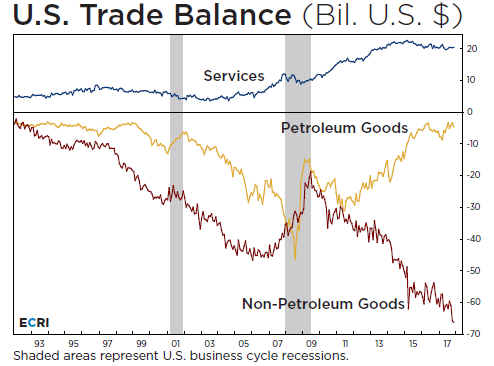
In the United States, there is absolutely a trade problem that needs to be addressed; the non-petroleum trade deficit has reached a record high so President Trump is certainly feeling pressure to act on this campaign promise. I am not sure this exact tariff is the best policy, but it is likely to go through nonetheless.

Non-Petroleum Trade Deficit:
A close up of a map Description generated with high confidence
Source: ECRI

The goal of this tariff to target steel industry manipulation by China, specifically the subsidized steel dumping through Canada. Steel and Aluminum only represent 1.5% of US imports and 1-2% of global trade. This specific tariff will not have large impacts. However, the retaliation and escalations of trade wars are what will impact markets.

As a general rule, the country with the largest trade deficit has the upper hand and the leverage in the negotiations. Put another way, Germany's exports as a % of GDP are 46%; South Korea, 42%; Mexico, 38%; Canada, 31%; China, 20%; and the United States, 12%. If all trade stopped tomorrow, the United States is hurt the least in terms of impact to GDP simply due to relative domestic demand. The United States does have the leverage in this negotiation. The specific industry, steel and aluminum are not a large portion of global trade so the market is likely overreacting. As retaliation attempts intensify, more market dislocations are likely.

William Koldus, author of The Contrarian: This is a loaded question. Tariffs are a tax, which is a negative; however, many governments and central banks are involved in providing subsidies and protection to various industries. Tesla (TSLA) is an example, in the United States, of a company that has received and benefited from government largesse. Thus, when is "free trade" really free trade?

Joseph L. Shaefer, author of The Investor's Edge®: Tariffs are not an economic policy. They are a political contrivance, a political convenience, a political negotiating tactic and, sometimes, economic suicide. See Smoot-Hawley 1930. (In fairness, in that case, the US placed tariffs on more than 20 THOUSAND products from abroad.)

Eric Parnell, author of The Universal: I am someone that believes in policies to improve the prospects of domestic manufacturers, having worked as an economist in anti-trust and trade issues in the past. However, I am someone that is strongly against tariffs as a policy to achieve this goal, as they work directly against promoting long-term economic growth and prosperity.

Tariffs are likely to lead to higher input costs not only for those manufacturers that import these inputs but also for those that rely on domestic production, as these prices are likely to rise as well in response to the pricing shift in the marketplace. These higher costs are likely to be passed along at least in part to customers, thus resulting in an indirect tax on businesses and consumers. Moreover, such protectionist trade actions have historically resulted in retaliation in kind by foreign governments, thus further dampening growth and resulting in additional negative pricing effects. While such policies may be well intended, they invariably end up being counterproductive in working to achieve their intended goals.

Kirk Spano, author of Margin of Safety Investing: Well, the short answer is that tariffs generally don't work well and have unintended consequences. History is ripe with those lessons. However, people often feel as if some foreigner has wronged them, so they support these usually counterproductive measures.

Certainly, in rare circumstances, very directed measures can be taken to counter a bad actor, but in those situations, the tariff is a last resort as other measures, such as domestic subsidies or bilateral trade negotiations are usually more productive.


Wednesday, 7 March 2018

ABSOLUTELY ESSENTIAL READING!!!

This is macro and micro, and addresses a critical issue - why aren't wages going up? You can jump to the bits you understand, and still get really good material for an essay - monopsony employers, union power, inequality, multiplier - it hits right on the nail one of the central questions that need to be answered in order to get some economic stability again. Very US-centric, but main points hold elsewhere:


Why American Workers Aren’t Getting A Raise: An Economic Detective Story
By Jonathan Tepper
For the past few months, I’ve been trying to solve an economic puzzle: why are wages growing so slowly despite a growing economy and a booming stock market?

Workers are productive and helping the economy grow, yet unlike previous economic expansions, we are hardly seeing big increases in wages. Instead, companies are sitting on their cash or giving it back to their shareholders through dividends and share buybacks.

The answer of why wages are not growing mattered a lot to me. A few years ago, some friends and I started Variant Perception a company that predicts the ups and downs of the economy using leading indicators. Before growth or inflation turn up and down, there are generally clues that tell you what is coming. For example, building permits provide a good warning sign that growth will turn up or down. When the US stopped building as many houses in 2005-06, it predicted the recession of 2007-08.

Our leading indicator for wages normally provides a 15 month advanced warning of changes in wages. It is pretty good and all the ingredients are the same ones that have accurately worked for decades, yet the relationship has broken down. It was annoying me: why are wages not following growth? I should know the answer to why this is happening. I should have all the tools, yet something appeared broken in the economy.


All the signs that should lead to higher wages are present. Today, employers are saying that it is hard to find workers and many small businesses say they expect to raise wages, initial unemployment claims are extremely low. This should be an economy that is good for workers to get higher wages, yet wages stink.

After a lot of research, I think the answers are clear. Let’s look at the problem.

Companies are keeping more of the economic pie

The flipside of low wages is that companies have taken a record part of the economic pie. Corporate profits as percentage of Gross Domestic Profit (GDP) are near record highs and labor’s share of GDP is near record lows. You can see from the following chart that the chart looks like a giant alligator jaws. The divergence started in the early 1980s when the regular rise and fall of corporate profits and workers’ compensation broke down.

The trend in corporate profits is a mystery to economists and investment strategists. Jeremy Grantham, a well-known investor, has pointed out, “Profits are the most mean reverting series in finance. If margins don’t revert something has gone wrong with capitalism.”

Employee compensation as a percentage of GDP has been falling for years
(Source: Economic Cycle Research Institute)

Something has indeed gone very wrong with capitalism. In a competitive market, if a company is making a lot of money, other companies will get excited by the prospects of high profits and will enter the industry and compete. Eventually margins decline as more competitors fight each other. That is how dynamic, capitalist economies should be. Something is profoundly broken with capitalism if corporate profit margins do not revert to the historical mean.

Rising industrial concentration is a powerful reason why profits don’t mean revert and a powerful explanation for the imbalance between corporations and workers. Workers in many industries have fewer choices of employer, and when industries are monopolists or oligopolists, they have significant market power versus their employees.

The role of high industrial concentration on inequality is now becoming clear from dozens recent academic studies. Work by The Economist found that over the fifteen-year period from 1997 to 2012 two-thirds of American industries were more concentrated in the hands of a few firms.(i) In 2015, Jonathan Baker and Steven Salop found that “market power contributes to the development and perpetuation of inequality.”(ii)

One of the most comprehensive overviews available of increasing industrial concentration shows that we have seen a collapse in the number of publicly listed companies and a shift in power towards big companies. Gustavo Grullon, Yelena Larkin, and Roni Michaely have documented how despite a much larger economy, we have seen the number of listed firms fall by half, and many industries now have only a few big players. There is a strong and direct correlation between how few players there are in an industry and how high corporate profits are.(iii)

Workers are productive but are not getting paid for it
Given the gaping disparity in pay between the average worker and CEOs, you might imagine managers were superstars and the average worker was bad at his job. But that is hardly the case. While many executives go on the front cover of Fortune or Forbes and get all the credit for their company stock, worker productivity has been steadily rising for decades. 
Unfortunately, earnings have not kept up with productivity increases. Workers are producing more goods with less labor, and companies are making higher profits, but the benefits are not being shared with workers. Notice that productivity growth has been rising in a straight line since the 1950s, but starting in 1980 hourly compensation has not risen much. The money from that gap doesn’t vanish into thin air, and it has to show up somewhere.


Disconnect between productivity and typical worker’s compensation
(Source: Economic Policy Institute)

Some economists have argued that the gap between wages and productivity is an illusion. They argue that much of the gap can be explained by year-end bonuses, which are not included in hourly pay, by healthcare costs, which doesn’t show up in a paycheck but the worker benefits from, and by stock options, which also doesn’t show up in a paycheck. However, we can discount these explanations. Healthcare, bonuses and options are a real expense to companies, and if companies were getting hit with these costs instead of wages, it would show up in corporate profit margins. Today, corporate profit margins would not be at record highs. If the divergence between wages and productivity is real, the difference should clearly shows up in corporate profits, and it does.

Companies have more market power

The economists Jan De Loecker of Princteon University and Jan Eeckhout of the University College London found that average markups, have surged since the early1980s. The average markup was 18% in 1980, but by 2014 it was nearly 70%. Higher markups suggest an increase in what economists refer to as “market power,” which is the result of more highly concentrated industries.

A markup may sound like a very technical term, but you see it in everyday life. The best example is in luxury goods, where the right logo on a handbag will make the leather sell for a lot more than it costs to make. Part of what you’re paying for is status and association.
De Loecker and Eechkhout noted that The rise in markups explains lower wages almost perfectly. They also found that “the rise in markups naturally gives rise to a decrease in the labor share, a decrease in the capital share, a decrease in low skilled wages, a decrease in labor market participation, and decrease in job flows.”(iv)


The Evolution of Average Markups (1960-2014)
 (Source: Jan De Loecker, Jan Eeckhout)

Market power has been rising in many industries. Americans have the illusion of choice, but in industry after industry, a few players dominate the entire market:
  • Two corporations control 90% of the beer Americans drink.
  • When it comes to high-speed internet access, almost all markets are local monopolies; over 75 percent of households have no choice with only one provider.
  • Four airlines completely dominate airline traffic, often enjoying local monopolies or duopolies in their regional hubs. Five banks control about half of the nation’s banking assets.
  • Many states have health insurance markets where the top two insurers have 80-90% market share. For example, in Alabama one company has 84% market share and in Hawaii one has 65% market share.
  • Four players control the entire US beef market.
  • After two mergers this year, three companies will control 70 percent of the world’s pesticide market and 80 percent of the US corn-seed market.
The list of industries with dominant players is endless.
After a wave of mergers, there is simply less competition.


Merger Manias 1890-2015: Merger Waves Are More Frequent and Bigger
(Source: Pine Capital)

Over half of all public firms have disappeared over the last twenty years. We’ve seen a collapse of publicly listed companies. Astonishingly, according to a study by Credit Suisse, “between 1996 and 2016, the number of publicly-listed stocks in the U.S. fell by roughly 50% — from more than 7,300 to fewer than 3,600 — while rising by about 50% in other developed nations.”(i) It is not lower growth or the global Financial Crisis that caused fewer IPOs. This is distinctly an American phenomenon.

The decline in listed companies has been so spectacular that the number lower is than it was in the early 1970s, when the real GDP in the US was just one third of what it is today.(ii) America’s economy grows ever year, but the number of listed companies shrinks. On this trend, by 2070 we will only have one company per industry.

Many workers are dealing with a monopsonist

In a monopoly, there is only one seller, while in a monopsony, there is only one buyer. The extreme example of a monopsony is a coal town in West Virginia, where the only buyer of labor is the coal company.

Large parts of America are dominated by monopsonies. In a comprehensive study, Marshall Steinbaum, Ioana Marinescu, and Jose Azar looked across all industries and commuting zones in the US to measure how concentrated employers were. They found that most labor markets are very concentrated and that it has a strong negative impact on posted wages for job openings.(v) They showed that going from a very competitive to a highly concentrated job market is associated with a 15-25% decline in wages.

The study shows that labor monopsony is not only pervasive across the US, but is especially so in non-metropolitan areas. This makes intuitive sense – smaller towns mean fewer employment options.


Areas with fewer employers have lower wages
(Source: Roosevelt Institute)

In a monopsony, workers have little choice in where they work and have little negotiating power for wages with employers. In a healthy economy, many firms would be competing equally for workers and would be incentivized to entice new hires with higher wages, better benefit packages, and few restrictions on their next career moves. But monopsonies make it easier for firms to depress worker wages. The classic example of this is a coal-mining town, where the coal plant is the only employer and only purchaser of labor. Today, in many smaller towns, WalMart is the new coal plant – and is the only retail company hiring.

Many firms are able to suppress the bargaining power of labor by making labor markets less competitive. Economists Jason Furman and Alan Krueger argue that firms in concentrated industries are able to suppress wages through collusion and non-compete agreements that cover 20% of American workers.(vi)

Many workers live in a rural area with less choice of jobs

Today, the story of America is largely the story of two economies – rural and urban. It was not always this way. The antitrust movement of the 1940s not only targeted giant firms, but was also an attempt to weaken regional centers that had amassed too much power. This largely worked and, by the mid 1970’s, there was a fairly uniform American standard of living – being middle class in the Mideast was pretty much the same as middle class in New England. However, in the 1980s, many of the policies that helped ensure this balance between regions was neglected or reversed.

A great divide formed between rural and metropolitan areas in the US. In 1980, if you lived in Washington D.C., your per-capita income was 29 percent above the average American; in 2013 you would be 68 percent above. In New York City, the income was 80 percent above the national average in 1980 and skyrocketed to 172 percent above by 2013.(vii) Power and money began concentrating in urban centers across the country as a rural ‘brain drain’ occurred.
Major cities attract diverse talent and many corporations, which must bid competitively for workers. Workers living in these cities make significantly more money than workers elsewhere. There is power in numbers, and nurses who have 5 metropolitan hospitals to choose from will make more money than those who work in a town with only one hospital.


Rural Areas Are Lagging
(Source: Bloomberg, Shift: The Commission on Work, Workers, and Technology)

CEOs are getting paid a lot more than workers

In the US CEO pay has exploded. From 1978 to 2013, CEO compensation adjusted for inflation increased 937%. By contrast, the average worker’s income grew by a pathetic 10% over the same period. To put the change in perspective, the CEO-to-worker pay ratio was 33-to-1 in 1978 and grew to 276-to-1 in 2015.(viii) The US is a big outlier in terms of how vastly overpaid the top corporate officers are vs the average worker. For CEOs in the UK, the ratio is 22; in France, it’s 15; and in Germany it’s 12.(ix) US CEOs are vastly overpaid no matter how you look at it.


Rising CEO-to-Worker Compensation Ratio
(Source: Economic Policy Institute)

There is no countervailing force to high CEO and low worker pay
Unions maintained an important part in American working life for decades, but then declined again. In 1983, about 1 in 5 Americans were part of a union; today, only 6.4% of private sector workers in America are unionized and less than 11% of total workers.(x) This represents a considerable decline in the ability of workers to organize. Unions, though controversial, provided a needed forum for workers to band together and advocate for their collective rights.


Falling Union Membership and Lower Middle Class Share of Income
(Source: The Atlantic)

Inequality is inversely related to union membership. If you plot the percentage of national income going to the top 10%, as you can see it is almost the perfect mirror image. When union membership is low, a higher percentage of income goes to the top 10%. This may help, in part, to explain recent trends in income inequality.


Union Membership vs Income Distribution to Top 10%
(Source: The Atlantic, Emin M. Dinlersoz and Jeremy Greenwood) (xi)

Managers collectively represent thousands if not millions of shareholders. Union leaders may likewise represent thousands if not millions of workers. The strength of unions, however, does not come merely from concentrating forces but from the real threat of strikes. There is an extremely high correlation historically between the index of the number of strikes in the US with the wage growth of workers. Today, strikes are extremely rare, and this in part explains why wages are so low.


Wage growth closely associated with strikes
(Source: Taylor Mann, Pine Advisors)

I’m writing a book on monopolies, monopsonies and how they are affecting startups, workers’ pay and economic growth. This is just a small part of some of the ideas in the book.
If you liked this post, let me know and I’ll keep you posted on further charts, blog posts and let you know when my book is coming out.


(ii) Baker, Jonathan and Salop, Steven, “Antitrust, Competition Policy, and Inequality” (2015). Working Papers. http://digitalcommons.wcl.american.edu/fac_works_papers/41/
(iii) Grullon, Gustavo and Larkin, Yelena and Michaely, Roni, Are U.S. Industries Becoming More Concentrated? (August 31, 2017). Available at SSRN: https://ssrn.com/abstract=2612047
(iv) Jan De Loecker, Jan Eeckhout, “The Rise of Market Power and the Macroeconomic Implications”, (August 2017) NBER Working Paper No. 23687 http://www.nber.org/papers/w23687
(i) Credit Suisse, The Incredible Shrinking Universe of Stocks: The Causes and Consequences of Fewer U.S. Equities http://www.cmgwealth.com/wp-content/uploads/2017/03/document_1072753661.pdf
(ii) Grullon, Gustavo and Larkin, Yelena and Michaely, Roni, Are U.S. Industries Becoming More Concentrated? (August 31, 2017). Available at SSRN: https://ssrn.com/abstract=2612047
(v) http://rooseveltinstitute.org/how-widespread-labor-monopsony-some-new-results-suggest-its-pervasive/ and Azar, José and Marinescu, Ioana Elena and Steinbaum, Marshall, Labor Market Concentration (December 15, 2017). Available at SSRN: https://ssrn.com/abstract=3088767
(vi) Why Aren’t Americans Getting Raises? Blame the Monopsony, Jason Furman and Alan B. Krueger Wall Street Journal https://www.wsj.com/articles/why-arent-americans-getting-raises-blame-the-monopsony-1478215983
(vii) Longman, Phil. “Why the Economic Fates of America’s Cities Diverged.” Nov 28, 2015. https://www.theatlantic.com/business/archive/2015/11/cities-economic-fates-diverge/417372/
(x) Bureau of Labor Statistics. “Union Members Summary.” January 26, 2017. https://www.bls.gov/news.release/union2.nr0.htm