Quote of the day

“I find economics increasingly satisfactory, and I think I am rather good at it.”– John Maynard Keynes

Monday, 6 May 2024

Globalisation and poverty - a counter-factual


Globalisation may not have increased income inequality, after all

A new study questions the received wisdom on trends within countries

photograph: stephen shaver/upi/shutterstock
Listen to this story.
 Enjoy more audio and podcasts on iOS or Android.

Working out who earns what is surprisingly tricky. Both the very rich, who sometimes try to keep their wealth from the taxman, and the very poor, who are sometimes mistrustful of clipboard-wielding officials, are especially hard to pin down. Nevertheless, before the covid-19 pandemic, household surveys consistently found a fall in the number of people living in poverty. The World Bank counted 659m living on less than $2.15 a day in 2019, down from around 2bn in 1990.

Yet this progress came at a cost: a global “precariat” emerged, members of which were barely out of poverty and perilously exposed to shocks, while the top 1% got rich faster. That, at least, is the received wisdom. The World Inequality Database, a project associated with Thomas Piketty and Gabriel Zucman, two economists, combines tax data with other sources of information to estimate the incomes of the uber-rich. They have found that although inequality between countries has fallen, as the rest has caught up with the West, within countries it may have risen. Chinese and Indian elites have done the best relative to their countrymen. American and European plutocrats, who are busy stashing wealth in tax havens, have done well, too.

A new paper by Maxim Pinkovskiy, Xavier Sala-i-Martin, Kasey Chatterji-Len and William Nober, economists at Columbia University and the New York branch of the Federal Reserve, challenges this picture. The researchers look at how likely people in different parts of the income distribution are to understate their income. They find that as the poor become richer, they become more likely to do so. Once adjustments are made for this, poverty has fallen faster than previously thought, and inequality within countries has not risen. It may even have fallen slightly.

To reach this conclusion, the authors look at the difference between estimates of income from regional household surveys and gross domestic product in the same area. When surveys imply that a region has less overall income than official figures, it suggests more income is going unreported. The researchers find that the richer an area, the larger the gap tends to be. This makes sense, notes Mr Sala-i-Martin. As a subsistence farmer becomes a small business owner or market trader, he develops more complex income streams and has more incentive to mislead the taxman.

If the finding holds, it changes the history of globalisation. Rather than a precariat, the researchers conclude that a “true global middle class” has emerged. Its members will not be plunged back into poverty by a financial crisis or a pandemic.

Yet the study will not be the final word. Economists have been arguing about trends in global inequality—and the quality of the data that lie beneath them—for decades. When it comes to the world’s richest people, the new research has more to say about the top 10% than the top 1%, who are widely believed to have done so much better than the rest. Like most papers, this one relies on assumptions that could be challenged by other researchers. Working out the global income distribution is one thing; convincing others you have the right answer is quite another.

Sunday, 5 May 2024

Some charts to give food for thought

 If you can interpret these they provide good material for conclusions (monetary policy, recession etc.). The first shows Fed hiking cycles and recessions - most, but not all, were followed by recessions:


The next is how long after the first hike the recession began; it is 25 months since the Fed's first hike:


The average is 26 months. The data won't be in before your exam but you can talk about it.

Next is the infamous yield curve:


The grey bars are recessions. Look at the inversion points and note that the inversion declined (usually) before recession hit.

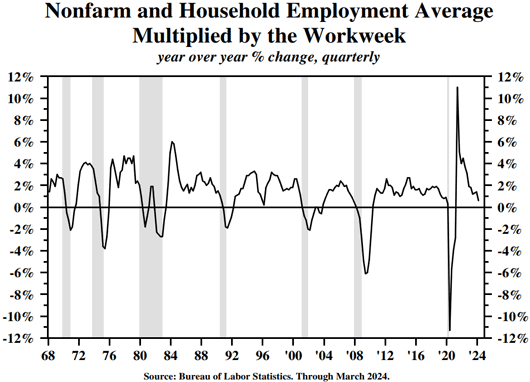
Finally, some job numbers. This is the US Non-farm payroll, THE most closely watched employment number; that last release (Friday) was a "miss" - 240,000 jobs forecast, actual was 170,000:


Again, look at the grey bars, where the jobs numbers were before and where they appear to be headed now. It will prove particularly interesting if inflation turns out to be sticky!


Saturday, 4 May 2024

A quick look at the problems for fiscal policy when interest rates are tackling inflation


Higher interest rates make government debt unviable as an economic solution

Big economies such as the US must change fiscal policy as the realities of debt and inflation bite

For more than a decade, numerous economists – primarily but not exclusively on the left – have argued that the potential benefits of using debt to finance government spending far outweigh any associated costs. The notion that advanced economies could suffer from debt overhang was widely dismissed, and dissenting voices were often ridiculed. Even the International Monetary Fund, traditionally a stalwart advocate of fiscal prudence, began to support high levels of debt-financed stimulus.

The tide has turned over the past two years, as this type of magical thinking collided with the harsh realities of high inflation and the return to normal long-term real interest rates. A recent reassessment by three senior IMF economists underscores this remarkable shift. The authors project that the advanced economies’ average debt-to-income ratio will rise to 120% of GDP by 2028, owing to their declining long-term growth prospects. They also note that with elevated borrowing costs becoming the “new normal”, developed countries must “gradually and credibly rebuild fiscal buffers and ensure the sustainability of their sovereign debt”.

This balanced and measured assessment is far from alarmist. Yet, not too long ago, any suggestion of fiscal prudence was quickly dismissed as “austerity” by many on the left. For example, Adam Tooze’s 2018 book on the 2008-09 global financial crisis and its consequences uses the word 102 times.

Until very recently, in fact, the notion that a high public debt burden could be problematic was almost taboo. Just this past August, Barry Eichengreen and Serkan Arslanalp presented an excellent paper on global debt at the annual gathering of central bankers in Jackson Hole, Wyoming, documenting the extraordinary levels of government debt accumulated in the aftermath of the global financial crisis and the Covid-19 pandemic. Curiously, however, the authors refrained from clearly explaining why this might pose a problem for advanced economies.

This is not merely an accounting issue. While developed countries rarely formally default on their domestic debt – often resorting to other tactics such as surprise inflation and financial repression to manage their liabilities – a high debt burden is generally detrimental to economic growth. This was the argument Carmen M Reinhart and I presented in a brief article for a conference in 2010 and in a more comprehensive analysis we co-authored with Vincent Reinhart in 2012.

These papers sparked a heated debate, frequently marred by gross misrepresentation. It did not help that much of the public struggled to differentiate between deficit financing, which can temporarily boost growth, and high debt, which tends to have negative long-term consequences. Academic economists largely agree that very high debt levels can impede economic growth, by crowding out private investment and by narrowing the scope for fiscal stimulus during deep recessions or financial crises.

To be sure, in the pre-pandemic era of ultra-low real interest rates, debt really did seem to be cost-free, enabling countries to spend now without having to pay later. But this spending spree rested on two assumptions. The first was that interest rates on government debt would remain low indefinitely, or at least rise so gradually that countries would have decades to adjust. The second assumption was that sudden, massive spending needs – for example, a military buildup in response to foreign aggression – could be funded by taking on more debt.

While some might argue that countries can simply grow their way out of high debt, citing the US postwar boom as an example, a recent paper by the economists Julien Acalin and Laurence M Ball refutes this notion. Their research shows that without the strict interest rate controls the US imposed after the end of the second world war and periodic inflationary surges, the US debt-to-GDP ratio would have been 74% in 1974, instead of 23%. The bad news is that in today’s economic environment, characterised by inflation targeting and more open global financial markets, these tactics may no longer be viable, necessitating major adjustments in US fiscal policy.

 Kenneth Rogoff is professor of economics and public policy at Harvard University. He was the IMF’s chief economist from 2001-03.

Thursday, 2 May 2024

Innovation (potentially) - made in the UK:

 Why the world’s fifth-richest man is taking a $1bn ‘bet on Britain’

Oracle founder taps Tony Blair to help lead efforts to create UK companies worth billions

Larry Ellison, who founded American software giant Oracle, has a net worth of roughly $146bn
Larry Ellison, who founded American software giant Oracle, has a net worth of $146bn CREDIT: TORU YAMANAKA/AFP via Getty Images

One of the world’s richest men will create tens of thousands of UK jobs as part of a $1bn “bet on Britain” that will see cash poured into creating batteries and fighting superbugs.

Larry Ellison, the founder of American software giant Oracle, announced last year that he was building a new research institute in Oxford to “help solve the world’s great problems”.

The Ellison Institute of Technology (EIT) in Oxford, which is being headed by Sir John Bell, is working with former Labour prime minister Sir Tony Blair to create homegrown companies worth billions of pounds.

“It’s absolutely a bet on Britain,” said Sir John, who is known for his role in steering the Covid vaccine rollout. “He could have placed this anywhere in the world and he’s chosen to place it here for a couple of reasons.

“One is that we have some great universities and great scientists. And on the whole, the output of that science has not been very effectively exploited in the UK.

“It’s a real opportunity to round some of that excellent science up and make it deliver at scale against the big global problems.”

The $1bn Ellison Institute of Technology (EIT) in Oxford promises to 'help solve the world's great problems'
Oxford's $1bn Ellison Institute of Technology promises to 'help solve the world's great problems' CREDIT: Foster + Partners

Sir John explained that the world’s fifth-richest man has been drawn to Britain because he believes the country is not fulfilling its potential.

The former Oxford Regius professor, who gave up a position he held for more than two decades to take the role, said Ellison would create “tens of thousands” of UK jobs in the coming years in areas such as medicine, food security, clean energy and government policy.

The idea driving the $1bn (£800m) Oxford campus, which opens next year, is that the US mogul will do more than just invest millions of pounds into existing companies.

Instead, Ellison, Sir John and Sir Tony want to build companies in the UK from scratch.

Sir John, a 71-year-old Canadian immunologist, said the Institute’s priorities included trying to create a new superfuel that replicates the energy that powers the sun.

If successful, nuclear fusion could provide almost limitless clean and affordable energy to meet the world’s demand.

He also wants to invest in battery technology to power drones and other large vehicles.

“We not only want to produce green energy, but we want to store it as well,” said Sir John, who was formerly an adviser to the Government on its life sciences strategy. “Batteries for airplanes, batteries for ships, batteries for everything.”

Part of the motivation is to break China’s dominance in a sector that has so far focused on electric vehicles. But Sir John insists the EIT’s mission is bigger.

“Of course, there is a geopolitical argument. Obviously, we’ve got Tony Blair involved, and he’s there for good reason. But we’re not picking a fight with China. We just think we can do things just as good as them.”

Sir John is also planning to play to his strengths and create a database of infectious diseases that could be used to identify and fight superbugs, as well as combat the growing problem of antimicrobial resistance.

All these endeavours are designed to help arrest the slow decline of British companies that have been forced to look to overseas investors for cash.

Sir John, who has previously branded London a “bad place” to raise money, said this bet on Britain was designed to retain some of the country’s success stories.

“We don’t really have the productive capital in this country to allow us to scale and to take bets on some of this technology as it evolves,” he said. “That is the big problem.

“And I think if there was more access to that capital, I think we would have more successful companies that would have gone on and commercialised products and ultimately sold them and paid more tax.

“There have been massive subsidies for science research and development. And the trouble is if no companies ever pay that tax [back when they make a profit], you can imagine that the Treasury starts to get a bit grumpy. So we really need to turn that corner and make that happen. But it is the lack of capital which is holding us back.”

However, he concedes that moving the dial won’t be easy.

“I think this [money] gives us an opportunity to demonstrate that it can be done,” he said. “We’ll train people to be able to do it. We will have a cohort of people growing companies here, which can expand and help grow other companies. And it’ll perhaps be proved to other people, other investors, that this may not be such a bad place to invest.”

Ellison stepped down as Oracle chief in 2014 but remains its biggest shareholder and has a net worth of roughly $146bn.

The US billionaire, who races yachts and collects samurai swords, is reportedly pushing Donald Trump to pick senator Tim Scott as his running mate in the 2024 presidential election.

Although Ellison is an unorthodox character, his money and ambitions are very real.

Public filings show he has donated $44m to Tony Blair’s think tank and earmarked a further $272m for future donations to “support effective governance work in Africa”.

Ellison has already given $44m to Tony Blair's think tank – with a further $272m earmarked for donations
Larry Ellison (left) is set to hand Tony Blair's think tank donations totalling more than $300m

The EIT could also soon be involved in shaping government policy. It is no secret that Sir Tony is a fan of digital ID cards that proponents say will make it easier for people to access public services and for policymakers to target support.

Critics argue they involve too much state intrusion.

Darren Jones, shadow chief secretary to the Treasury, is also understood to be very interested in digital IDs.

A Labour victory in this year’s general election could see Blair’s think tank team up with the EIT to deliver such a scheme.

Sir John said it’s early days, and stressed that his institute is apolitical.

He said: “We’re not an arm of the Labour Party. The ideas and the innovations that we’re going to generate should be of interest to any party. If we get another Conservative government, I think they will be very enthusiastic about what we’re doing as well.”

Sir John is confident the Oxford site will be home to a new generation of fast-growing companies, though he admits there are challenges ahead.

“We just don’t have a lot of really good examples in life sciences at least where we’ve grown companies, kept them in the UK and grown them to be global leaders,” he said.

“And as a result, I think people are sceptical. I think this gives us an opportunity to demonstrate that it can be done.”