From Merryn Somerset-Web's Moneyweek blog
In my interview with author Peter Frankopan on the Silk Roads this week (see the upcoming issue of the magazine for the write up – the video will be up here soon), we talked about the longevity of quality infrastructure. Goods are still moving back and forth along exactly the same east-west/west-east Silk Road routes between, say, Germany and China, as they were 2,500 years ago. Those goods might have been moved on horseback then, and via three-mile long freight trains now, but you don’t really need a new map to follow their paths.
During the conversation, I mentioned to Peter that I had seen some fascinating research on the way in which European development has followed the paths of the 80,000km of roads built by the Romans: we think their empire is long gone, but we are still using the infrastructure the Romans put in place. Several of you have asked for the source for this. So here it is.
This link is to a presentation given by a group of academics in 2014. The title pretty much sums it up (Roman Roads to Prosperity: The Long-run Impact of Transport Infrastructure), but it’s worth looking at the slides and the conclusion. If you accept that night-time light intensity is a proxy for economic development (which I think you can – note how dark poor North Korea is at night), you will see that the roads built in Roman times are still with us – in a good way.
The report finds a “persistent positive effect of Roman roads on current levels of light intensity”. Why? In the short term, it was about security. In the medium term, it was just because they were there – the Dark Ages didn’t have much to offer, but at least the roads were there as one of the few functioning modes of communication. And in the long term, it was because populations stayed settled along established routes. For 2,000 years.
The link takes you to the slide show, but it is a bit impenetrable without the commentary (I will be looking at the interview with Peter Frankopan, as he is a highly respected commentator on China, and you may know that China is proposing to re-build the silk road routes in order to facilitate trade.

Blog resource for 6th Form, with contributions from teachers and students.
Thursday, 5 November 2015

Sunday, 1 November 2015
Wide ranging article on UK outlook, long but persevere
North vs South
THE SOUTH: London's pulling power
Captain Karen Atherton dips the nose of her Airbus A318 jet and British Airways flight 004 from New York bumps its way down through the morning clouds towards Docklands. There never used to be much to see on the final approach to London City Airport. Heathrow it wasn’t. But look out of the window today and you can make out the future of the capital.
To the left, past the new Olympic Village, there’s Stratford Crossrail station, where trains to Paddington will soon plunge into the world’s longest high-speed commuter tunnel. To the right, 20 new skyscrapers are rising at Canary Wharf. Ahead, over the Emirates Air Line cable car, 25,000 homes are being built on Greenwich Peninsula and around the Royal Docks.
Peer back over the twisted trapezoid extension to Tate Modern and you can make out the chimneys at Battersea Power Station, which are being rebuilt as part of a £15bn redevelopment. Further west lie the remains of the demolished Earls Court exhibition centre, the first stage of a £10bn reconstruction of the area. Everywhere you look, cranes pinpoint new developments like giant tacks in a real-life A-Z map.
London is rebuilding itself. It’s not just an impression from 10,000ft. It’s a fact. The property consultancy Arcadis has analysed planning consents, public and private investment plans, and housing and jobs growth from now until 2030. Its research shows that more than £620bn will be invested in the capital in the next 15 years.

“If London’s economy continues to grow at its long-term rate of about 5% a year, that figure could easily rise to £650bn, more than is being invested in any other city in the world,” says Simon Rawlinson, head of research at the King’s Cross-based analysts.
£650bn is an almost unimaginably huge sum. It is one-third of the entire GDP of Britain, the value of everything we produce in a year. It’s easier to think of it as about £75,000 for every Londoner — £5,000 per head, every year. What will it be spent on? Rawlinson’s research reveals 700,000 new homes, 70m sq ft of new office space and more than 10m sq ft of retail. The biggest single sum, £320bn, will be sunk into infrastructure, mainly Crossrail, the extensions of the Northern and Bakerloo Underground lines, the HS2 high-speed rail line from London to Birmingham and a new third runway at either Gatwick or Heathrow — if that ever happens.
London was founded on the Thames. The Romans used it for trade. It’s the same for today’s empire builders. Most of the big new developments in the capital — also built by foreigners — are close to the river. So, to get a sense of how the £650bn will transform my home town, I decide to go for a walk from Battersea, heading east.
The most obvious change is architectural. The skyline is getting helter-skeltery. I lose count of the half-built hollow-eyed towers that stretch to the horizon before I even reach Lambeth Bridge. Fortunately, Peter Murray knows the number — because he has built them all. There they all are in the giant scale model of central London at the entrance to the offices of New London Architecture, a think-tank in the West End, where he is chairman.
“More than 260 towers more than 20 storeys high are being developed,” he tells me. That’s a four-fold increase on the number already built. I take a close look at Murray’s model. Most of the towers are residential. After centuries of aspiring to a terraced or semi-detached home with a garden, London families are going to have to get used to living in apartments, Manhattan-style.
 Londoners have long cherished their city’s distinctly un-Manhattan character, in particular its low-rise skyline. Do all the new towers make the capital more handsome or merely reduce it, as many critics say, to “Dubai on Thames”? I decide to ask Tony Pidgley, the boss of one of London’s biggest home builders, Berkeley Group, when we meet in his latest development next to Tower Bridge. Tall buildings are “like tall, beautiful women,” he declares, flinging his jacket on the floor as he rushes around the marketing suite. “They make a great statement.”
Perhaps. But as I pass the latest block, decorated with slogans that assure me I will “live the life I deserve”, provided I plonk down £1m for a poky studio flat, I have my doubts. To my right, Strata, better known as the “Philishave Tower” in Elephant & Castle is not just ugly, it’s silly. It gets worse when I reach the City. There, the outsized Walkie Talkie expands as it rises to cram in as much floor space as possible and ends up crashing into the skyline like an unwelcome party guest.
John Paul Maytum, an NHS worker whose council flat in Bermondsey looks out over the Walkie Talkie, hates tall buildings, but not because of their architecture. He thinks they have turned his life — his city — upside down. He invites me into his £100-a-week home and points towards the empty apartments at the top of the Shard, where the lights are never on and no one is ever home.
“I don’t mind people living in towers — I live in one — but I do mind people buying a home in a tower as an investment and not using it,” he says. “People who don’t want to live here are investing and driving up prices for people who do. Londoners are being priced out.”
He’s right to say London’s social geography is changing. It’s not just that tall buildings are now for rich people, not poor people, as they were when they first began to be built in the 1950s. The latest figures confirm that rising rents, benefits cuts and a shortage of low-cost homes are driving a growing number of Londoners out of the city. In the year to the end of March, councils moved low-income households out of the capital 1,653 times, up 28% on the previous year. The problem will get worse as councils sell off homes under the government’s revamped right-to-buy initiative, critics say.
Walking across London, the other change you can’t miss is the emergence of vast new residential and commercial neighbourhoods. Battersea Power Station and Nine Elms, which will become a hub of 18,000 new homes, roads and railway stations and the new fortress-like American embassy, is the most obvious. Then there are the 15,000 flats that will soon cover Greenwich Peninsula, south of the O2 arena. Canary Wharf, just across the river, is doubling in size to 30m sq ft, with the development of the adjacent Wood Wharf.

“It’s amazing to think that, only 30 years ago, this was a wasteland where you only went if you wanted to be killed or hire somebody to kill someone for you,” jokes the development’s boss, Sir George Iacobescu, in a nod to the 1980 gangster film The Long Good Friday, which was set in the abandoned Docklands. I meet him on the top floor of One Canada Square — once Britain’s tallest building, but now a relative tiddler.
Further afield, almost 8,000 new homes will transform Earls Court, while King’s Cross, Stratford, Brent Cross, the Royal Albert Dock and Victoria are being almost completely rebuilt as commercial hubs.
Big new developments, for the rich or the poor, can be soulless. But that’s not the way Janice Gray, a hairdresser, sees it. She and her family have lived amid the abandoned car parks and concrete walkways of the Royal Albert Dock ever since the last vessel docked in 1981. She welcomes the £1.7bn redevelopment of the area, led by the Chinese business park entrepreneur Xu Weiping. “People will care about it again, just like they care about Canary Wharf,” she says.
The biggest development in London is the one Londoners cannot see — yet. The £16bn east-west Crossrail, the 26-mile-long tunnel section of which was completed in June, will increase rail transport capacity by 10% when it opens in 2018 and carry 200m passengers a year, three times the population of Britain.
Who will gain from all the capital’s gains? Many who now rent, but are desperate to buy, will find it easier to get on the housing ladder. As many as one-third of the 700,000 new homes that will be constructed between now and 2030 will be owned by councils or by housing associations. A further 20% will be aimed at the middle “affordable” market. But will it be enough to solve the housing crisis? Not, alas, if London’s population continues to grow as forecast. Arcadis calculates that 900,000 new homes — 200,000 more than the 700,000 being built — will be needed by 2030.
Nor are the new homes likely to answer the complaint of Maytum and many others that London is becoming the preserve of the rich, many of whom can’t even be bothered to live in their London homes. Can anything be done to combat what many are calling “social cleansing”?

Yes, says Peter John, Southwark council’s Labour leader and Maytum’s landlord. What’s more, he insists that he and other council leaders are already doing it. They are using “the once in a lifetime opportunity of London’s economic boom” to build new homes. Developers pay councils up to £100m when they negotiate planning consents for big developments, such as the Shard. Councils plough that cash back into social housing. In Southwark, John is building 11,000 new council homes, for which one-quarter of the £3bn cost will come from private developers.
Geographically, it is the east of London that will benefit most from all the pennies from heaven. Ever since the 1980s, when Clerkenwell became fashionable, the capital’s centre of gravity has been shifting ever eastwards. Shoreditch, Hackney, Spitalfields, Whitechapel and Stratford have all become go-to locations, especially for the young. To that list, we can now add Silvertown, Woolwich Arsenal, Greenwich Peninsula, the Royal Albert Dock and Barking on the river, and further away Leyton, Walthamstow and Plaistow. The population of the fastest-growing eastern boroughs is rising by almost 50% year on year.
One question keeps recurring when you look at all the new developments in London. When public expenditure is being slashed as the government tries to reduce the deficit, how come one-third of GDP is being spent in the capital? The answer is, it isn’t our money that’s being spent. We’ve out-sourced the budget. “London enjoys more overseas investment than any other city in Europe and probably the world,” says Professor Tony Travers of the London School of Economics. Qatar, Malaysia, Singapore, China and the US are the biggest investors.
I meet the bosses of some of the developers on my travels. Winnie Chiu, a former banker from Hong Kong, and I chat over a plate of light-as-air prawn dim sum in Shikumen restaurant in the Dorsett, the hotel she recently opened in west London. She is sinking up to £300m into hotels and real estate. In Greenwich, I have tea with the Hong Kong-born Sammy Lee, whose firm, Knight Dragon, is spending £5bn rebuilding the 150-acre Greenwich peninsula. Investment by women such as Chiu and men such as Lee will improve things for many Londoners. But many question whether their cash, and the billions more being sunk into the capital, will make Britain, as a whole, better.
Tom Bloxham is a good man to provide the answer. He is the leading developer in the north of England. His Manchester-based firm, Urban Splash, has spent £1bn building more than 5,000 homes north of Watford. As a “Manc”, you’d think he’d be a professional London-hater. Quite the opposite. “London refreshes the parts of Britain other cities cannot reach,” he tells me over a glass of sauvignon blanc which seems a bit poncey for a man who likes old Victorian warehouses more than people. “The more that is invested in London, the better it does, and, in turn, the better Britain does.”
 Travers has the numbers that confirm Bloxham’s analysis. London produces one-quarter of our national income — £350bn of value a year, even though it has only 15% of the workforce. One pound of every five earned in London is spent elsewhere in the country. More than one-quarter of all tax raised in Britain is raised in London and more of it is spent outside the capital than in it.
Can London carry on booming? And even if it does, is it a good thing? Professor Danny Dorling of Oxford University sees trouble ahead. London, he argues, “depends on absurdly over-inflated property and financial services sectors” and is riding for a spectacular fall that will damage Britain as a whole.
“When the skyscrapers were put up with abandon in Manhattan in the late 1920s, just as they are in London now, speculators thought the boom times would last for ever and they would make millions,” he says. “But the market crashed in 1929 and it took 40 years before buildings so high were seen again. Every boom ends.”
Others disagree with equal passion. Back in the marketing suite in One Tower Bridge, Pidgley picks his jacket up off the floor and rushes for the door. We walk and talk a bit. Does he feel like a neo-Victorian, casting the capital anew, I ask. The former Barnardo’s boy who spent some of his childhood living in a disused railway carriage, looks out over a cityscape, much of which he has built, and explodes with laughter. “I’ve been called a lot of f****** things in my life but never that.” He then pauses and thinks. “I’ll tell you one thing, though: if you think the last decade has been exciting, you ain’t seen nothing yet. This city has only just begun.”
THE NORTH: new cities of gold?
 Die-hard Manchester United fans still wear the team’s red shirts with the iconic white Sharp logo on the front. “We were quite decent then,” says Andrew Daniels. Sharp hasn’t been United’s main sponsor since 2000 — it’s America’s Chevrolet now — but the Japanese electronics firm is key to Daniels’s future and that of his hometown.
The 32-year-old runs Degree 53, a digital design agency, from an office in what used to be Sharp’s microwave distribution centre for Europe, in Manchester. The abandoned warehouse was recently converted into a 200,000 sq ft tech incubator for hundreds of entrepreneurs, who run start-ups that generate £30m a year. “The kids here show what the northern powerhouse can be,” says Sue Woodward, the Merseyside-born former managing director of ITV Granada, who set up the hub, known as the Sharp Project.
Ah, the northern powerhouse. When the chancellor, George Osborne, unveiled the idea a year ago, most people dismissed it as a pre-election gimmick to grab votes up north. Nick Forbes, the Labour leader of Newcastle City Council, said it “sounds more like a gay club I used to go to in the 1990s” than a bold economic initiative to reverse the seemingly endless drift south of people and money.
But sitting in the sun in his mid-20th-century-modern office near the banks of the Tyne, Forbes is not making fun of the idea any more. “I’m very optimistic about it,” he says. That’s because the first chancellor to represent a northern English constituency since Denis Healey has made the north a priority. “We need a northern powerhouse that can take on the world,” Osborne says.
He has pledged £13bn to upgrade roads and railways, £250m for a new science research centre in Manchester and £78m to build a home for the acclaimed Manchester International Festival of the Arts, to be called The Factory — a homage to Factory Records, the label behind Joy Division, New Order and the Happy Mondays.
Osborne also wants to join forces with the Labour leaders of northern city councils, giving them new powers to attract investment, provided they agree to co-operate with other northern cities rather than compete against them, as so many do now. He’s wooing even odder fellow travellers abroad. The Chinese president, Xi Jinping, visited Manchester last week, for the announcement of a direct air link between Manchester and Beijing. Tax breaks to encourage Chinese firms to invest in the north are also planned.
 British governments, red and blue, have tried for decades to address what is politely known as “the regional question” and less politely as the “it’s grim up north” question. Can Osborne, a right-winger who grew up in London and is a member of the Tories’ wildly privileged Notting Hill set, really succeed where so many others have failed?
“He’s got a strong political motive,” just about every Tory — and Labour — MP I meet in the north of England tells me. With Scotland lost to the nationalists and Jeremy Corbyn’s poll ratings under water in the prosperous south, “attacking Labour here could hobble it for good,” says one of the few northern Tory MPs, gleefully.
There’s a strong economic incentive, too. The professional northerner in charge of the powerhouse, the Treasury minister Lord (Jim) O’Neill of Gatley, points out that the world’s stongest economies boast dozens of successful cities, not just one really big one. Germany has eight cities whose economies are as big as, if not bigger than, Berlin’s. By contrast, only one of England’s second-tier cities — Bristol — generates GDP per head above the national average. O’Neill, former chief economist at Goldman Sachs, calculates a resurgent England outside London could generate an additional £80bn over the next 15 years. “If we had done that over the past 15 years, we’d have no deficit now,” he says.
But he and Osborne are battling years of industrial decline and neglect. Take transport — the litter-strewn, two-carriage Northern Rail train that travels the 40 miles from Newcastle to Middlesbrough, to be precise. I board on a sunny afternoon. It’s an hour and a half before I get off. That’s almost as long as it takes to get from London to Paris on the Eurostar, a journey seven times further. “We stop at every lamppost,” the driver tells me. He’s joking. I think.
I fill the time on northern trains — there’s plenty of it — talking to commuters, and it’s not long before I come across another challenge. Strong local identity means Osborne’s dream of getting cities to work with, not against, each other will be tough. David Crow, an accountant, on his way from his office in Newcastle to his home in Edgecliffe, tells me that so little love is lost between Sunderland and Newcastle that “if I were to go into Sunderland in a Toon top [Newcastle’s black-and-white football shirt], I’d be lynched”. He’s not joking. I think.
Deprivation is entrenched in the north. London may be the most socially divided city in the country, but there are more people living in poverty in the north than in the capital, and more who have been living in poverty for longer. More than one in five households in the northwest, and two in five children in Greater Manchester, live in poverty, according to the Institute for Public Policy Research.
In Toxteth, Liverpool, one of the most run-down areas in the north, I can buy an abandoned council house for £1. All I have to do is agree to spend about £35,000 doing it up and live in it for five years. Carol has lived in the area all her life in one of the nicer council houses. Over tea in the Local Solutions support centre, she tells me: “Osborne has no idea how powerless poverty makes people feel.” Her ash-grey skin creases like cigarette paper as she frowns. “There are food banks,” she says. “When I was growing up, there was food and there were jobs. There’s not even shop work any more. Some days, it’s so bad I feel like jumping off the roof.”
Osborne faces political problems, too. Some Labour council leaders want to grab the new powers he’s dangling to attract new investment. Manchester, in particular, has pioneered partnerships with other northern cities and private-sector firms to develop everything from the Manchester Ship Canal to the city’s Hotel Football, backed by former United stars including Ryan Giggs and Gary Neville. Struggling to make himself heard over the clang-clatter of the tea trolley down the vast, gothic hallways outside his office, Sir Richard Leese, leader of the city council, praises Osborne as “a rarity, very astute”.
 Tony Blair’s former policy chief, Lord Adonis, agrees. He has just resigned the Labour whip to join Osborne’s northern crusade. That infuriates many senior Labour party figures in Westminster. They oppose the chancellor’s plan to devolve more power to local councils, fearing it is a cynical move to try to spread the blame for deep public-spending cuts. “Beware Tories bearing gifts,” says Andy Burnham, the shadow home secretary, who was born in Liverpool and represents Leigh in Greater Manchester.
Osborne relishes a challenge. He imposed austerity on voters — and his party got voted back in with an overall majority. One year on, is his powerhouse powering ahead? Not so much. In fact, it got off to what even Lord O’Neill admits was “a cock-up”. Ministers “paused” the planned electrification of the TransPennine rail line, which aims to reduce the journey time from Manchester to York by 15 minutes. The work has now been unpaused, but critics point out that it will not be finished until 2022. HS3, a 125mph rail line linking the biggest cities in the north of England from east to west, won’t arrive any time soon.
Economists have scant praise for the chancellor’s efforts to rebalance the economy. The latest figures confirm that London is far wealthier than it was before the global financial crisis, as the City has recovered and house prices have soared, but the north is struggling to get back to where it was before the crash. Things are getting dramatically worse, not better, on Teesside and in Scunthorpe, where thousands of steel workers’ jobs are being axed.
Private Eye now jokes that the government is downgrading the northern powerhouse plan “to the northern shithouse initiative”. Burnham enjoys the metaphor. “Northern powerhouse? My arse,” he says.
It’s gloomy stuff. So, why, as he walks along the banks of the Tyne, past the new bridges and art galleries, is Newcastle Council’s Nick Forbes so upbeat? He insists a new entrepreneurial spirit is beginning to spread across the north. “Since the 1980s, we’ve felt like we were having the shit kicked out of us, day after day,” he tells me. “But the mind of this region is changing. Business is growing. We’re recovering our confidence.”
 Could he be right? Could business, which powered the industrial revolution and made the north what it is, spark a new renaissance? It certainly looks that way half an hour down the road in Sunderland. There, I meet Colin Lawther. He manages more than 7,000 workers, who will this year turn out 500,000 Nissan cars, more than are screwed together in all the car factories in Italy.
“We used to have coal, shipbuilding and steel. Now we have the most efficient car plant, not just in Britain, but in the whole of Europe,” he says, as he yanks on his grey shop-floor bomber jacket. “We’re creating the hi-tech manufacturing economy that Britain needs.”
Where Nissan leads, other Japanese manufacturers are following. Hitachi will soon start making trains down the road in Newton Aycliffe, Co Durham, in a new £82m factory that will employ around 730 people. “We’ve brought train design and manufacturing back home to its birthplace,” Hitachi’s chief executive, Hiroaki Nakanishi, tells me — Stephenson’s Rocket was built just up the road in Newcastle.
Supporting all the new overseas and UK investors across the north of England are the resurgent financial services, legal and insurance firms, many of which are based in Leeds. Legal & General has just announced that it is investing £160m in almost 1m sq ft of new office space and 7,000 new homes on the outskirts of the city.
Across the Pennines, it’s not just the Sharp Project that is helping to transform Manchester. Salford Quays — once a wasteland where Degree 53’s Daniels used to fish “when I wasn’t fending off muggers” — is now the biggest media and digital hub in Europe outside London.
After much of BBC news, sport and children’s TV and radio services moved there four years ago, hundreds of independent media and tech firms have followed, including much of ITV, which has rebuilt its Coronation Street set there. MediaCityUK, as the district is now known, will stimulate £7.6bn of increased economic output by 2030, according to New Economy, the Manchester- based economic analysts.
It’s a far cry from the local culture that the former Oasis guitarist and songwriter Noel Gallagher remembers when he was growing up in Manchester in the 1970s. “We had Granada Studios and George Best, and that was it,” he said recently.
Thirty-five miles down the road, Liverpool is even daring to rediscover the maritime edge that once made it one of the wealthiest cities on the planet. The world’s largest container ships will soon start docking at Peel Ports Group’s new £300m deep-water terminal.
 Anyone from the Midlands reading these pages will have a nagging question: where does the nascent northern powerhouse and London’s £650bn resurgence leave Birmingham — still (officially, at least) Britain’s second city? Is it, as Daniels jokes, “just a big roundabout” between north and south — a thin circle of meat in the national sandwich?
“Yes, we are,” says Mark Rogers, chief executive of Birmingham City Council, whose office is a sandwich throw away from the spiffy new £750m New Street station, before swiftly adding, “and we’re also the bread on top and the bread on the bottom.”
Fast rail connections with London, which will get faster when the £50bn HS2 high-speed rail line is completed, mean the West Midlands will benefit from the southeast’s white-hot economy. At the same time, Birmingham will profit from the northern powerhouse, especially when HS2 extends to Manchester and Leeds. “We’ll prostitute ourselves in every direction to create the Midlands engine,” says Rogers.
So, that’s England sorted, then. Thanks to its record new investment, London will remain the gleaming city on the hill/death star* (*delete according to your housing equity).
The capital’s influence and power will grow so much, its northern border will extend past Cambridge and Milton Keynes to reach Birmingham. To the west, it will reach Bristol, to the south, Portsmouth, and to the east, Norwich. There’s no stopping it, but it is surely a good idea to try to make Britain’s once-great second cities great again. And, thanks to a mix of public, private and Chinese cash, a new entrepreneurialism, and an alliance between forward-looking Labour councils and Osborne, there’s the best chance in years that it might just happen. It certainly will, if the spirit of Liverpool is anything to go by. While researching this article, I asked everyone I interviewed in the north what they thought was Britain’s second city. Everyone named their own northern home town, except Carol in Liverpool. She named London.
Saturday, 31 October 2015
The financialisation of our economy - please read before Wednesday
This encapsulates John Kay's thoughts contained in his book, Other People's Money , which I am currently reading. This provides a very strong counter argument to the idea that we should be relying on financial services to help drag our economy forward, and although it talks about the US, London is very similar:

John Mauldin, Editor
Outside the Box
JohnMauldin@2000wave.com
The Financialization of the Economy
John Mauldin | Oct 28, 2015
Roger Bootle once wrote:
The whole of economic life is a mixture of creative and distributive activities. Some of what we ‘‘earn’’ derives from what is created out of nothing and adds to the total available for all to enjoy. But some of it merely takes what would otherwise be available to others and therefore comes at their expense.
Successful societies maximise the creative and minimise the distributive. Societies where everyone can achieve gains only at the expense of others are by definition impoverished. They are also usually intensely violent….
Much of what goes on in financial markets belongs at the distributive end. The gains to one party reflect the losses to another, and the fees and charges racked up are paid by Joe Public, since even if he is not directly involved in the deals, he is indirectly through costs and charges for goods and services.
The genius of the great speculative investors is to see what others do not, or to see it earlier. This is a skill. But so is the ability to stand on tip toe, balancing on one leg, while holding a pot of tea above your head, without spillage. But I am not convinced of the social worth of such a skill.
This distinction between creative and distributive goes some way to explain why the financial sector has become so big in relation to gross domestic product – and why those working in it get paid so much.
Roger Bootle has written several books, notably The Trouble with Markets: Saving Capitalism from Itself.
I came across this quote while reading today’s Outside the Box, which comes from my friend Joan McCullough. She didn’t actually cite it but mentioned Bootle in passing, and I googled him, which took me down an alley full of interesting ideas. I had heard of him, of course, but not really read him, which I think may be a mistake I should correct.
But today we are going to focus on Joan’s own missive from last week, which she has graciously allowed me to pass on to you. It’s a probing examination of how and why the financialization of the US and European (and other developed-world) economies has become an anchor holding back our growth and future well-being. Joan lays much of the blame at the feet of the Federal Reserve, for creating an environment in which financial engineering is more lucrative than actually creating new businesses and increasing production and sales.
There are no easy answers or solutions, but as with any destructive codependent relationship, the first step is to recognize the problem. And right now, I think few do.
What you will read here is of course infused with Joan’s irascible personality and is therefore really quite the fun read (even as the message is sad).
Joan writes letters along this line twice a day, slicing and dicing data and news for her rather elite subscriber list. Elite in the sense that her service is rather expensive, so I thank her for letting me send this out. Drop me a note if you want us to put you in touch with her.
John Mauldin, Editor
Outside the Box
JohnMauldin@2000wave.com
The Financialization of the Economy
Joan McCullough, Longford Associates
October 21, 2015
October 21, 2015
Yesterday, we learned that lending standards had eased and that there was increased loan demand from institutions and households, per the ECB’s September report. (Which was attributed to the success of QE and which buoyed the Euro in the process.)
This has been bothering me. Because it is a great example of the debate over “financialization” of an economy, i.e., is it a good thing or a bad thing?
The need to further explore the topic was provoked by reading this morning that one of the larger shipping alliances, G6, has again announced sailing cancellations between Asia and North Europe and the Mediterranean. This round of cuts targets November and December. The Asia-Europe routes, please note, are where the lines utilize their biggest ships and have been running below breakeven. So it’s easy to understand why such outsized capacity is further dictating the need to cancel sailings outright. G6 members: American President, Hapag Lloyd, Hyundai Merchant Marine, Mitsui, Nippon and OOCL. So as you can see from that line-up, these are not amateurs.
We have already discussed in the past in this space, the topic of financialization. But seeing as how the stock market keeps rallying while the economic statistics have remained for the most part, punk, time to revisit the issue once again. Is it all simply FED or no FED? Or is the interest-rate issue ground zero and/or purely symptomatic of the triumph of financialization over the real economy?
Further urged to revisit the topic by the seemingly contradictory developments of the ECB banks reportedly humming along nicely while trade between Asia and Europe remains obviously, significantly crimped.
Let’s make this plain English because it takes too much energy to interpret most of what is written on the topic.
Snappy version:
Definition (one of quite a few, but the one I think is accurate for purposes of this screed):
Financialization is characterized by the accrual of profits primarily thru financial channels (allocating or exchanging capital in anticipation of interest, divvies or capital gains) as opposed to accrual of profits thru trade and the production of goods/services.
Economic activity can be “creative” or “distributive”. The former is self- explanatory, i.e., something is produced/created. The latter pretty much simply defines money changing hands. (So that when this process gets way overdone as it likely has become in our world, one of the byproducts is the widening gap called “income inequality”.)
You guessed correctly: financialization is viewed as largely distributive.
So now we roll around to the nitty-gritty of the issue. Which presents itself when business managers evolve to the point where they are pretty much under the control of the financial community. Which in our case is simply “Wall Street”.
This is something I saved from an article last summer which ragged mercilessly on IBM for having kissed Wall Street’s backside ... and in the process over the years, ruined the biz.
... “And of course, it’s not just IBM. ... A recent survey of chief financial officers showed that 78 percent would ‘give up economic value’ and 55 percent would cancel a project with a positive net present value—that is, willingly harm their companies—to meet Wall Street’s targets and fulfill its desire for ‘smooth’ earnings.... http://www.forbes.com/sites/stevedenning/2014/06/03/why-financialization-has-run-amok/
IBM is but one possible target in laying this type of blame where the decisions on corporate action are ceded to the financial community; the instances are innumerable.
You probably could cite the well-known example of a couple of years back when Goldman Sachs was exposed as the owner of warehouse facilities that held 70% of North American aluminum inventory. And how that drove up the price and cost end-users dearly. (Estimated as $ 5bil over 3 years’ time.)
First link: NY Times article from July of 2013, talking about the warehousing issue.
Second link: Senate testimony from Coors Beer, complaining about the same situation.
http://www.banking.senate.gov/public/index.cfm? FuseAction=Files.View&FileStore_id=9b58c670-f002-42a9-b673- 54e4e05e876e Well, here’s another from the same article which makes the point quite clearly:
... Boeing’s launch of the 787 was marred by massive cost overruns and battery fires. Any product can have technical problems, but the striking thing about the 787’s is that they stemmed from exactly the sort of decisions that Wall Street tells executives to make.
Before its 1997 merger with McDonnell Douglas, Boeing had an engineering-driven culture and a history of betting the company on daring investments in new aircraft. McDonnell Douglas, on the other hand, was risk-averse and focused on cost cutting and financial performance, and its culture came to dominate the merged company. So, over the objections of career-long Boeing engineers, the 787 was developed with an unprecedented level of outsourcing, in part, the engineers believed, to maximize Boeing’s return on net assets (RONA). Outsourcing removed assets from Boeing’s balance sheet but also made the 787’s supply chain so complex that the company couldn’t maintain the high quality an airliner requires. Just as the engineers had predicted, the result was huge delays and runaway costs. ... Boeing’s decision to minimize its assets was made with Wall Street in mind. RONA is used by financial analysts to judge managers and companies, and the fixation on this kind of metric has influenced the choices of many firms. In fact, research by the economists John Asker, Joan Farre-Mensa, and Alexander Ljungqvist shows that a desire to maximize short-term share price leads publicly held companies to invest only about half as much in assets as their privately held counterparts do.” ...
That’s from an article in the June, 2014, Harvard Business Review by Gautam Mukunda, “The Price of Wall Street’s Power” also cited in the Forbes article. This is the link; it is worth the read though you may not agree with parts of the conclusion: https://hbr.org/2014/06/the-price-of-wall-streets-power
The upshot to this type of behavior is that the balance of power ... and ideas ... then migrates into domination by one group.
Smaller glimpse: Over-financialization is what happens when a company generates cash then pays it to shareholders and senior management which m.o. also includes share buybacks and vicious cost cutting. This is one way, as you can see, in which the real economy is excluded from the party!
Part of the financialization process also includes ‘cognitive capture’ where the big swingin’ investment banking sticks have the ear of business managers.
And the business managers/special interest groups, in turn, have the ear of the federal government. See? The control by Wall Street is still there, but sometimes the route is a tad circuitous! The clandestine formulation of the TPP agreement is a perfect example of this type of dominance. (Congress shut out/ corporate lobbyists invited in.)
So the whole process goes to the extreme. Therein lies the rub: the extreme.
So that business obediently complies with the wishes of these financial wizards. Taken altogether, over time, our entire society morphs to where it assumes a posture of servitude to the interests of Wall Street.
An example of that? John Q.’s sentiment meter (a/k/a consumer confidence) is clearly known to be tied most of the time to the direction of the S&P 500. Which of course, is aided and abetted by the foaming-at- the-mouth Talking Heads who pretty much .... dictate to John Q. how he is supposed to be feeling.
Forty years on the Street, I am still agog at the increasing clout of the FOMC to the extent where we are now hostages to their infernal sound bites and communiqués. Another example of the process of creeping financialization? I’d surely say so!
This is not an effort to try and convict “financialization” as indeed it has its place. When it is used prudently. Such as to facilitate trade in the real economy! Sounds kind of Austrian, eh? You bet. The simplest example of this which is frequently cited is a home mortgage. The borrower exchanges future income for a roof via a bank note.
And so it goes. Financialization humming along nicely, facilitating trade in the real economy.
Unfortunately, along the line somewhere, it got out of hand. Which is where the World Bank comes in: http://data.worldbank.org/indicator/FS.AST.PRVT.GD.ZS as they have the statistics on “domestic credit to private sector (% of GDP)”
Why do we wanna’ look at that? Well the answer is suggested by yet another institution who has studied the issue. Correct. The IMF. Which espouses the notion that:
... ““the marginal effect of financial depth on output growth becomes negative ... when credit to the private sector reaches 80-100% of GDP ...
Does the above sound familiar? Right. Too much financialization crimps growth.
That’s when we turn to the above-referenced World Bank table. Which shows the latest available worldwide statistics (2014) on domestic credit to private sector % of GDP.
Okay. Maybe we oughta’ read this bit from the World Bank before we get to the US statistic:
... “Domestic credit to private sector refers to financial resources provided to the private sector by financial corporations, such as through loans, purchases of nonequity securities, and trade credits and other accounts receivable, that establish a claim for repayment. ...
The financial corporations include monetary authorities and deposit money banks, as well as other financial corporations ...
Examples of other financial corporations are finance and leasing companies, money lenders, insurance corporations, pension funds, and foreign exchange companies.” ...
Clear enough. Again, the IMF suggests that 80 to 100% of GDP is where it gets dicey in terms of impact on growth:
In 2014, the US ratio stood at 194.8. In 1981 (as far back as the table goes), our ratio stood at 89.1.
For comparison, also in 2014, Germany stood at 80.0; France at 94.9. China at 141.8 and Japan at 187.6. Which is suggestive of what can be called “over-financialization”. So what’s the beef with that, you ask?
For all the reasons mentioned above which led to increasing dominance by the financial sector on corporate and household behavior, the emphasis leans heavily towards making money out of money. Which I’d like to do myself. You?
But when massaged into the extreme which is clearly, I believe, where we find ourselves now ... at the end of the day, we create nothing.
By creating nothing, the economy relies on the financialization process to create growth. But the evidence supports the notion that once overdone, financialization stymies growth.
“ ... The whole of economic life is a mixture of creative and distributive activities. Some of what we “earn” derives from what is created out of nothing and adds to the total available for all to enjoy. But some of it merely takes what would otherwise be available to others and therefore comes at their expense. Successful societies maximize the creative and minimize the distributive. Societies where everyone can achieve gains only at the expense of others are by definition impoverished. They are also usually intensely violent.” ... Roger Bootle quoted here: http://bilbo.economicoutlook.net/blog/?p=5537
In short, corporate behavior is dictated by Wall Street desire which in turn results in a flying S&P 500. Against a backdrop, say, of a record number of US workers no longer participating in the labor force.
So instead of cogitating the entire picture and all of its skanky details, we have so farbeen willing to accept a one-size fits all alibi for stock market action where financialization still dominates; the only choice is what financialization flavor will trump the other: “FED or no FED”.
I now wonder if when Bootle said a few years back ... “they are usually intensely violent”,if this wasn’t prescience. Which can be applied to the current political landscape in the US where the financialization of the economy has so excluded the average worker ... that he is willing to put Ho-Ho the Clown in the White House. Just to change the channel. And hope for relief.
As you can see, I am trying very hard to understand how as a society we got to this level. |
Share Your Thoughts on This Article
|
World economic outlook October 2015
from the excellent Pearson blog/website:
http://pearsonblog.campaignserver.co.uk/?cat=315&paged=2
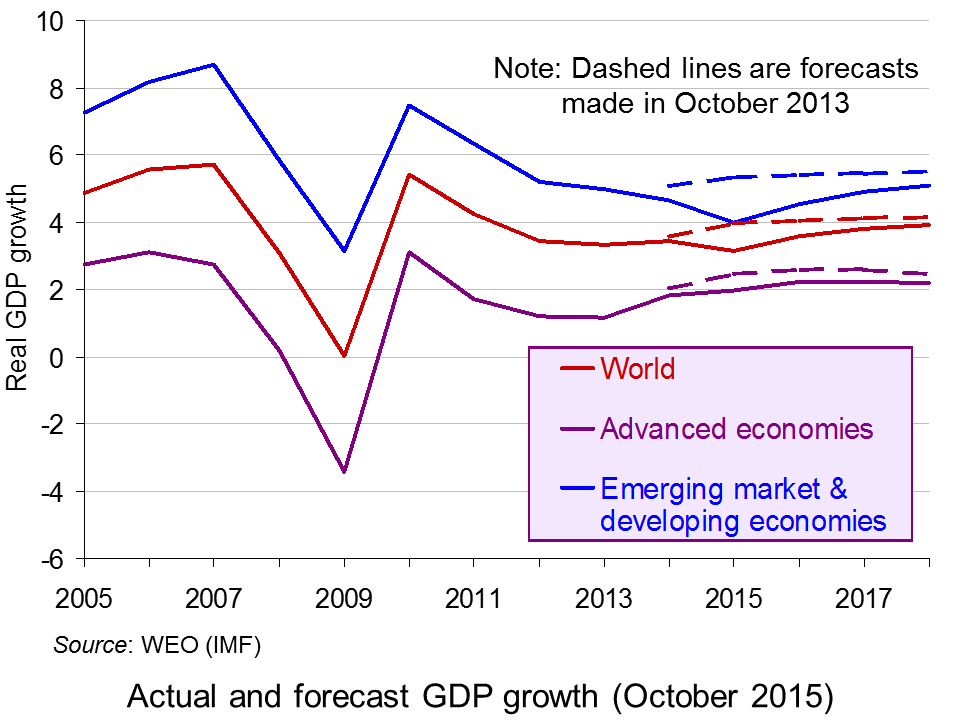
 The International Monetary Fund has just published its six-monthly World Economic Outlook (WEO). The publication assesses the state of the global economy and forecasts economic growth and other indicators over the next few years. So what is this latest edition predicting?
 To achieve faster economic growth in the longer term, potential national output must grow more rapidly. This can be achieved by a combination of more rapid technological progress and higher investment in both physical and human capital. But in the short term, aggregate demand must expand sufficiently rapidly. Higher short-term growth will encourage higher investment, which in turn will encourage faster growth in potential national output.

http://pearsonblog.campaignserver.co.uk/?cat=315&paged=2
What’s the outlook for the global economy?
 The International Monetary Fund has just published its six-monthly World Economic Outlook (WEO). The publication assesses the state of the global economy and forecasts economic growth and other indicators over the next few years. So what is this latest edition predicting?
Well, once again the IMF had to adjust its global economic growth forecasts down from those made six months ago, which in turn were lower than those made a year ago. As Larry Elliott comments in the Guardian article linked below:
Every year, economists at the fund predict that recovery is about to move up a gear, and every year they are disappointed. The IMF has over-estimated global growth by one percentage point a year on average for the past four years.
In this latest edition, the IMF is predicting that growth in 2015 will be slightly higher in developed countries than in 2014 (2.0% compared with 1.8%), but will continue to slow for the fifth year in emerging market and developing countries (4.0% in 2015 compared with 4.6% in 2014 and 7.5% in 2010).
In an environment of declining commodity prices, reduced capital flows to emerging markets and pressure on their currencies, and increasing financial market volatility, downside risks to the outlook have risen, particularly for emerging market and developing economies.
So what is the cause of this sluggish growth in developed countries and lower growth in developing countries? Is lower long-term growth the new norm? Or is this a cyclical effect – albeit protracted – with the world economy set to resume its pre-financial-crisis growth rates eventually?
To achieve faster economic growth in the longer term, potential national output must grow more rapidly. This can be achieved by a combination of more rapid technological progress and higher investment in both physical and human capital. But in the short term, aggregate demand must expand sufficiently rapidly. Higher short-term growth will encourage higher investment, which in turn will encourage faster growth in potential national output.
But aggregate demand remains subdued. Many countries are battling to cut budget deficits, and lending to the private sector is being constrained by banks still seeking to repair their balance sheets. Slowing growth in China and other emerging economies is dampening demand for raw materials and this is impacting on primary exporting countries, which are faced with lower exports and lower commodity prices.
Quantitative easing and rock bottom interest rates have helped somewhat to offset these adverse effects on aggregate demand, but as the USA and UK come closer to raising interest rates, so this could dampen global demand further and cause capital to flow from developing countries to the USA in search of higher interest rates. This will put downward pressure on developing countries’ exchange rates, which, while making their exports more competitive, will make it harder for them to finance dollar-denominated debt.
As we have seen, long-term growth depends on growth in potential output, but productivity growth has been slower since the financial crisis. As the Foreword to the report states:
The ongoing experience of slow productivity growth suggests that long-run potential output growth may have fallen broadly across economies.Persistently low investment helps explain limited labour productivity and wage gains, although the joint productivity of all factors of production, not just labour, has also been slow. Low aggregate demand is one factor that discourages investment, as the last World Economic Outlook report showed. Slow expected potential growth itself dampens aggregate demand, further limiting investment, in a vicious circle.
But is this lower growth in potential output entirely the result of lower demand? And will the effect be permanent? Is it a form of hysteresis, with the effect persisting even when the initial causes have disappeared? Or will advances in technology, especially in the fields of robotics, nanotechnology and bioengineering, allow potential growth to resume once confidence returns?
Which brings us back to the short and medium terms. What can be done by governments to stimulate sustained recovery? The IMF proposes a focus on productive infrastructure investment, which will increase both aggregate demand and aggregate supply, and also structural reforms. At the same time, loose monetary policy should continue for some time – certainly as long as the current era of falling commodity prices, low inflation and sluggish growth in demand persists.
Articles
Uncertainty, Complex Forces Weigh on Global Growth IMF Survey Magazine (6/10/15)
A worried IMF is starting to scratch its head The Guardian, Larry Elliott (6/10/15)
Storm clouds gather over global economy as world struggles to shake off crisis The Telegraph, Szu Ping Chan (6/10/15)
Five charts that explain what’s going on in a miserable global economy right now The Telegraph, Mehreen Khan (6/10/15)
IMF warns on worst global growth since financial crisis Financial Times, Chris Giles (6/10/15)
Global economic slowdown in six steps Financial Times, Chris Giles (6/10/15)
IMF Downgrades Global Economic Outlook Again Wall Street Journal, Ian Talley (6/10/15)
WEO publications
World Economic Outlook, October 2015: Adjusting to Lower Commodity Prices IMF (6/10/15)
 Global Growth Slows Further, IMF’s latest World Economic Outlook IMF Podcast, Maurice Obstfeld (6/10/15)
Transcript of the World Economic Outlook Press Conference IMF (6/10/15)
World Economic Outlook Database IMF (October 2015 edition)
World Economic Outlook, October 2015: Adjusting to Lower Commodity Prices IMF (6/10/15)
Global Growth Slows Further, IMF’s latest World Economic Outlook IMF Podcast, Maurice Obstfeld (6/10/15)Transcript of the World Economic Outlook Press Conference IMF (6/10/15)
World Economic Outlook Database IMF (October 2015 edition)
Questions
- Look at the forecasts made in the WEO October editions of 2007, 2010 and 2012 for economic growth two years ahead and compare them with the actual growth experienced. How do you explain the differences?
- Why is forecasting even two years ahead fraught with difficulties?
- What factors would cause a rise in (a) potential output; (b) potential growth?
- What is the relationship between actual and potential economic growth?
- Explain what is meant by hysteresis. Why may recessions have a permanent negative effect, not only on trend productivity levels, but on trend productivity growth?
- What are the current downside risks to the global economy?
- Why have commodity prices fallen? Who gains and who loses from lower commodity prices? Does it matter if falling commodity prices in commodity importing countries result in negative inflation?
- To what extent can exchange rate depreciation help commodity exporting countries?
- What is meant by the output gap? How have IMF estimates of the size of the output gap changed and what is the implication of this for actual and potential economic growth?
Subscribe to:
Posts (Atom)