Quote of the day

“I find economics increasingly satisfactory, and I think I am rather good at it.”– John Maynard Keynes
Showing posts with label IMF. Show all posts

Thursday, 29 September 2022

Time to dig deeper and analyse things:

 You must be aware of headlines about the IMF saying Truss & Kwarteng have got it wrong; this is not unusual, and a quick search would find numerous instances where they have been proven wrong - and worse. Still, to understand their stance we should look at the data and facts:


28 September 2022

Why does the IMF care more about equality than growth?
By  

The IMF is less than impressed with Liz Truss and Kwasi Kwarteng’s first mini-budget. In the kind of admonishment you’d normally expect them to make about an emerging economy, they said, ‘the nature of the UK measures will likely increase inequality… [the government might want to] reevaluate the tax measures, especially those that benefit high income earners’.

This is a bizarre statement to make. The UK is substantially less unequal than the USA, and the inequality/growth relationship is not particularly strong for developed economies. Should the IMF be expressing concern that the American economy will be undermined by its low top tax rates?

The cut in the highest rate of tax from 45% to 40% has driven a huge amount of media coverage, but is expected to cost around £2bn a year once behavioural responses are taken into account. As the IFS notes, it may very plausibly end up costing nothing.

It does, however, run contrary to an interesting strain of thought that has begun to predominate the IMF’s guidance to Britain. In this analysis, what really matters is how equal a country is, rather than how well off rich and poor are. But if this were true then why are so many people leaving countries like Pakistan – fractionally less unequal than Britain – in the belief that they will live better lives in the UK?j

To get a taste of how the Fund thinks Britain should be run, we can look at their country reports from earlier in this year. The UK needed a ‘revenue-based strategy’ for funding government spending, which meant tax rises. Among the suggested options were increasing income tax for the upper 50% of the population, applying a one-off wealth tax ‘payable on all individual wealth… above £2bn and charged at 1% a year for five years’, or raising dividend taxes for higher rate payers to 26%.

These suggestions are insane. Economists uniformly recommend against ‘one-off’ wealth taxes precisely because after a government’s done it once, nobody will ever believe that they won’t do it again. The damage this does to the incentive to invest or situate wealth in Britain would be huge, particularly as it probably wouldn’t actually raise very much: anyone with more than £2bn in assets is likely to simply leave the country rather than pay. Similarly, taxing dividends for the people most likely to invest in companies is a great way to shut off capital for British firms.

The March of the Sensibles

One explanation for this is that the IMF has been captured by a deep cover cabal of Soviet sleeper agents desperate to bring down the capitalist system and revert to communism. I am sympathetic to this argument, but think we can probably do better. Financial markets didn’t much like the Truss budget either, and while they may be many things they are rarely hotbeds of Trotskyism.

I’ve written about the market reaction on these pages, but to reiterate, my view is that they are understandably pessimistic about the ability of the UK government to produce the sort of growth it’s promising. They expect inflation to increase. Generally, this should drive a currency upwards (see my thread here). This means the drop signals either a sudden panic over the long-term fiscal sustainability of the UK, which would be entirely unwarranted, the competence of the government (which won’t affect the previous), or – most plausibly – Mike Bird’s suggestion that markets don’t think the Bank of England will do its job sufficiently well to mop up the inflation created by the tax cuts (although, again, it’s debatable just how much inflation will be caused).

The IMF’s reaction doesn’t fit neatly into these categories, and I think that’s because it’s driven by something else entirely. The IMF is staffed by a certain sort of person who is commonly found in the policy world, writing at papers like the Financial Times, working at think tanks like the IFS, or speaking soberly about fiscal sustainability in the Treasury. Let’s call them the Sensibles.

Sensibles pride themselves on being, above all else, sensible. Sensible means not doing anything that might rock the boat; like the apocryphal provincial official, their working orders are to ensure that nothing changes. In macroeconomic policy, that means making sure that governments don’t do anything unusual. If the country is on a long, slow path of decline – like the UK very much is – then that’s bad. But if an attempt to shake that up fails and drives up borrowing costs, that’s much worse: now you’re paying more on your debt, and still in decline. Much better to try the Approved Method again and see if it works this time.

The Sensibles hated the mini-budget. It put growth ahead of the deficit. It didn’t go out of its way to appease bond markets and keep borrowing rates ultra low – resulting in borrowing costs rising to a dizzying 0.2% real yield. It made lots of sweeping statements about planning reform and deregulation – risky! It wasn’t at all what British economic policy orthodoxy has preached for the last decade.

The Sensibles have quite a lot riding on this. If the mini-budget and the associated supply side reforms work in the long run, then everything we were repeatedly told was Sensible was not. This would be quite damaging if your career is based on sitting in an office and wisely telling people that changing anything is bad. Doubling down on Sensibleness is the only response open to the mini-budget: if you can bully Truss into changing course, then Sensibleness prevails. If Truss changes course after failing to get further supply-side reforms through, you are vindicated. And if the policies do work, well – you’ve lost anyway.

This is republished from Marginally Productive. Read the original article here.

Sunday, 4 March 2018

IMF says Osbourne was right...

And to think they gave him 2 out of 10 for his austerity policy back in the day...

You need to be aware that this "surplus" does not mean we can stop borrowing:

Britain is now running a current budget surplus as tax revenues cover all day to day spending, for the first full year since 2001.
This surplus, which excludes capital investment by the Government, came in at £3.8bn for 2017, the Office for National Statistics said.
George Osborne set this as a target in 2010 and hoped to achieve it two years earlier in 2015.
More good news is expected later this month as the Office for Budget Responsibility is set to upgrade its growth forecasts, giving the Chancellor a windfall of extra tax revenues.
Research published by the International Monetary Fund said Britain set an example for other countries to follow in slashing the deficit by cutting public spending, rather than raising taxes. 
“Following the financial crisis, the two countries that adopted spending-based austerity and did better than the rest of the sample were Ireland and the UK,” said economists in the IMF's Finance and Development publication.
“The result: growth in the United Kingdom was higher than the European average.”
It is increasingly important that other countries copy this approach, the researchers said, as Governments around the world have racked up too much debt which will harm growth and stifle productivity when interest rates rise.
The surge in global growth gives countries the perfect opportunity to cut their debt burdens - and they should do it by cutting spending rather than by raising taxes, before the economy slows down again and the debt burden becomes tougher to bear.
“Countries take a smaller hit to growth if they cut spending - including for entitlement programs - than if they raise taxes. In fact, the latter can be self-defeating, leading to even higher debt and lower growth,” said Camilla Lund Andersen, editor of the IMF magazine.
Britain's economy is growing faster than expected this year, giving Philip Hammond, the Chancellor, more money to play with in this month's Spring Statement - though he is not expected to use it to go on a spending spree CREDIT: EDDIE MULHOLLAND
“Governments should use the current upswing to put their house in order. And while each country must chart its own course, the global recovery presents a rare opportunity - rising interest rates will soon make it harder to refinance and service debt.”
Advanced economies have an average government debt of 104pc of GDP, which is close to the highest levels seen since the Second World War.
Political momentum behind deficit reduction has waned in many countries, as years of fiscal restraint led to policy fatigue and the economic recovery made debt reduction appear less important.
But the IMF warns that upbeat assessments of the global economy “ignore debt levels that remain close to historic highs and the inevitable end of the cyclical upswing”.
“Servicing debt will become a major burden,” it warns.
Spending cuts have been unpopular in some instances, but the new study from academics Alberto Alesina, Carlo Favero, and Francesco Giavazzi indicates they are less damaging than tax rises.
“Our conclusion runs against the basic Keynesian message, which implies that spending cuts are more recessionary than tax increases,” the trio found.
“On the contrary, our study confirms that expenditure-based plans generally were less harmful to growth than tax-based plans.”
Studying a range of deficit-cutting programmes, the economists found spending cuts of 1pc of GDP hit economic growth by 0.5 percentage points relative to the trend rate of growth, with the dent put in growth lasting for less than two years.
If this is done at a time of economic growth it has no negative impact, so the economy grows even at a time of austerity.
By contrast plans based on tax hikes resulted in a two percentage point fall in GDP relative to its previous path.
“This large recessionary effect tends to last several years,” they said.
This also indicates Britain did the right thing after 2010 by cutting spending to keep the public finances in line.

Sunday, 1 May 2016

Shocks Pt2 - Debt and Confidence

Another article from Project Syndicate that crosses over with the prior article; again, I have highlighted key elements that could be brought into a "shocks" essay:

The Next Global Boom – and Bust

WASHINGTON, DC – The mood at the International Monetary Fund-World Bank spring meetings here earlier this month was grim. The latest IMF forecast for global growth has been revised downward yet again – suggesting the world will grow at an annual rate of just over 3% this year and again in 2017.
If realized, this would be a dismal performance. Before 2007, global growth (using the IMF’s methodology) was in the 4.5-5% range, based on steady productivity improvements in industrial countries and rapidly rising living standards in large emerging markets such as China, Brazil, and Russia.
Brazil storm Christ the Redeemer

The Brazil Syndrome

Renowned economist Anders Ã…slund engages the views of Dani Rodrik, Nouriel Roubini, Joseph Stiglitz, and others on the growing turmoil in emerging markets.

PS On Point: Your review of the world’s leading opinions on global issues.
Now the US faces the uncertainty of a presidential election, weaker parts of the eurozone continue to struggle, and Japan is teetering on the edge of outright economic contraction. Brazil is in the midst of a political crisis, China is dealing with the after effects of prolonged fiscal expansion and explosive growth in its shadow banking system, and lower commodity prices are undermining economic performance in many other emerging markets. On top of all this, the British may vote in June to leave the European Union.
Economic activity is affected by confidence: Do consumers believe their incomes are likely to rise (or even prove secure), and do companies believe that future growth will be buoyant enough to warrant current investment? And today’s macro mood is shared pessimism.
Yet the medium-term scenario is unlikely to be global stagnation. New technologies continue to be invented, and billions of people aspire to improve their standard of living through education and hard work. Leading industrial economies have demonstrated remarkable resilience in the face of large negative financial-sector shocks over the past decade – as has China.
Unemployment in the United States is down to 5%, and parts of Europe are doing fine. And the most important point about the commodity price cycle is that it is indeed a cycle: Demand for commodities rises and falls, while supply changes only slowly. We should expect volatility in commodity prices – as well as in the price of oil.
The biggest question is whether we can get off the economic roller coaster and return to robust global growth without debt-fueled overconsumption (as seen in the pre-2008 US), overinvestment (as in China), and overexpansion of government spending (still an issue in some parts of Europe).
Debt can fund productive investments and improvement in human capital. But why do we always seem to like it too much? Part of the reason stems from tax systems, which in some countries allow some consumer interest payments (for example, mortgages in the US) to be deducted from taxable income. Corporate interest payments are typically deductible, too.
But the main appeal of debt is that it is a very simple contract: Either you pay the agreed amount or you don’t. And when things go well, a highly leveraged enterprise – a company or your house – will show a great return on equity. But those returns are not risk-adjusted, which means that when the economy slumps, big losses are allocated – as American homeowners learned in 2008, Korean conglomerates learned in 1997, and governments in emerging markets learn repeatedly.
Policymakers know that excessive debt brings financial fragility, of course, and some efforts at reform over the past decade have aimed to scale back leverage. But financial reform is hard to do during a slump, when the main task is to revive growth. Official intentions often remain just that; time and again, political leaders find it easier simply to keep in place the existing system of rules, incentives, and guarantees. And, because large financial firms do very well with a great deal of leverage, they continue to devote abundant lobbying resources to resisting efforts to ensure that they are better capitalized (with more shareholder equity relative to their total balance sheets).
Indeed, the largest banks in the US – but also in most other countries – are even bigger today than they were before 2008. All candid accounts indicate their internal incentives are not much changed, and restrictions on their activities are unlikely to prove effective as global growth picks up.
In the US, officials hold out hope that the largest financial firms will eventually be forced to comply with a provision of the 2010 Dodd-Frank financial reform legislation requiring that they draw up credible “living wills.” Yet most big banks have repeatedly failed to produce plausible plansexplaining how they could fail in bankruptcy without any government assistance and without damaging the world economy, and none has faced meaningful consequences for noncompliance.
Growth will return. Entrepreneurs will start new companies, and they will fund their risk-taking with equity investments provided by venture capital funds. Established nonfinancial firms have learned the hard way that they need to be careful with leverage and keep large cash cushions.
It’s the big banks that continue to prefer being highly leveraged. And too many policymakers are deferring to them. Like it or not, that means we are in line for another stomach-turning round on the global economy’s wild ride.

Saturday, 31 October 2015

World economic outlook October 2015

from the excellent Pearson blog/website:

http://pearsonblog.campaignserver.co.uk/?cat=315&paged=2

What’s the outlook for the global economy?

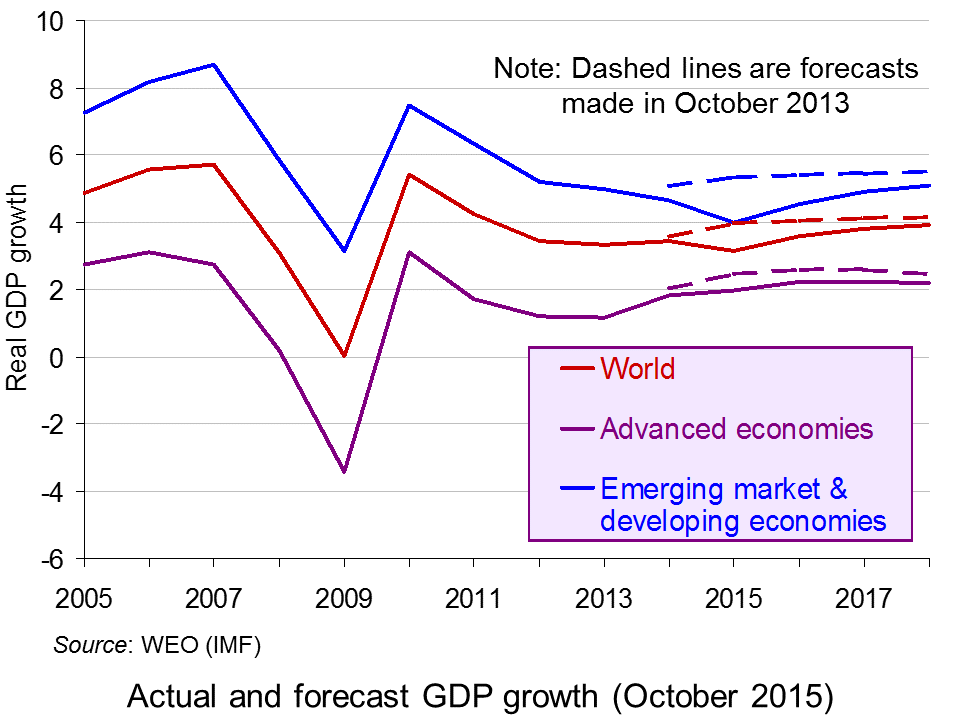
The International Monetary Fund has just published its six-monthly World Economic Outlook (WEO). The publication assesses the state of the global economy and forecasts economic growth and other indicators over the next few years. So what is this latest edition predicting?
Well, once again the IMF had to adjust its global economic growth forecasts down from those made six months ago, which in turn were lower than those made a year ago. As Larry Elliott comments in the Guardian article linked below:
Every year, economists at the fund predict that recovery is about to move up a gear, and every year they are disappointed. The IMF has over-estimated global growth by one percentage point a year on average for the past four years.
In this latest edition, the IMF is predicting that growth in 2015 will be slightly higher in developed countries than in 2014 (2.0% compared with 1.8%), but will continue to slow for the fifth year in emerging market and developing countries (4.0% in 2015 compared with 4.6% in 2014 and 7.5% in 2010).
In an environment of declining commodity prices, reduced capital flows to emerging markets and pressure on their currencies, and increasing financial market volatility, downside risks to the outlook have risen, particularly for emerging market and developing economies.
So what is the cause of this sluggish growth in developed countries and lower growth in developing countries? Is lower long-term growth the new norm? Or is this a cyclical effect – albeit protracted – with the world economy set to resume its pre-financial-crisis growth rates eventually?
To achieve faster economic growth in the longer term, potential national output must grow more rapidly. This can be achieved by a combination of more rapid technological progress and higher investment in both physical and human capital. But in the short term, aggregate demand must expand sufficiently rapidly. Higher short-term growth will encourage higher investment, which in turn will encourage faster growth in potential national output.
But aggregate demand remains subdued. Many countries are battling to cut budget deficits, and lending to the private sector is being constrained by banks still seeking to repair their balance sheets. Slowing growth in China and other emerging economies is dampening demand for raw materials and this is impacting on primary exporting countries, which are faced with lower exports and lower commodity prices.
Quantitative easing and rock bottom interest rates have helped somewhat to offset these adverse effects on aggregate demand, but as the USA and UK come closer to raising interest rates, so this could dampen global demand further and cause capital to flow from developing countries to the USA in search of higher interest rates. This will put downward pressure on developing countries’ exchange rates, which, while making their exports more competitive, will make it harder for them to finance dollar-denominated debt.
As we have seen, long-term growth depends on growth in potential output, but productivity growth has been slower since the financial crisis. As the Foreword to the report states:
The ongoing experience of slow productivity growth suggests that long-run potential output growth may have fallen broadly across economies. Persistently low investment helps explain limited labour productivity and wage gains, although the joint productivity of all factors of production, not just labour, has also been slow. Low aggregate demand is one factor that discourages investment, as the last World Economic Outlook report showed. Slow expected potential growth itself dampens aggregate demand, further limiting investment, in a vicious circle.
But is this lower growth in potential output entirely the result of lower demand? And will the effect be permanent? Is it a form of hysteresis, with the effect persisting even when the initial causes have disappeared? Or will advances in technology, especially in the fields of robotics, nanotechnology and bioengineering, allow potential growth to resume once confidence returns? 
Which brings us back to the short and medium terms. What can be done by governments to stimulate sustained recovery? The IMF proposes a focus on productive infrastructure investment, which will increase both aggregate demand and aggregate supply, and also structural reforms. At the same time, loose monetary policy should continue for some time – certainly as long as the current era of falling commodity prices, low inflation and sluggish growth in demand persists.
Articles
Uncertainty, Complex Forces Weigh on Global Growth IMF Survey Magazine (6/10/15)
A worried IMF is starting to scratch its head The Guardian, Larry Elliott (6/10/15)
Storm clouds gather over global economy as world struggles to shake off crisis The Telegraph, Szu Ping Chan (6/10/15)
Five charts that explain what’s going on in a miserable global economy right now The Telegraph, Mehreen Khan (6/10/15)
IMF warns on worst global growth since financial crisis Financial Times, Chris Giles (6/10/15)
Global economic slowdown in six steps Financial Times, Chris Giles (6/10/15)
IMF Downgrades Global Economic Outlook Again Wall Street Journal, Ian Talley (6/10/15)
Questions
  1. Look at the forecasts made in the WEO October editions of 2007, 2010 and 2012 for economic growth two years ahead and compare them with the actual growth experienced. How do you explain the differences?
  2. Why is forecasting even two years ahead fraught with difficulties?
  3. What factors would cause a rise in (a) potential output; (b) potential growth?
  4. What is the relationship between actual and potential economic growth?
  5. Explain what is meant by hysteresis. Why may recessions have a permanent negative effect, not only on trend productivity levels, but on trend productivity growth?
  6. What are the current downside risks to the global economy?
  7. Why have commodity prices fallen? Who gains and who loses from lower commodity prices? Does it matter if falling commodity prices in commodity importing countries result in negative inflation?
  8. To what extent can exchange rate depreciation help commodity exporting countries?
  9. What is meant by the output gap? How have IMF estimates of the size of the output gap changed and what is the implication of this for actual and potential economic growth?
Share in top social networks!


Sunday, 1 March 2015

Greece, the EU & the euro

On the basis that the recent deal has not actually changed anything, just delayed the denouement, you do need to be on top of what is unfolding. It is not essential to read this, but it will give some useful background if something happens before the exam.

https://www.project-syndicate.org/commentary/greece-eurozone-breakup-by-alberto-bagnai-et-al-2015-02

Tuesday, 24 February 2015

Austerity, supply-side - great context material:

Read this article from The Times carefully; feel sorry for Greece - or is the Troika right, and pain now will lead to gain later?

What if we had to take the Greek medicine?

Ed Conway
 
 
The troika prescribing Greece a bitter economic cure might have some radical treatments for Britain’s public finances.
 
Strange as this might sound to the average Greek, bailouts sometimes have happy endings. Look no further than the last major developed country to receive help from the International Monetary Fund: the United Kingdom.
 
In the 1970s, Britain appeared to be in terminal decline. Inflation and interest rates were both in double figures; around half of all young people were out of work. Between 1950 and 1976, Britain’s per-capita national income had been outpaced by every other leading economy. What was once the world’s economic powerhouse had diminished to the extent that it was smaller, on this basis, than the rest of western Europe, except for Finland and Italy.

As in Greece today, the $3.9billion loan offered by the IMF in 1976 was tied to unpleasant conditions, including £2 billion of spending cuts and some painful economic reforms.
Yet in retrospect, it’s clear this was the moment Britain’s economy took off again. Between 1976 and 2008, gross domestic product per head rose faster in the UK than in any other industrialised nation. Living standards rose faster than during the heyday of the industrial revolution.

However, since the 2008 financial crisis, productivity has slumped and real wages have fallen. For each hour put in, British workers generate 30 per cent less income than their American counterparts — the biggest shortfall since 1991. Many factors may be to blame: the growth in part-time jobs and stubbornly poor education standards (17 million adults in England have the numerical skills of a primary school pupil, according to the Bank of England’s chief economist, Andy Haldane). Whatever the reason, poor productivity is the biggest threat to the economy.
There have been plenty of attempts to fix it over the past five years: from Michael Gove’s school reforms to Iain Duncan Smith’s shake-up of unemployment benefits. But, rather like the British public, the government’s extra sweat isn’t transforming into extra output.
That raises the question: if the IMF, the EU and the European Central Bank, the bailout institutions that make up the so-called troika, were in London rather than Athens, what would they recommend to tackle Britain’s persistent economic problems? Today, the Organisation for Economic Co-operation and Development will be in the Treasury to unveil its own list, though if previous editions are anything to go by, the most controversial item on it will be road charging.

If the troika really had the run of the Treasury, they would go much farther than that.
No doubt they’d start by calling for deficit cuts that would make Mr Osborne’s austerity plan look namby-pamby. In Greece under the troika, the deficit has been slashed by 88 per cent over the past six years, compared with a mere 63 per cent in the UK. Matching that here would mean an extra £53 billion worth of deficit reduction next year. Were that to come purely through taxes, it would require a 5 percentage point increase in VAT and a 7 per cent rise in the basic rate of income tax.

Then again, Britain’s long-term spending figures look grim too: in the coming decades the cost of the National Health Service will grow exponentially. So the troika would undoubtedly remove the government’s ring-fence on health spending. It would probably introduce fees for better-off patients to see their GPs. The winter fuel allowance would be scrapped, or at least limited to the least well-off. It would be much the same story for child benefit. In fact, any inessential spending (including on culture, sport and, as far as the IMF is concerned, defence) would be slashed to shreds.

Though most of Britain’s industries were privatised in the 1980s and 1990s, anything remaining in public hands would soon be on the block, including the banks, the state broadcasters and the Royal Mint, which Mr Osborne had been protecting up until now.
The planning system — long Britain’s bête noire — would be the next victim. The chancellor’s softly-softly reforms would be replaced with ones instantly disempowering nimbyish local authorities. The green belt would meet its end — after all, Britain is still far from being the most urbanised or developed landmass in Europe.

The property taxation system would need a complete overhaul. Stamp duty would be cut or ditched, replaced with a proper annual tax on the value of homes — a cross between council tax and a mansion tax. The financial sector’s fangs would be ground down with a permanent banking tax, rather than an ad hoc one introduced each year.

Some of these reforms seem straightforwardly sensible. Some look like madness — especially the scale of deficit reduction which, in Greece’s case, was imposed so quickly that the troika precipitated the very social disaster it was supposed to prevent.

What they have in common is that they would never make it anywhere near a party manifesto this year. While none of them is likely to happen any time soon, trying to imagine what the IMF would do in Britain today is a useful thought exercise. It reminds us that there is still plenty of room for the kinds of reform that could boost productivity in the coming years. But, as Greece is learning, such reforms tend to happen only in the depths of an economic crisis — and no one is grateful for them until decades later.

Friday, 6 February 2015

Greece & the EU

Think about the future for Greece; is it really crucial they stay in Europe? Would a euro exit be a total disaster for Greece? What would it take to make them a viable country on their own? Consider tax collection; spending plans; credibility; reform. And if Greece does it, what then? A few politicians will be having sleepless nights, I think.

AEP in the Telegraph BEFORE Varoufakis met Schauble

Sunday, 11 January 2015

Read the last 2 paragraphs


NEW YORK – For several years, and often several times a month, the Nobel laureate economist and New York Times columnist and blogger Paul Krugman has delivered one main message to his loyal readers: deficit-cutting “austerians” (as he calls advocates of fiscal austerity) are deluded. Fiscal retrenchment amid weak private demand would lead to chronically high unemployment. Indeed, deficit cuts would court a reprise of 1937, when Franklin D. Roosevelt prematurely reduced the New Deal stimulus and thereby threw the United States back into recession.
Well, Congress and the White House did indeed play the austerian card from mid-2011 onward. The federal budget deficit has declined from 8.4% of GDP in 2011 to a predicted 2.9% of GDP for all of 2014. And, according to the International Monetary Fund, the structural deficit (sometimes called the “full-employment deficit”), a measure of fiscal stimulus, has fallen from 7.8% of potential GDP to 4% of potential GDP from 2011 to 2014.
Krugman has vigorously protested that deficit reduction has prolonged and even intensified what he repeatedly calls a “depression” (or sometimes a “low-grade depression”). Only fools like the United Kingdom’s leaders (who reminded him of the Three Stooges) could believe otherwise.
Yet, rather than a new recession, or an ongoing depression, the US unemployment rate has fallen from 8.6% in November 2011 to 5.8% in November 2014. Real economic growth in 2011 stood at 1.6%, and the IMF expects it to be 2.2% for 2014 as a whole. GDP in the third quarter of 2014 grew at a vigorous 5% annual rate, suggesting that aggregate growth for all of 2015 will be above 3%.
So much for Krugman’s predictions. Not one of his New York Times commentaries in the first half of 2013, when “austerian” deficit cutting was taking effect, forecast a major reduction in unemployment or that economic growth would recover to brisk rates. On the contrary, “the disastrous turn toward austerity has destroyed millions of jobs and ruined many lives,” he argued, with the US Congress exposing Americans to “the imminent threat of severe economic damage from short-term spending cuts.” As a result, “Full recovery still looks a very long way off,” he warned. “And I’m beginning to worry that it may never happen.”
I raise all of this because Krugman took a victory lap in his end-of-2014 column on “The Obama Recovery.” The recovery, according to Krugman, has come not despite the austerity he railed against for years, but because we “seem to have stopped tightening the screws: Public spending isn’t surging, but at least it has stopped falling. And the economy is doing much better as a result.”
That is an incredible claim. The budget deficit has been brought down sharply, and unemployment has declined. Yet Krugman now says that everything has turned out just as he predicted.
In fact, Krugman has been conflating two distinct ideas as if both were components of “progressive” thinking. On one hand, he has been the “conscience of a liberal,” rightly focusing on how government can combat poverty, poor health, environmental degradation, rising inequality, and other social ills. I admire that side of Krugman’s writing, and, as I wrote in my book The Price of Civilization, I agree with him.
On the other hand, Krugman has inexplicably taken up the mantle of crude aggregate-demand management, making it seem that favoring large budget deficits in recent years is also part of progressive economics. (Krugman’s position is sometimes called Keynesianism, but John Maynard Keynes knew much better than Krugman that we should not depend on mechanistic “demand multipliers” to set the unemployment rate.) Deficits were not increased enough in 2009 to escape from high unemployment, he insisted, and were falling dangerously fast after 2010.
Obviously, recent trends – a significant decline in the unemployment rate and a reasonably high and accelerating rate of economic growth – cast doubt on Krugman’s macroeconomic diagnosis (though not on his progressive politics). And the same trends have been apparent in the United Kingdom, where Prime Minister David Cameron’s government has cut the structural budget deficit from 8.4% of potential GDP in 2010 to 4.1% in 2014, while the unemployment rate has fallen from 7.9% when Cameron took office to 6%, according to the most recent data for the fall of 2014.
To be clear, I believe that we do need more government spending as a share of GDP – for education, infrastructure, low-carbon energy, research and development, and family benefits for low-income families. But we should pay for this through higher taxes on high incomes and high net worth, a carbon tax, and future tolls collected on new infrastructure. We need the liberal conscience, but without the chronic budget deficits.
There is nothing progressive about large budget deficits and a rising debt-to-GDP ratio. After all, large deficits have no reliable effect on reducing unemployment, and deficit reduction can be consistent with falling unemployment.
Krugman is a great economic theorist – and a great polemicist. But he should replace his polemical hat with his analytical one and reflect more deeply on recent experience: deficit-cutting accompanied by recovery, job creation, and lower unemployment. This should be an occasion for him to rethink his long-standing macroeconomic mantra, rather than claiming vindication for ideas that recent trends seem to contradict.

Read more at http://www.project-syndicate.org/commentary/krugman-budget-deficit-support-by-jeffrey-d-sachs-2015-01#BxTfZbi1ZHf3e50v.99