Quote of the day

“I find economics increasingly satisfactory, and I think I am rather good at it.”– John Maynard Keynes
Showing posts with label house prices. Show all posts

Monday, 19 April 2021

House building and oligopoly - a new report


Time for the big builders to lose their plots

As the ranks of “generation rent” swell it is vital we overcome the powerful vested interests responsible for this housebuilding gridlock

The news is dominated by Covid-19 – and plans to lift lockdown. Northern Ireland and the Westminster lobbying scandal – plus Prince Philip’s funeral, of course – are also rightly generating reams of coverage.

Yet away from the bulletins, perennial policy issues remain unresolved, blighting the lives of millions. Perhaps the most pressing is housing.

The UK has a chronic housing shortage. We need around 250,000 new homes each year to meet population growth and household formation. Housebuilding hasn’t reached that level since the late 1970s.

The shortage of homes to both buy and rent means adults aged 25-45 now spend more on housing and are more likely to rent than any generation since the 1930s – as sky-high prices deny home ownership. And over the last decade, a dearth of social housing has seen overcrowding and homelessness escalate among low-income families.

Lockdown has highlighted the gulf between the comfortably housed and those in cramped conditions. An ongoing stamp duty holiday and now vaccine rollout has meanwhile sparked a buying frenzy, fuelling house prices even more – with the average home now costing eight times the average annual wage, double the long-term earnings multiple. And localities with a high share of sub-standard housing have seen far more Covid deaths.

Average house prices in the UK hit an all-time high in March

Line chart with 13 data points.
Property prices rose by £15,430 over the year
The chart has 1 X axis displaying Time. Range: 2020-02-26 08:24:00 to 2021-03-04 15:36:00.
The chart has 1 Y axis displaying Average house price (£). Range: 235000 to 260000.
Halifax
End of interactive chart.

As the ranks of “generation rent” swell, Boris Johnson often says he wants to “fix housing” – given the Conservatives’ long-term reliance on owner-occupying voters. Better social housing provision would also be popular in “red wall” Northern and Midlands seats the Tories hope to retain.

Last August, the Government proposed a “radical planning shake-up”, with ministers claiming “a lack of land with planning permissions” explains why we’ve built two to three million too few homes since the turn of the century. That’s nonsense, as this column has previously argued.

Four-fifths of residential planning applications are now accepted and permissions for over a million homes remain unused. The real problem is ever-lengthening delays between permissions being granted and homes being built.

That’s because the big, powerful developers who hoover up most permissions are staging a deliberate building go-slow. They make higher profits overall by producing fewer homes so prices keep rising. Unless ministers tackle this massive market failure, the lack of competition within a housebuilding sector dominated by a few large players, our chronic housing shortage will remain – as I detailed in my book Home Truths.

As such, I welcome a new study by Alex Morton, a former Downing Street adviser and noted housing policy specialist. His report “The Housing Guarantee” was published last week by the Centre for Policy Studies – arguably Westminster’s most influential thinktank, boasting senior staff who helped write last year’s Conservative election manifesto.

Planning reforms, resulting in councils granting more permissions, “haven’t fixed the problem of insufficient housing supply …. a decline in new homes that reaches back to the 1960s,” writes Morton. “The assumption was new permissions would axiomatically be turned into homes,” he observes. Yet despite various recent reforms that have seen permissions “soar” – from under 200,000 in 2010 to over 350,000 in 2019 – the number of homes built each year “has risen much more slowly”.

The problem, says Morton, is that planning permissions are “a one-way gift which boosts the value of the land from say £20,000 a hectare to £2-£3 million, in return for no obligation to do anything beyond breaking ground”. As a result, “housebuilding is largely in the hands of a few large builders and a cottage industry of land promoters, pushing up the value of land with permissions and meaning permissions don’t necessarily translate into homes”.

So the current system “incentivises large house builders to acquire and control land”, says Morton, with the six largest now holding over a million plots, 90pc controlled by the biggest three. No wonder a recent House of Lords report concluded our housebuilding industry “now has all the characteristics of an oligopoly”.

The big players’ grip has tightened significantly in recent years as once ubiquitous small and medium-sized enterprises (SMEs) have been wiped out. Countless such firms, which build-out quickly to aid cashflow, helping to keep the industry competitive, perished when their bank finance was withdrawn during the 2008 financial crisis. In the late 1980s, firms building fewer than 100 homes each year accounted for two-fifths of all new supply, reports Morton. Now it’s just one-tenth.

“The current major housebuilder model traps us in a slow build-out system,” concludes this CPS report. The Government’s proposed planning reforms – which include “planning zones” to reduce uncertainty – “have many positive elements”, says Morton. “But they don’t tackle the issue of ensuring supply by reforming how planning permissions operate.”

Morton wants “delivery contracts” so permissions come with legal obligations to build out within a certain timeframe – or the original applicant gives up land to other builders at a pre-set price. “This would force the existing model of housebuilding to focus more on delivery, not land speculation,” he says.

Councils should be set targets relating to houses actually built, not just making land available. And some public sector acreage should be sold off to SMEs, “at a pre-set price”, also with delivery targets, “to help level the playing field between smaller firms and large”.

This is an important report, in which a genuine government insider puts forward some radical ideas – many of which I proposed in Home Truths. But it doesn’t go far enough.

What’s needed is a reversal of the 1961 Land Compensation Act, so when land gets planning permission and valuations surge, often several-hundred-fold, this massive “planning uplift” is shared with local authorities – an idea backed by successive Parliamentary inquiries. That would dampen land speculation, making building plots – and ultimately housing – more affordable. It would also fund new infrastructure as new housing appears, revolutionising the local politics of planning.

On top of that, a full Competition and Market Authority inquiry is now vital. Powerful vested interests benefit mightily from this high-price-low-build gridlock. They make big political donations to protect the status quo.

But the harsh reality – hinted at in this CPS report, but not spelt out – is that our housebuilding industry is denying millions of hard-working people the chance to rent or buy a reasonably priced home. It’s time to shake it up.


Sunday, 4 March 2018

Higher Interest Rates in US

Some nice little snippets on monetary policy impacts:

 
New savers in the United States stand to gain as returns on savings – which have been subject to severe financial repression for most of the last decade – begin to rise. But higher interest rates could leave homeowners and shareholders vulnerable to losses.
CAMBRIDGE – Long-term interest rates in the United States are rising, and are likely to continue heading up. Over the past 20 months, the yield on ten-year Treasury bonds has more than doubled, from 1.38% to 2.94%. Why is this happening?
OR
High and rising interest rates have important effects on the economy, especially on the prices of stocks and of homes. Because extremely low interest rates during the past decade caused equity prices to rise to unprecedentedly high levels, the shift to higher interest rates will slow and depress share prices. The level of real interest rates is particularly important for share prices, because higher inflation raises nominal profits in a way that offsets the inflation component of higher interest rates.
The interest rate charged on home mortgages reflects the long-term yield on Treasury bonds, with the rate for 30-year mortgages rising a full percentage point during the past 20 months. House prices reflect nominal interest rates as well as real interest rates. Higher nominal interest rates limit the number of qualified homebuyers by increasing the monthly interest payments for any size of mortgage.
The US Federal Reserve’s monetary policy has an important effect on long-term interest rates. Although the Fed traditionally controlled only the short-term federal funds rate, investors’ response to a change in that rate depended on their expectation of how long the rate change would last. If an increase in the short-term rate were expected to persist or to be an indicator of further increases in the future, the long-term rate would also rise. During the period of monetary easing that followed the 2008 financial crisis, the Fed cut the federal funds rate to just 0.15% and declared that it would remain low for a long period of time. Not surprisingly, that caused the long-term rate to fall from 3% at the beginning of 2014 to 1.5% in mid-2016.
The Fed has now started to raise the short-term rate and has said that it will continue to do that gradually for the next few years, aiming at a rate of nearly 3% in 2020 and beyond. That doubling of the federal funds rate will pull up the long-term bond rate.
During the past decade, the Fed also intervened in the long-term market as part of its “unconventional monetary policy” aimed at stimulating the economy. The Fed bought Treasury bonds and mortgage-backed securities, increasing its balance sheet from $900 billion in 2008 to about $4.5 trillion now. Those bond purchases bid up the price of bonds and caused their yields to decline. The Fed is now in the process of shrinking its balance sheet, forcing the market to buy more bonds and therefore raising interest rates.
Changes in expected inflation have a direct effect on long-term interest rates. Growing confidence in economic expansion and falling unemployment has raised investors’ expectation of future inflation, pulling up the nominal interest rate on ten-year bonds. Inflation has still remained very low, with the consumer price index up only 2.1% over the past 12 months. But with an unemployment rate of just 4.1% and a weakening dollar, investors’ expected rate of inflation is increasing. The expected inflation rate over the next ten years implied by the inflation-indexed bonds rose 0.3 percentage points in the 14 months after July 2016, but then increased 0.8 percentage points in the next five months. Future evidence of increasing inflation will be reflected in higher long-term interest rates.
The widening budget deficit and rising national debt will also push up long-term interest rates. The federal budget deficit is projected to increase from about 3.5% of GDP in recent years to 5% in 2018 and for the rest of the decade. The debt-to-GDP ratio has doubled in the last ten years, to 75%, and is projected to rise to nearly 100% during the coming decade. My own forecast assumes an even greater rise in the debt level, owing to continued increases in government spending and extensions of recent reductions in personal income tax.
As a result, the government’s net sale of bonds will rise from about $700 billion a year in 2017 to more than $1 trillion in 2019 and about $1.5 trillion in 2027. The cumulative increase in the debt during the decade will therefore be about $10 trillion. Getting the market to absorb those bonds will require higher real interest rates.
All of this could make new savers happy, as returns on savings – which have been subject to severe financial repression for most of the last decade – begin to rise. But higher interest rates could leave homeowners and shareholders vulnerable to losses.

Wednesday, 28 February 2018

Higher interest rates & US Housing Market

They used to say that if IBM sneezes the US catches a cold; and if the US sneezes, the rest of the world catches a cold. Will housing take the place of IBM? Think about this for the UK, as the BoE pencils in rate increases:


Summary

Mortgage rates have been rising along with treasury rates.
Housing data is starting to fall as higher rates make housing less attractive.
New home sales and existing home sales volumes are contracting.

Higher Mortgage Rates Hurting Housing (ITB)

Interest rates have been rising across the curve over the past several weeks. Interest rates on the short end of the curve, 0-5 year duration, have been rising much faster on a relative basis than 20-30 year treasury rates. 

Even though the move in interest rates has only taken place over a few weeks, and most of the action has been on the short-end of the curve, the rising rates have already started to impact the housing market. The economic data for the housing sector has started to drastically miss expectations and has moved into contractionary territory.
Mortgage rates have risen recently which has impacted the housing market. It is surprising how quickly the impact was felt from such a short move and truthfully, not a big one on the long end.
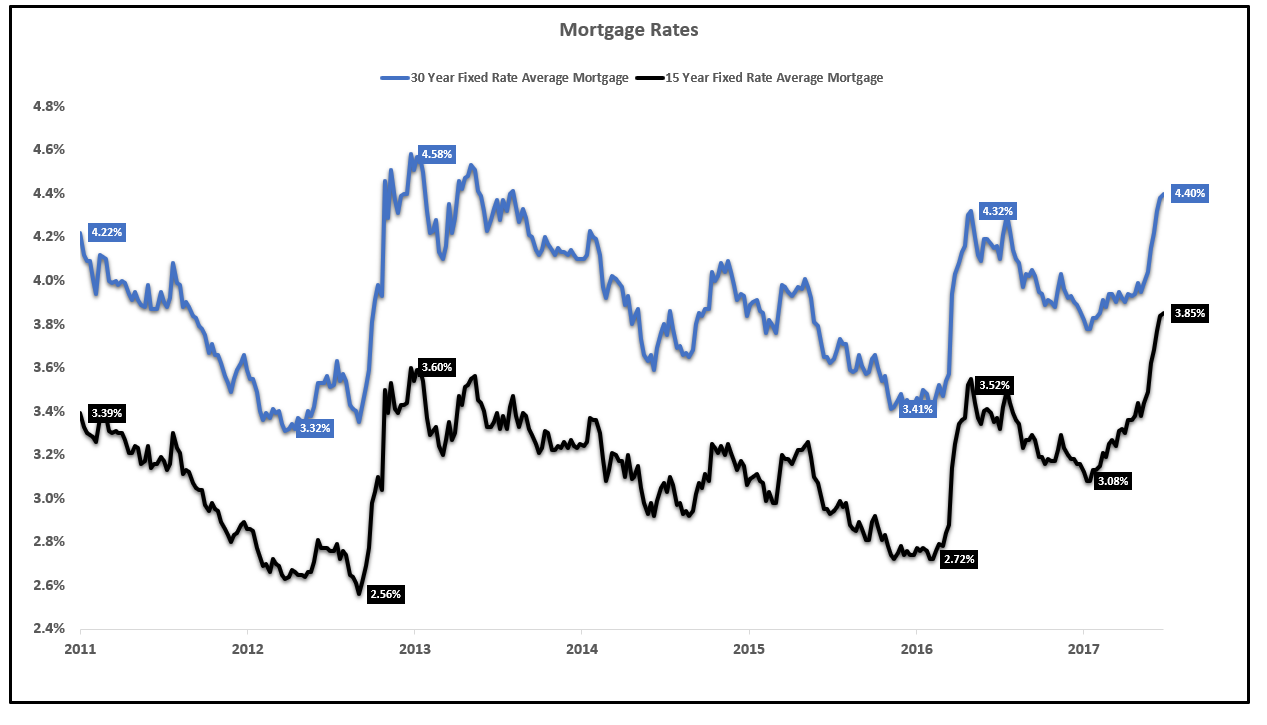
Mortgage Rates:
Source: FRED, EPB Macro Research
Mortgage rates have risen to an average of 4.40% for a 30-year fixed and 3.85% for a 15-year fixed. These rates are roughly 100 basis points off the lows in 2016. A 100 basis point move in long-term rates has dented the housing market as I will outline below. What would happen if rates moved 300 basis points?
In an over-leveraged economy such as the United States, a small move in interest rates has massive impacts on the rest of the economy. It is for this reason that the economy cannot withstand higher interest rates.
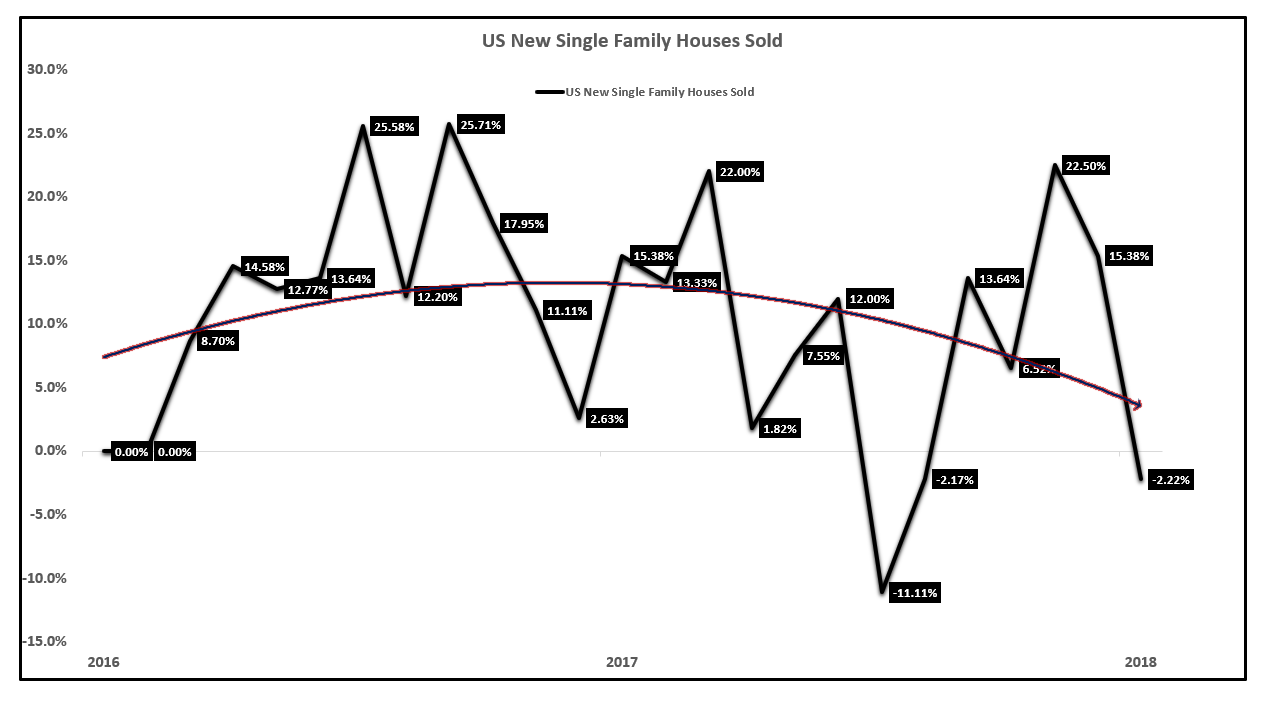
Earlier this week, the Census Bureau released the report on New Home Sales. The New Home Sales report, published by the Census Bureau each month, provides national and regional data on the number of new single-family houses sold and for sale. It also provides national data on median and average prices, the number of houses sold and for sale by stage of construction, and other statistics. New Home Sales, or homes that were just built, make up 10% of the housing market. Existing Home Sales are roughly 90% of the market.
New Home Sales Year over Year Growth:
Source: Census Bureau, EPB Macro Research
New home sales are falling at an annual rate of 2.2% as of the last report. The trend in new home sales growth is also lower as the chart above shows.
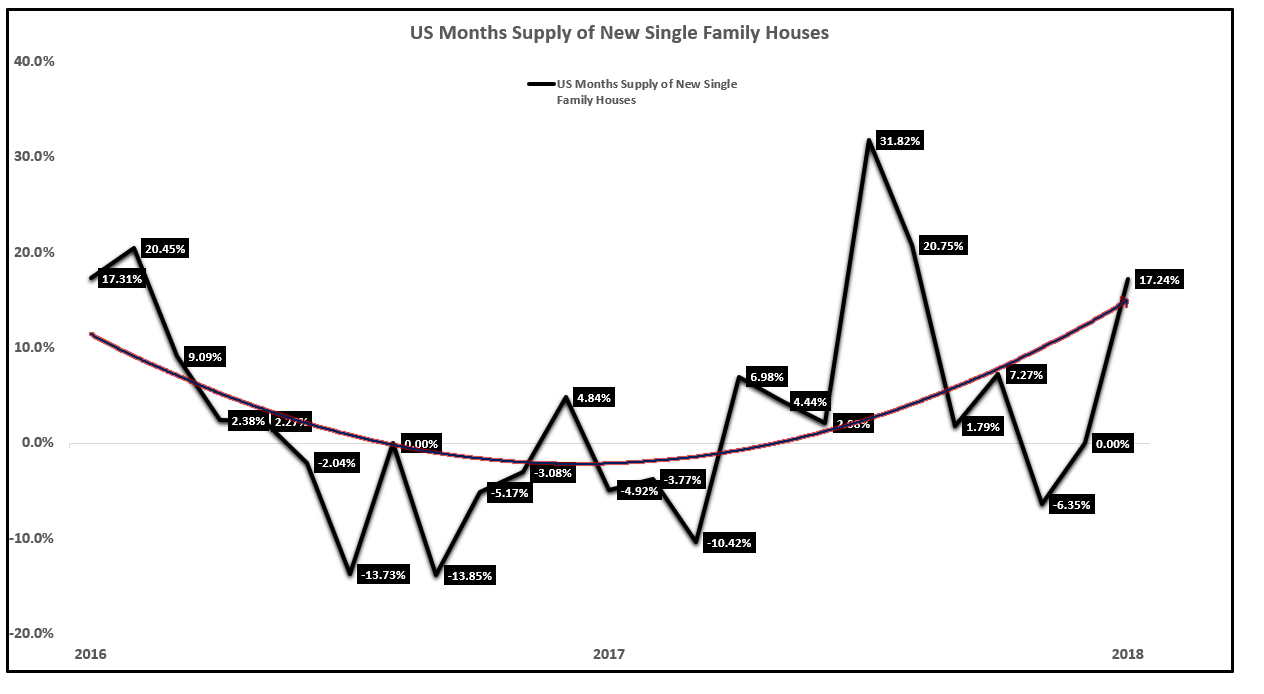
The growth in the supply of new homes is increasing which is going to put downward pressure on prices, on top of the impact of rising mortgage rates.
New Home Sales Supply Year over Year Growth:
Source: Census Bureau, EPB Macro Research
The growth in the supply of new homes is trending higher, increasing at a rate of 17.24% in January after being in negative territory for much of the past two years.
Supply is coming online for new home sales at the end of the economic cycle; this will put heavy downward pressure on prices over the next several months.
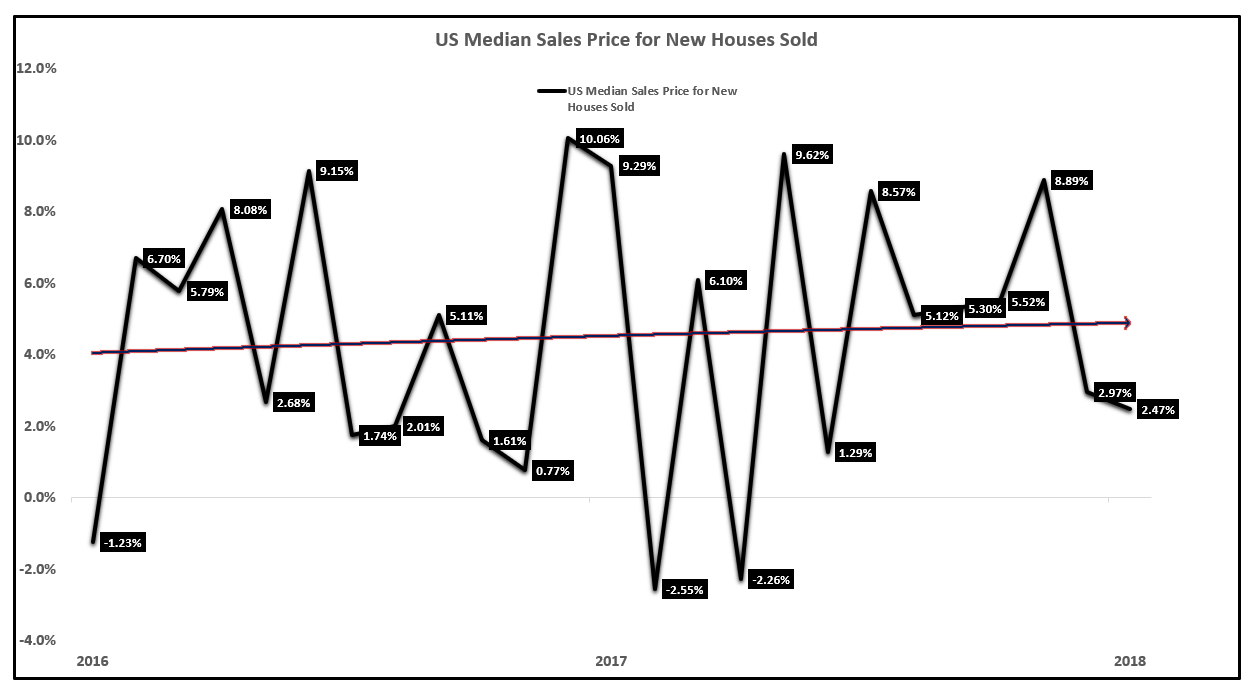
New Home Sales Median Sales Price Year over Year Growth:
Source: Census Bureau, EPB Macro Research

Thursday, 8 June 2017

2 topics - enterprise zones and green belt

Two points from a bigger article (linked) suggesting 5 things that could help U.K. Grow. The first section, Growth Flashpoints, will give you material to use on red tape/deregulation, ideas for structural change & government assistance for that, future jobs growth. The second section on building homes may still come into Paper 3, but may also work in Paper 2, as a suggestion for reducing labour immobility/helping structural/regional unemployment, and relieving housing pressure in the South East:


1 GROWTH FLASHPOINTS

The UK needs more growth, and should secure its place in the world of the future by taking steps now to attract high tech start-ups. These will ultimately create the jobs that will keep our own high-skills people in the country and will attract high skills people from overseas.

Business entrepreneurs claim that they find regulation the biggest bugbear. Instead of developing and expanding their businesses they have to spend hours ling compliance documents and meeting the minutiae of rules imposed by both national and central government. When they employ people they complain about the amount of time and effort taken up by PAYE tax returns and National Insurance. Their premises have to meet exacting standards, and it is claimed that firms such as Apple could never have started up in the UK because they would not have been allowed to operate from a garage.

In an ideal world we would not burden our start-up businesses with the costs of regulatory compliance, but in this less than ideal world we could have small pockets where start-ups could develop unhindered. The government should learn from the successes and failures of its Enterprise Zones project from the early 1980s. The idea was bold, but its execution was limited because the civil service put too many curbs upon the new zones. Its greatest success was in London’s Docklands, where skyscrapers could be built only because it was designated as an Enterprise Zone.

The government should announce a nationwide competition to have places designated as Growth Flashpoints. Syndicates of business, trade unions and local government should put together bids to be one of the chosen sites, listing in their bids the facilities and terms they were prepared to o er high-tech start-ups establishing with the flashpoints, including buildings that would be available and transport links. They could be about one square mile in area, with perhaps four or five to be chosen across the nation.

The rules would be simple. For their first five years new high-tech start-ups within the flashpoints would pay no taxes, local or national. They would be exempt from regulations that covered premises, employment, health and safety, or the need to file compliance documents. All those working within the flashpoints would be classfied as self-employed, with employers therefore not required to o er non-wage benefits such as holiday or sick pay.

The bids put in by local areas wishing to be one of the designated flashpoints would be adjudicated by a panel of people from high tech industries, not by ministers or civil servants. And applications by would-be start-ups to set up within a flashpoint would be approved or rejected by similar panels drawn from the technology sector. 

2 CREATING LIVING SPACE

The UK’s housing shortage is not caused by lack of finance to build houses, or by lack of labour or materials. It is caused by a lack of suitable land that people are allowed to build on. It is exacerbated by some of the conditions that local authorities impose by tacking on to planning permission such things as the necessity of including a proportion of “social housing.”

It is the Green Belt created by the 1947 Town and Country Planning Act and revised since which prevents towns and cities expanding outwards as their population increases. Political pressures from environmentalist organizations and wealthy home-owners who have homes within it or overlooking it have conspired to prevent development. 

Some towns and cities make the problem worse by putting height restrictions on buildings erected within them, effectively meaning that residences cannot expand outward or upward, so people are having to buy beyond the green belt and commute through it to work in the city.

People have recently softened their opposition to any kind of green belt development, and this creates an opportunity for a novel approach to be tried. Government should decide to slice a mile off the inner circumference of the green belt, and add a mile to its outer circumference. Verdant land within that inner mile would be preserved, meaning that meadows, woods and genuinely green land would be left untouched. But damaged land such as disused buildings, gravel pits and the like, would be available for development,
as would prime agricultural farmland, itself not particularly green.

The mile added to the outer circumference would not apply to buildings already there, and could be added in such a way as to create more verdant, genuinely green land. This would result in a net gain of green land, in that the inner circumference of the green belt is smaller than the outer one.

Environmentalists could draw consolation from the net gain of green, while the strip of land around the inner circumference would allow a million more new homes to be built where they are needed, in towns and cities where people want to live and work.

Families presently living in the green belt could console themselves with the thought that at least their children would have somewhere to live in the future. The building of a million new homes on the edge of the green belt would put downward pressure on the prices of existing homes, making it easier for young people to become home-owners. It would break the cycle of expectation in the UK that house prices must inevitably rise, and that a home is an investment rather than a place to live, and an investment that will yield greater returns than practically any other. 

When this is no longer true, people will seek other assets in which to invest, creating opportunities for business expansion and job creation. The actual construction of a million new homes would put some strain on the supply of materials such as bricks and timber, but output could be stepped up to meet the new
demand. And the building, done over the course of several years, would itself give a massive boost to employment within the industry, creating well-paid jobs and opportunities for skilled craftsmen. The ultimate bottom line, however, is that many more people, especially young people, would gain the opportunity to become home-owners.

Tuesday, 27 December 2016

Is the US in the throes of another housing bubble?

This graphic tells a grim story:


It would appear the answer is a resounding "yes"! This leads to 2 questions:

1. What happens when the bubble bursts?

2. Can the US central bank do anything to help when it does?